
The Explanation You Were Given Is Wrong

Two people finish the same training block, at the same gym, running the same volume. One of them holds their output in the final rounds, the final miles, the final hours of a hard workday. The other doesn't. This performance divergence is consistent across domains: it shows up in late-round combat sports performance, in the final miles of a race, and in the quality of decisions made at hour six of a demanding workday. When you ask the one who faded what happened, they'll usually give you something vague: not focused enough, a bad day, not built for this. When you ask coaches or observers, you get the same kind of answer dressed in different language: mental toughness, genetics, character under pressure.
These answers feel explanatory but they aren't. Calling something mental toughness or a genetic ceiling names the outcome without identifying the mechanism. What actually drives that performance gap is a specific sequence of biological events, and the most important of these is called central nervous fatigue: a measurable physiological state in which the brain's descending motor drive decreases even when the peripheral musculature still has contractile capacity remaining.
COMMON EXPLANATION
Mental toughness and genetics
Names the outcome without identifying the mechanism. Attributes trainable physiological variables to fixed biology. Gives the individual no actionable information.
ACTUAL MECHANISM
Central nervous fatigue
A measurable reduction in voluntary motor drive that occurs even when the peripheral musculature retains contractile capacity. Specific, trainable, and addressable.
This is not a metaphor for tiredness. Central nervous fatigue is studied experimentally, its markers are measurable, and the threshold at which it begins to limit output responds to training. The genetics framing attributes a trainable variable to fixed biology. What genetics provides is a range. Training, recovery structure, and an accurate understanding of what the system is doing when it starts to slow determine where within that range a person actually operates.
What actually drives that performance gap is a specific sequence of biological events, and the most important of these is called central nervous fatigue.
Two Systems Are Failing, Not One
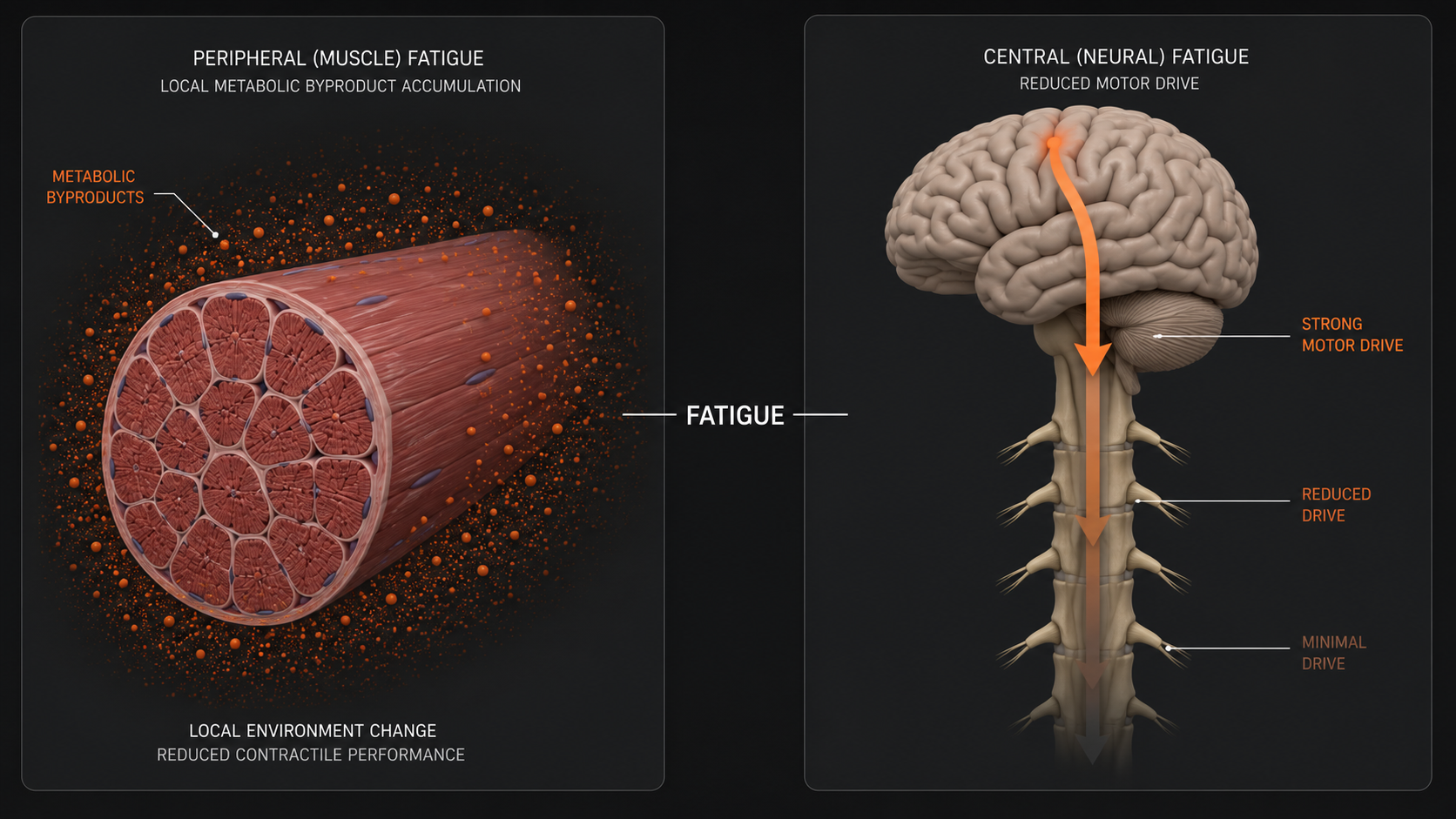
Performance fade within a session develops along two parallel tracks: one rooted in the muscle's chemistry, one in the brain's descending motor signal. These tracks have distinct mechanisms, but they interact in ways that compound each other's effects. Understanding both changes how you read fatigue when it arrives and what kinds of responses actually matter.
Extreme Fatigue During Exercise: What Actually Breaks Down in the Muscle
Extreme fatigue during exercise is not a single event. It is a cascade, and understanding the sequence changes how you interpret what you are feeling when it arrives.
The cascade begins with substrate depletion. As glycogen and phosphocreatine reserves decline, the rate of ATP resynthesis starts falling below the demand imposed by sustained muscle contraction. Muscle fibers operating aerobically can sustain output longer than those relying on anaerobic pathways, but both eventually confront the same bottleneck: less ATP per unit time means less contractile force per unit of effort.
PERIPHERAL FATIGUE MECHANISMS
Inorganic Phosphate (Pi)
Accumulates in myoplasm; directly impairs cross-bridge cycling and reduces peak force at any given calcium concentration.
Hydrogen Ions (H+)
The actual driver of the “lactic acid” effect; disrupts contractile protein function and reduces calcium sensitivity.
ADP
Elevated ADP-to-ATP ratio signals metabolic deficit; impairs contractile efficiency and intensifies afferent feedback signaling.
What causes muscle fatigue during exercise at the cellular level, however, is not simply running low on fuel. The more precise mechanism involves the accumulation of metabolic byproducts: inorganic phosphate (Pi), hydrogen ions (H+), and ADP. These compounds accumulate faster than the system can clear them under sustained high-output effort. They directly impair the cross-bridge cycling between actin and myosin filaments, and they reduce the sensitivity of contractile proteins to calcium, meaning the same calcium concentration produces less force. The common shorthand for this (“lactic acid building up”) is inaccurate. Lactate itself is a metabolic fuel that can be redistributed and used. The contractile disruption comes from the H+ ions produced alongside it (Allen et al. 2008).
Simultaneously, calcium release from the sarcoplasmic reticulum becomes impaired under sustained load. The SR is the muscle cell's calcium reservoir: it releases calcium to trigger each contraction, then reabsorbs it to allow relaxation. Under prolonged high-output effort, this release mechanism begins to fail, reducing force production independent of perceived effort and independent of how hard the athlete is trying (Allen et al. 2008).
This is peripheral fatigue: the problem is inside the muscle itself. It is real, measurable, and it contributes to output decline. But in most moderate-to-high-intensity sustained efforts, peripheral fatigue is a significant contributor, not the primary ceiling. The primary ceiling is set upstream, by the brain.
9%
INCREASE IN VOLUNTARY MUSCLE ACTIVATION
when afferent feedback was pharmacologically blocked
Hureau et al. 2019
9%
IMPROVEMENT IN CYCLING ENDURANCE PERFORMANCE
with afferent blockade; no peripheral change
Hureau et al. 2019
What Is Central Nervous System Fatigue?
The muscles in a fatigued athlete still have contractile capacity. What has diminished is the motor command to use that capacity.
Central nervous system fatigue is defined as a progressive, task-dependent reduction in voluntary motor drive: the descending neural signal from supraspinal centers decreases even when the peripheral musculature could still produce force ((Gandevia 2001)). The primary driver of this reduction is not motivational failure but an afferent feedback mechanism. Group III and IV muscle afferents are sensory neurons embedded in the working muscle that continuously monitor metabolic stress: H+ accumulation, Pi buildup, and mechanical load. As these signals intensify with sustained effort, they feed information back to the brain and progressively attenuate the motor drive descending to the muscle. The function is protective throttling: the brain is modulating output to prevent irreversible tissue damage. But the threshold at which this protective throttling begins varies considerably between individuals, and it shifts with training (Gandevia 2001).
The experimental evidence for afferent-driven motor limitation is precise. When Group III/IV afferents were pharmacologically blocked to prevent their signals from reaching the brain, voluntary muscle activation increased by approximately 9% and cycling endurance performance improved by the same margin, with no change in the peripheral muscle's actual mechanical capacity (Hureau et al. 2019). The peripheral hardware wasn't the constraint; the afferent feedback signal was.
The brain, not the muscle, sets the ceiling
Group III/IV afferents in working muscle continuously report metabolic stress (H+, Pi, mechanical load) back to the brain, which throttles the descending motor drive to protect the tissue. When researchers pharmacologically blocked that afferent signal, voluntary activation rose ~9% and endurance performance rose ~9% — with no change to the muscle's actual capacity.
Sustained effort — afferent signals intensifyPERIPHERAL FATIGUE
The muscle fails
Metabolic byproduct accumulation impairs cross-bridge cycling and calcium sensitivity. Ca²⁺ SR release degrades. Force production declines at the contractile level. Localized in working muscle groups.
CENTRAL FATIGUE
The signal fails
Descending motor drive from the brain attenuates even when peripheral capacity remains. Triggered by Group III/IV afferent feedback. Global in distribution — affects all output, not just fatigued muscle.
Neurotransmitter dynamics compound this effect. During prolonged exercise, the ratio of serotonin to dopamine in relevant brain regions shifts toward serotonin dominance. Dopaminergic activity supports effort initiation and sustained motor output. Elevated serotonin relative to dopamine is associated with increased perceived effort and reduced motor system responsiveness (Meeusen et al. 2006); (Cordeiro et al. 2017).
This is why perceived exertion, the conscious sense of how much effort a task requires, is a better predictor of performance fade than any single peripheral marker. The brain constructs a continuous estimate of the cost of continuing, and it adjusts output accordingly. This is the psychobiological model in experimental form: exercise is terminated not when the muscles are spent, but when the perceived cost of continuing exceeds the perceived benefit of doing so. In high-intensity cycling trials, the slope of RPE over time predicted performance with correlations of r = -0.75 to -0.83, while residual muscle capacity remained substantial at exhaustion (Staiano et al. 2018). Peripheral markers correlate with this threshold. They do not set it.
Central Nervous System Fatigue Symptoms: What It Looks Like During Effort
CNS FATIGUE IN SPORT: FOUR MARKERS
Reduced power without localized soreness
Output falls but no single muscle group is obviously the limiter. The signal is attenuating globally, not the tissue failing locally.
Slowed reaction time and motor sequencing
Technical precision degrades before peripheral force production falls. The motor program executes more slowly.
Effort cost inflation
A familiar movement starts requiring more perceived effort than at session start, even with no change in external load.
Decision errors under load
Tactical and technical choices degrade as prefrontal attenuation compounds motor drive reduction.
Recognizing central nervous system fatigue symptoms during effort requires a different kind of attention than monitoring peripheral fatigue, because the signals are more diffuse and present differently.
In athletic settings, the characteristic markers are reduced force output and power that cannot be explained by localized muscle soreness, slowed reaction time and degraded motor sequencing, and loss of technical precision in the final portion of sustained effort. A fighter whose guard drops in later rounds, a runner whose form deteriorates in the final miles: these are motor drive failures, not motivational ones. The peripheral muscles retain output capacity. The descending signal is attenuating the instruction to use it.
Decision errors under physical stress belong to the same category and are frequently mislabeled. When an athlete chooses the wrong shot, misreads positioning, or makes a tactical error they would normally navigate correctly, the explanation is often “lost their head” or “choked under pressure.” The more accurate mechanism is that central fatigue is attenuating prefrontal function. The executive circuits governing real-time decision-making are downstream of the same motor drive reduction that is limiting physical output.
The peripheral hardware wasn't the constraint; the afferent feedback signal was.
A key distinguishing marker separates peripheral from central fatigue in practice: the effort required for a given output increases even when nothing external or muscular has obviously changed. The movement is not heavier. The signal to execute it has become more costly. When an athlete notices that executing a familiar technical skill feels like more work at the end of a session than it did at the beginning, that is CNS fatigue operating on the motor system.
The peripheral presentation differs from the central one in its distribution. Peripheral fatigue concentrates: localized burning, heaviness, and reduced force in specific muscle groups. Central nervous system fatigue symptoms distribute globally: motivational erosion, increased effort perception that does not track with external load, and degraded motor precision spreading across the whole system rather than concentrating in one area.
The threshold at which these symptoms appear is not fixed. Mitochondrial density, lactate clearance rate, and repeated exposure to high-effort states that recalibrate the brain's protective triggers all shift where CNS fatigue begins to limit output.
Peripheral markers correlate with this threshold. They do not set it.
Fatigue and Mental Fog: Why Your Brain at Hour Six of Work Follows the Same Rules as Your Body at Mile 20

Fatigue and mental fog in a demanding workday and central fatigue in athletic effort are not analogous processes. They are the same process operating in different tissue contexts.
The brain accounts for roughly 20% of the body's energy consumption at rest, and that fraction increases substantially under conditions of sustained cognitive load. As accumulated cognitive work continues over hours, adenosine builds in brain tissue. The pattern mirrors the overnight accumulation that drives sleep pressure, though the precise intra-session dynamics remain less directly studied than overnight buildup. What is consistent in the literature is that sustained cognitive effort progressively attenuates prefrontal cortex activation, reducing the executive system's output quality over time: the prefrontal circuits responsible for planning, inhibition, and working memory produce degraded output relative to what was available at the start of the day.
Dopaminergic tone follows a parallel trajectory. Sustained cognitive effort draws on the motivational architecture in ways that reduce the signal available for goal-directed behavior over time. The nucleus accumbens and prefrontal circuits that evaluate whether a task's expected reward justifies its energetic cost become increasingly biased toward cost as effort accumulates, which is experienced as reduced drive to continue, increasing distractibility, and narrowing of motivational focus (Boksem and Tops 2008).
IN TRAINING
Motor drive attenuates
Afferent feedback from muscle reduces descending neural signal. The muscles can still produce force, but the brain's instruction to use them is progressively throttled.
AT WORK
Prefrontal output degrades
Adenosine buildup and dopaminergic attenuation reduce executive circuit output quality. Focus, working memory, and decision accuracy decline progressively through sustained cognitive load.
The fatigue and mental fog that arrives at hour six of a cognitively demanding workday is not a character problem. It is a real reduction in the cognitive system's output capacity, driven by the same accumulated metabolic and neurochemical costs that drive central fatigue in physical effort. The mechanisms are parallel, the subjective experience is analogous, and the interventions that address them overlap considerably.
What feels like “losing focus” or “going foggy” is the prefrontal cortex receiving attenuated input and producing degraded output: slower processing speed, reduced working memory span, and increased impulsivity in decisions that would normally involve more deliberation. This is a physiological state, not a motivational one, and it responds to physiological rather than volitional interventions.
For the reader managing both serious athletic training and a demanding professional career, these are not two separate fatigue problems. They are one system under load in two different contexts, sharing the same upstream mechanisms and competing for the same downstream resources.
Cognitive Fatigue Symptoms: What This Looks Like at Work
1
Working memory capacity
Ability to hold multiple variables simultaneously degrades first among complex outputs. The tasks that depend on it — integrating ambiguous information, tracking multiple moving variables — lose accuracy before anything is visibly wrong.
2
Decision latency
Time to reach decisions increases, especially for novel, ambiguous, or high-stakes choices. Familiar, well-practiced decisions remain relatively intact longer.
3
Novel problem-solving quality
Declines measurably while routine, well-practiced tasks remain relatively intact. The cognitive overhead of generating new solutions is disproportionately impaired.
Performance-relevant cognitive fatigue symptoms are not where most people look first. They are not primarily drowsiness or inability to keep eyes open. Those are late-stage markers. The earlier, more consequential degradation happens in the quality of outputs that carry the highest cognitive overhead.
The characteristic markers in high-performance work contexts are reduced ability to hold multiple variables in working memory simultaneously, increased time to reach decisions, and declining quality of novel problem-solving while routine, well-practiced tasks remain relatively intact. That last pattern is diagnostically useful. The work that stays sharp under cognitive fatigue is procedural and habitual. The work that degrades first is exactly what demanding professional contexts depend on: integrating ambiguous information, generating novel options, and evaluating consequences across longer time horizons.
The trajectory is predictable once the mechanism is understood. Morning executive function tends to be sharpest because adenosine has been partially cleared during sleep and dopaminergic tone is at a daily relative high. Performance begins degrading in the early afternoon and accelerates through the day, not from lack of discipline, but because four to six hours of sustained cognitive load have progressively depleted the neurochemical architecture that supports peak prefrontal performance.
THE COGNITIVE FATIGUE TRAJECTORY
Morning
Adenosine partially cleared by sleep. Dopaminergic tone at daily relative high. Working memory, novel problem-solving, and decision speed at peak capacity.
Early afternoon
Sustained cognitive load begins attenuating prefrontal function. Decision latency increases. Emotional regulation begins degrading.
Late afternoon
Four to six hours of sustained load have progressively depleted neurochemical architecture. All executive functions show measurable decline.
Emotional regulation follows the same trajectory and is the least recognized marker. A shorter fuse, reduced tolerance for ambiguity, and a tendency toward reactive rather than considered responses are additional consequences of prefrontal attenuation under sustained load. In controlled conditions, three hours of sustained cognitive work measurably increased EEG theta and alpha band power, slowed reaction times, and degraded goal-directed attentional control, with the effects growing stronger through the session (Boksem et al. 2005). These are physiological markers, not character ones.
For the reader who trains seriously before a cognitively demanding workday, an additional variable applies: hard physical training pre-loads some degree of central fatigue before the workday begins. Research has demonstrated the reverse pathway directly: 90 minutes of prior cognitive work increased perceived exertion at identical exercise intensities and reduced physical time-to-exhaustion by 15%, with no change in heart rate, oxygen consumption, or blood lactate (Marcora et al. 2009). The bidirectional relationship is the point: the central system is shared, and fatigue in one domain transfers measurably to the other.
The fatigue and mental fog that arrives at hour six of a cognitively demanding workday is not a character problem.
The bidirectional relationship is the point: the central system is shared, and fatigue in one domain transfers measurably to the other.

Where People Get This Wrong

Most training and performance frameworks are built around peripheral fatigue because peripheral fatigue is visible: localized soreness, elevated heart rate, blood lactate. The response is intuitive: rest the tissues, reload the substrates, manage volume. Central fatigue is less visible, its markers are more diffuse, and the interventions required to address it differ from peripheral recovery strategies.
The most common practical error is treating central fatigue as a peripheral problem. When the primary limiter is reduced CNS motor drive, adding training volume or pushing harder in the next session deepens the deficit rather than resolving it. The CNS threshold needs time and appropriate conditions to reset. An athlete who interprets CNS-driven performance decline as evidence of insufficient effort compounds the problem with each subsequent session.
The second error is attributing cognitive fade to character. When judgment and decision quality degrade through a workday, the dominant cultural frame is willpower: “focus harder,” “power through.” The underlying mechanism is neurochemical: adenosine clearance and dopaminergic restoration require time and appropriate conditions, not additional effort. The evidence that ego depletion (the idea that self-control draws down a finite, glucose-dependent resource) is the primary driver of this did not survive rigorous replication: a preregistered 23-laboratory study found no ego depletion effect, with d = 0.04 (Hagger et al. 2016). The original meta-analytic evidence had supported the model across 83 studies (Hagger et al. 2010), and that prior evidence is worth noting: the fade people experience is real and consistent. What the replication failure established is that the mechanism is primarily motivational and neurochemical, not glucose-supply-limited.
ERROR 1
Treating CNS fatigue as a peripheral problem
Adding training volume when the limiter is central motor drive deepens the deficit. Recovery, not more load, is the correct response. The threshold resets through time and appropriate conditions, not additional effort.
ERROR 2
Attributing cognitive fade to character
Adenosine clearance and dopaminergic restoration require time, not willpower. The fade is neurochemical, not motivational. Effort applied to a neurochemical deficit does not resolve it.
ERROR 3
Managing two domains as separate systems
Athletic and cognitive CNS resources are shared. Fatigue accumulated in one domain reduces capacity in the other. Frameworks that treat them separately will consistently misread the fatigue profile.
ERROR 4
The genetics attribution
Mitochondrial density, oxidative enzyme capacity, metabolic buffering, and neural recruitment efficiency are all trainable. Genetics sets the range; training sets where you operate within it.
A third error appears when people manage athletic and cognitive fatigue as entirely separate systems with separate frameworks. They share the same upstream architecture. CNS resources drawn on during a cognitively intensive morning are competing with the same resources that govern voluntary motor drive in an afternoon training session. Managing them in isolation produces fatigue profiles that neither framework can fully explain.
The fourth error is the genetics attribution. Sustained performance differences between individuals are real, but attributing them primarily to genetics misidentifies what are, in most cases, trainable variables. Mitochondrial density, oxidative enzyme capacity, metabolic buffering, and neural recruitment efficiency are all responsive to training. Genetics establishes parameters; training determines where within those parameters a person actually operates.
Genetics establishes parameters; training determines where within those parameters a person actually operates.
What This Means for How You Train and Work

The practical implication of understanding both peripheral and central fatigue is that the decisions that most affect sustained performance happen before and between sessions, not only during them.
Training pacing decisions should account for CNS load alongside peripheral volume. Two high-intensity sessions in close succession create a fatigue profile that differs qualitatively from the same volume distributed differently, and that profile includes a CNS component that standard load metrics (sets, reps, distance, weight) do not capture. An athlete or coach tracking only peripheral indicators will consistently underestimate accumulated central demand and overestimate readiness for subsequent high-intensity work.
The sequencing of cognitive and physical demands is a variable most people manage unconsciously. Prior cognitive work measurably impairs subsequent physical performance: 90 minutes of a sustained cognitive task before exercise increased perceived exertion at identical workloads and reduced time-to-exhaustion by 15%, with no peripheral change (Marcora et al. 2009). For someone managing both serious training and cognitively demanding professional work, the order and timing of these demands is a performance variable, not merely a scheduling preference.
MANAGING CNS FATIGUE: THREE PRINCIPLES
Training sequencing
Two CNS-demanding sessions in close succession produce central fatigue load that standard load metrics do not capture. Adequate CNS recovery between high-intensity sessions is a training variable, not just a scheduling preference.
Cognitive-physical ordering
Prior cognitive work increases perceived exertion and reduces physical endurance capacity by approximately 15% with no peripheral change. For people managing both domains simultaneously, the order of daily demands affects performance in both.
Decision timing
Prefrontal capacity measurably decreases through sustained cognitive load. High-stakes decisions and demanding analytical or creative work belong earlier in the day, before neurochemical attenuation has accumulated.
The same mechanism that makes high CNS fatigue costly for physical performance makes it costly for decision quality. Prefrontal capacity available at 9 a.m. differs measurably from what remains available at 4 p.m. after sustained cognitive load. Structuring the most consequential decisions and the most cognitively demanding analytical or creative work earlier in the day reflects the neurochemistry, not merely conventional productivity advice.
On the physical side, the most well-supported intervention for delaying CNS fatigue onset is increasing mitochondrial density. Greater mitochondrial density increases oxidative efficiency per unit of contractile work, which slows the rate at which metabolic byproducts accumulate in the muscle. Slower byproduct accumulation slows the rate at which Group III/IV afferent feedback signals intensify, which in turn delays the afferent-driven motor drive attenuation that defines central fatigue. The adaptation is trainable through both long slow distance work and high-intensity interval training, which target different aspects of mitochondrial development.
One additional variable is worth noting in this context. Cordyceps sinensis has been associated in some early models with increased efficiency of oxygen utilization at the mitochondrial level. If that mechanism holds in human subjects at relevant doses, the theoretical effect would be to slow the peripheral fatigue cascade described above and delay the accumulation of afferent feedback that triggers CNS down-regulation. The human trial evidence remains developing, and the effect sizes reported to date have been modest. This is a mechanistic plausibility argument rather than a confirmed intervention, and it belongs here as one variable among several that may influence the rate at which central fatigue accumulates.
For someone managing both serious training and cognitively demanding professional work, the order and timing of these demands is a performance variable, not merely a scheduling preference.
Frequently Asked Questions
What is central nervous fatigue?
Central nervous fatigue is a progressive reduction in the brain's voluntary motor drive, occurring even when the peripheral muscles retain contractile capacity. It is driven by afferent feedback signals from working muscle, shifts in the serotonin-to-dopamine ratio, and increasing perceived effort, not a failure of the muscles themselves. The threshold at which it begins is trainable.
What are the symptoms of central nervous system fatigue during exercise?
Symptoms include reduced power output not explained by localized muscle soreness, slowed reaction time, degraded motor sequencing, and loss of technical precision in later rounds or miles. A key marker: the effort required for a familiar movement increases even when external load or muscle condition has not obviously changed. Decision errors under physical stress also belong to this category.
Does mental fatigue affect physical performance?
Yes, measurably. Prior cognitive work increases perceived exertion at identical exercise intensities and reduces time-to-exhaustion by approximately 15%, with no change in heart rate, oxygen consumption, or blood lactate. The central nervous system is shared between cognitive and physical effort, meaning mental fatigue in one domain directly reduces output capacity in the other.
Is fatigue resistance genetic or trainable?
Fatigue resistance is primarily trainable, not genetically fixed. The variables that determine where the central fatigue threshold sits — mitochondrial density, oxidative enzyme capacity, metabolic buffering, and neural recruitment efficiency — all respond to training. Genetics establishes a range of possible adaptation; training determines where within that range an individual actually operates.
What is the difference between peripheral and central fatigue?
Peripheral fatigue occurs inside the muscle: metabolic byproduct accumulation impairs cross-bridge cycling and calcium sensitivity, reducing contractile force. Central fatigue occurs upstream: the brain's descending motor drive attenuates even when muscle capacity remains. Both contribute to performance decline, but the relative contribution of each varies with exercise intensity and duration.
Bottom Line
Performance fade within a session is a physiology question, not a character question. The biology is specific enough to be studied, measured, and, to a meaningful extent, addressed.
The mechanisms that govern who sustains output and who doesn't are not primarily determined at the genetic level. Mitochondrial density, metabolic buffering capacity, lactate clearance efficiency, and the threshold at which the CNS begins to throttle motor drive are all trainable variables. Genetics establishes a range; training and recovery structure determine where within that range a person actually operates.
The same mechanism operates in the ring, at mile 20, and at the conference table in hour six. The peripheral chemistry takes different forms across these contexts, but the central fatigue architecture is the same: afferent feedback accumulates, motor and cognitive drive attenuates, and output declines. Recognizing this as one integrated system changes both how you train for athletic durability and how you structure the demands of a cognitively intensive workday.
The useful reframe is from “why do I fade?” to “at what rate is central fatigue accumulating, and what determines that rate?” The first question invites genetics and character explanations. The second has mechanistic answers, and those answers point to trainable variables.
Genetics establishes a range; training and recovery structure determine where within that range a person actually operates.
Fade is a physiology problem. The threshold at which your brain throttles output is a variable — and variables respond to training.
The gap between sustained performance and premature fade traces back to mitochondrial density, CNS fatigue thresholds, and how you sequence cognitive and physical demands. It is not a genetics gap.
Mydos Performance
— Fatigue, Recovery and Durability Series —
Central Nervous Fatigue: Why Some People Fade — and It’s Not Genetics
The mechanism behind late-session breakdown in sport and at work.
· By Ricardo Londono, MD/PhD ·