
You Are Not Tired Because You Ran Out of Willpower

There is a specific reason that several hours of sustained decision-making degrades your mental energy in ways that feel uncomfortably similar to the physical depletion that follows a hard training session. That similarity is not metaphorical. It reflects a shared biological substrate: the same mitochondrial machinery that powers skeletal muscle during high-intensity effort powers neurons during prolonged cognitive work, and it is subject to the same fundamental constraints.
Mental fatigue has a precise biological definition. It is a performance-limiting state produced by accumulated metabolic costs in the brain, measurable in cognitive outputs: reaction time slows, decision accuracy declines, sustained attention becomes harder to maintain, and executive function becomes less reliable. This is not a decrease in motivation. The brain is not deciding to perform more poorly because effort feels unpleasant. A state has been reached in which the relevant neural circuits are biologically less capable of sustaining high-frequency activity.
PHYSICAL FATIGUE
Primarily Peripheral
Skeletal muscle glycogen depletes, metabolite accumulation alters working fiber chemistry, and central drive is modulated to protect output. Originates in the working muscle.
MENTAL FATIGUE
Primarily Central
Adenosine accumulates in active cortical circuits, suppressing neuronal excitability and degrading signal fidelity. Originates in the brain's own metabolic activity.
The distinction between mental fatigue and physical fatigue is real but often overstated. Physical fatigue is primarily peripheral: skeletal muscle glycogen depletes, metabolite accumulation drives pH changes in working fibers, and central nervous system drive is modulated to protect the system. Mental fatigue is primarily central: neurochemical accumulation in the brain suppresses neuronal excitability, active neural circuits lose signal fidelity, and the capacity for sustained cognitive output diminishes. Both states have metabolic causes. Both require metabolic recovery. The interventions are similar because the underlying biology is more similar than popular models of willpower tend to acknowledge. Understanding why this happens requires starting at the cellular level, with the question of how the brain generates the energy that sustained cognitive work consumes.
A state has been reached in which the relevant neural circuits are biologically less capable of sustaining high-frequency activity.
Both states have metabolic causes. Both require metabolic recovery.
Your Brain Runs on Glucose, and the Demand Is Constant

The human brain accounts for roughly two percent of total body mass and under resting conditions consumes approximately twenty percent of the body's total energy output (Raichle & Gusnard 2002). This disproportionate metabolic cost is not incidental. It reflects the biological price of maintaining the electrical gradients that make neural signaling possible.
Unlike skeletal muscle, which can shift substantially toward fat oxidation during low-intensity work and fasted states, neurons operate under a much narrower metabolic constraint. The brain's primary fuel is glucose, and this dependency is not easily substituted under normal physiological conditions. Neurons cannot significantly increase fat oxidation when glucose is limited. They have minimal glycogen reserves, and unlike muscle, they have no meaningful capacity for producing ATP through anaerobic glycolysis alone. If glucose or oxygen delivery is interrupted for even a matter of seconds, neural function deteriorates. If the interruption extends to minutes, the damage becomes permanent.
~2%
OF BODY MASS
~20%
OF TOTAL ENERGY OUTPUT
The mechanism of fuel delivery in the brain is also more complex than a simple "brain uses glucose" model would suggest. Neurons do not primarily metabolize glucose directly. Astrocytes, the support cells that surround and maintain neurons, take up glucose from the bloodstream, convert it to lactate through glycolysis, and then export that lactate to neurons via monocarboxylate transporters. Neurons oxidize this lactate through the TCA cycle and the mitochondrial electron transport chain to generate ATP. This architecture is called the astrocyte-neuron lactate shuttle, and it was first formally proposed by Pellerin and Magistretti in 1994 based on the observation that astrocytic glutamate uptake stimulated aerobic glycolysis in direct proportion to neural activity (Pellerin & Magistretti 1994). Subsequent work has extended and refined the model (Magistretti et al. 2015), but the central principle holds: the brain's fuel delivery system is a two-step cellular relay, and astrocytes are the first link in the chain.
This architecture means the brain has no meaningful metabolic buffer. There is no energy reservoir to draw on when demand spikes or delivery falters. The combination of continuous demand, minimal reserve, and total dependence on oxidative metabolism makes the brain uniquely sensitive to disruptions in fuel and oxygen supply. The cellular machinery generating that ATP is also the source of the fatigue signal that accumulates when sustained cognitive work is prolonged, which the next section addresses directly.
This architecture means the brain has no meaningful metabolic buffer.
The brain's fuel delivery system is a two-step cellular relay, and astrocytes are the first link in the chain.
How the Brain Metabolizes Glucose During Cognitive Work
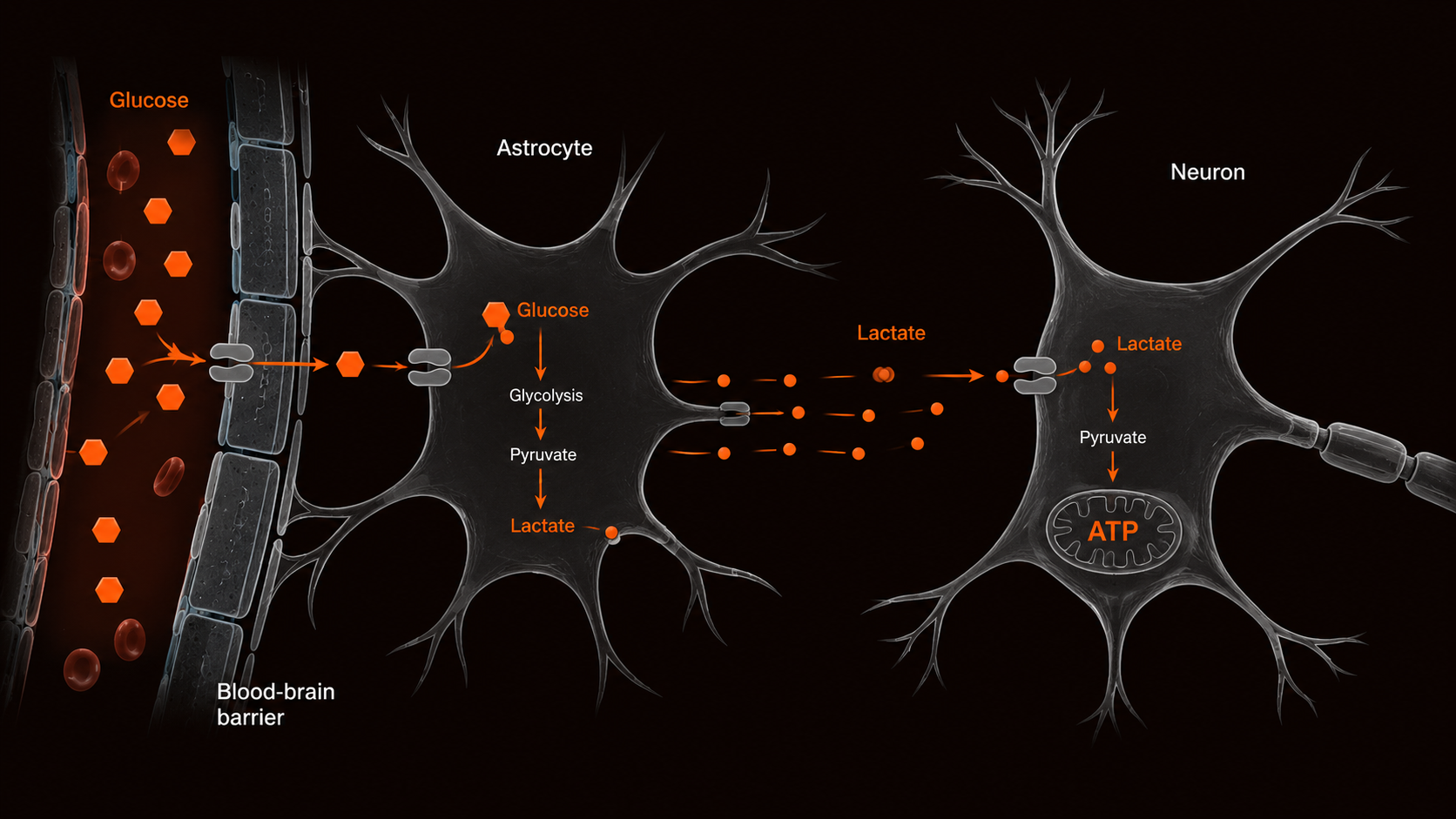
Once glucose enters the brain, GLUT1 transporters on astrocytes and GLUT3 transporters on neurons regulate its uptake, and both transporter types respond to local neural activity (Simpson et al. 2007). Higher activity in a given brain region is associated with increased glucose uptake in that region. This is the metabolic basis for functional neuroimaging signals: the fMRI blood oxygen level-dependent response and the fluorodeoxyglucose signal in PET imaging both reflect increases in local metabolic demand tied to neural activity.
A common assumption about this system is that intense cognitive work substantially increases the brain's total energy consumption. This assumption is largely incorrect. The brain's cerebral metabolic rate for glucose does not show dramatic increases during demanding cognitive tasks compared to a resting state. Raichle and colleagues documented that task-evoked increases in cerebral glucose metabolism are modest relative to the brain's resting metabolic rate, which is already very high (Raichle & Mintun 2006). The additional metabolic cost of hard thinking above the baseline the brain sustains continuously is comparatively small. Mental fatigue is not primarily caused by the brain running out of fuel. The brain's energy stores are not the limiting variable under most real-world conditions.
SUBSTRATE DEPLETION FATIGUE
The Fuel Runs Out
Glucose or ATP reserves exhaust completely and neural activity cannot be sustained. Rare under real-world conditions. Not the mechanism behind most everyday mental fatigue.
REGULATORY FATIGUE
The Signal Is Suppressed
Adenosine accumulates as a byproduct of neural firing and suppresses cortical excitability before depletion is reached. The dominant mechanism under virtually all real-world cognitive load.
What is the limiting variable, then? The answer lies downstream of ATP production. Each time a neuron fires, it hydrolyzes ATP to generate the electrochemical work of the action potential and to restore the ion gradients disrupted by that firing. That hydrolysis produces ADP, then AMP, and ultimately adenosine as a downstream metabolic product. Adenosine accumulates in the synaptic space with sustained neural activity, and it is this accumulation, not glucose depletion, that constitutes the primary biological mechanism of mental fatigue under most conditions.
Adenosine accumulates in the synaptic space with sustained neural activity, and it is this accumulation, not glucose depletion, that constitutes the primary biological mechanism of mental fatigue under most conditions.
How Caffeine Works in the Brain, and What That Reveals About Mental Fatigue
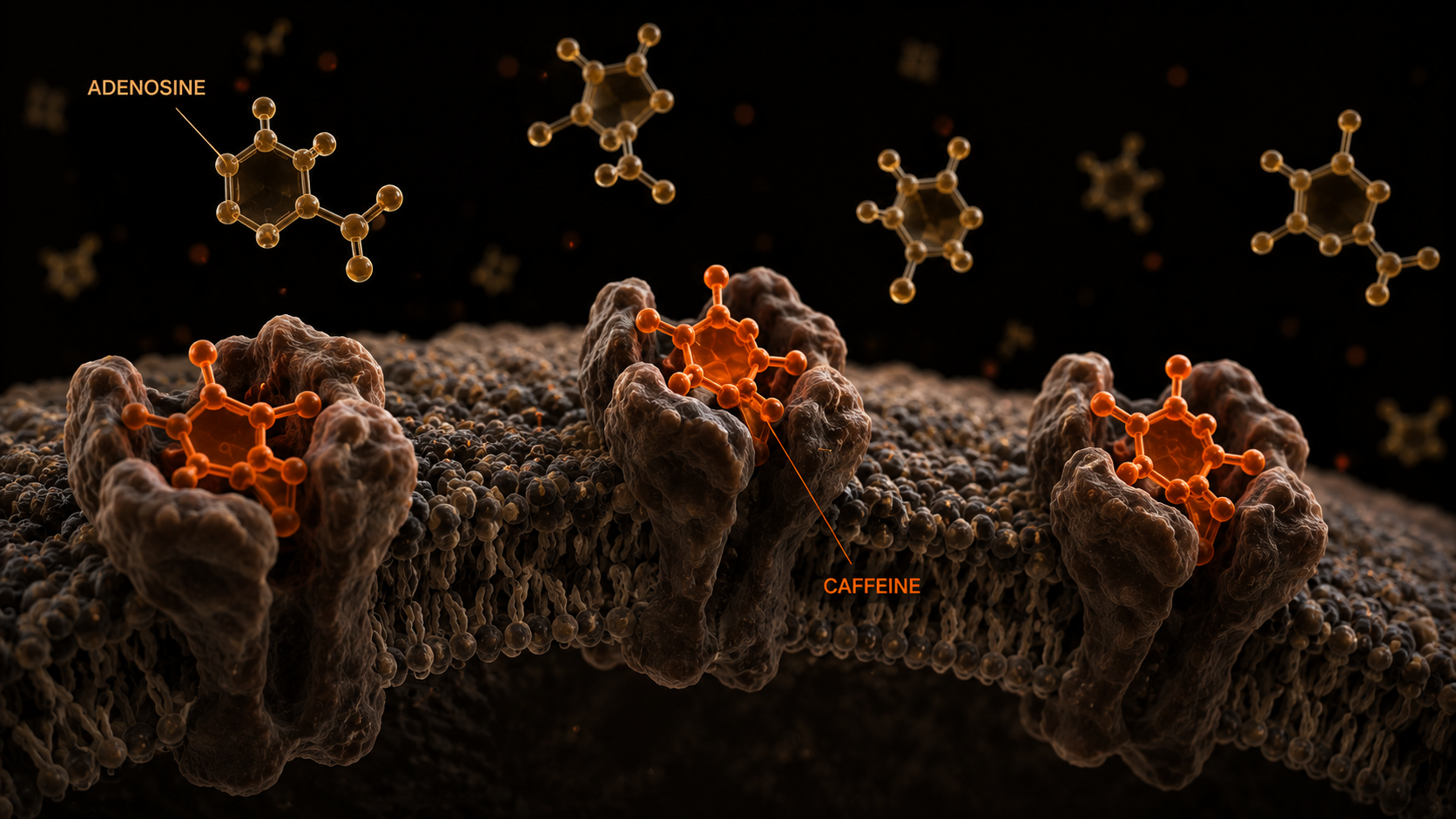
Caffeine's mechanism of action in the brain provides one of the clearest windows into the actual biology of cognitive fatigue, because caffeine works precisely by blocking the primary fatigue signal rather than by producing anything that would constitute energy.
Adenosine is a purine nucleoside that accumulates in the brain during sustained wakefulness and cognitive work as a direct product of neural activity. Every action potential fired costs ATP. ATP hydrolysis produces ADP and inorganic phosphate; further metabolism yields AMP and ultimately adenosine as the terminal metabolic byproduct. This adenosine diffuses into the extracellular space, where it binds to two receptor subtypes: A1 receptors, which are widely distributed in the cortex and hippocampus and suppress neuronal excitability when activated, and A2A receptors, which modulate dopamine-related signaling in striatal circuits involved in motivation and effort-based decision-making (Fredholm et al. 2011). The net effect of progressive adenosine accumulation is a reduction in the capacity of active neural circuits to sustain high-frequency firing, a degradation in signal clarity at synaptic junctions, and the subjective experience of slowing and fatigue that most people describe as being mentally drained.
Caffeine binds to the same adenosine receptors without activating them. It is a competitive antagonist: it physically occupies the binding site and blocks adenosine from doing so. Caffeine does not generate ATP. It does not supply the brain with energy or accelerate adenosine clearance. It prevents the adenosine signal from registering at the receptor, which maintains neuronal excitability at a level that would otherwise be suppressed (Fredholm et al. 2005). The adenosine accumulation does not stop while caffeine is active. It continues at the same rate because the neural activity producing it continues. This is why the effects of caffeine end while the underlying fatigue does not, and why caffeine-dependent individuals who abstain experience adenosine rebound as the signal they were masking becomes available at the receptor again.
ADENOSINE RECEPTOR SUBTYPES
A1 Receptors
Widely distributed in the cortex and hippocampus. Suppress neuronal excitability when activated. Primary mechanism through which adenosine accumulation throttles cortical activity during sustained cognitive work.
A2A Receptors
Concentrated in striatal circuits involved in motivation and effort-based decision-making. Modulate dopamine signaling. Targeted by caffeine's effects on perceived effort and drive.
The Porkka-Heiskanen group demonstrated directly that adenosine accumulates progressively in the basal forebrain during extended wakefulness in cats, and that this accumulation correlates with increasing sleep pressure (Porkka-Heiskanen et al. 1997). Subsequent work has confirmed that sleep is the primary biological mechanism for clearing accumulated adenosine, and that the recovery of cognitive performance following extended wakefulness tracks the restoration of adenosine homeostasis (Huang et al. 2011). Mental fatigue is not a state that resolves with effort or motivation. It resolves when adenosine is cleared, and adenosine clearance requires sleep.
There is an important distinction that the caffeine mechanism makes visible: most real-world mental fatigue is regulatory in nature, not substrate-depletion fatigue. The brain is not running out of glucose when a person feels cognitively spent after several hours of high-quality decision-making. The adenosine-mediated feedback system has throttled neural circuit activity before that depletion point is reached. This is a feature of the system, not a failure. It is the brain's mechanism for conserving resources and building sleep pressure in proportion to the neural work performed. The problem for high-performing individuals is that this regulatory signal arrives at times that are inconvenient, and masking it with caffeine does not address the underlying metabolic state.
Caffeine does not generate ATP. It does not supply the brain with energy or accelerate adenosine clearance.
Mental fatigue is not a state that resolves with effort or motivation. It resolves when adenosine is cleared, and adenosine clearance requires sleep.
Cerebral Blood Flow: Why the Brain's Fuel Supply Has Limits

The astrocyte-neuron lactate shuttle and the oxidative phosphorylation pathway it supplies both depend on continuous oxygen delivery, and oxygen in the brain arrives exclusively via cerebral blood flow. Unlike tissues that can temporarily buffer oxygen demand against local stores, the brain cannot. Blood flow must continuously match demand.
The brain regulates this match through neurovascular coupling, the process by which local increases in neural activity trigger local increases in blood flow. When a region of cortex becomes highly active, vasodilation in the local capillary bed increases perfusion to that area within seconds. This mechanism allows the brain to redistribute flow toward active regions rather than globally increasing total cerebral perfusion, which is why sustained focused work in specific brain areas can produce measurable local metabolic increases while total oxygen delivery remains relatively constant.
Cerebral blood flow autoregulation maintains stable perfusion across a wide range of blood pressure values through myogenic and metabolic feedback mechanisms. Within that range, the brain is well-protected against perfusion fluctuations. Outside that range, whether through sustained hypotension, extreme hypocapnia from hyperventilation, or severe physiological stress, blood flow declines and neurological function degrades within a predictable window. These are edge cases under normal training and work conditions, but they define the system's limits in a way that matters for understanding oxygen as the rate-limiting input to mitochondrial ATP production.
1
Blood Delivers Oxygen and Glucose
Cerebral blood flow delivers the two substrates required for all brain energy production. Local flow increases via neurovascular coupling when neural activity rises in a given region.
2
Astrocytes Convert Glucose to Lactate
Astrocytes take up glucose from the bloodstream, run glycolysis, and export lactate via monocarboxylate transporters to neighboring neurons.
3
Neurons Oxidize Lactate for ATP
Neurons oxidize lactate through the TCA cycle and mitochondrial electron transport chain, generating the ATP that powers all neural firing.
4
ATP Hydrolysis Produces Adenosine
Each action potential hydrolyzes ATP. Adenosine is the terminal metabolic byproduct, accumulating in the synaptic space and progressively suppressing neural excitability.
For the athlete managing training and professional cognitive demands in the same day, there is a more immediate consideration. Sustained high-intensity physical effort places competing demands on cardiac output, and under extreme conditions, this can affect cerebral perfusion. Both hard training and sustained cognitive work generate adenosine load through the same ATP hydrolysis pathway, and both systems are drawing on shared resources. The sequencing of physical training and high-stakes cognitive work within the same waking window matters partly because of this overlap. Each step in the chain has a limiting factor, and adenosine accumulation is the output that limits cognitive performance in most real-world scenarios.
The sequencing of physical training and high-stakes cognitive work within the same waking window matters partly because both systems are drawing on shared resources.
The Secondary Cost: Oxidative Stress in Neurons

The mitochondrial electron transport chain that generates most of the brain's ATP does not run without byproducts. High metabolic flux through Complex I and Complex III of the electron transport chain produces reactive oxygen species as a consequence of electron transfer reactions (Murphy 2009). Under normal conditions, the brain's antioxidant systems, including glutathione, superoxide dismutase, and catalase, manage this ROS production without significant net accumulation. Under sustained high metabolic demand, the balance between ROS generation and antioxidant clearance can shift.
Neurons are among the most metabolically active cells in the body. They maintain high mitochondrial density to meet ATP demands, and that density produces proportionally elevated ROS output during high-frequency firing and sustained cognitive load. Oxidative damage to mitochondrial proteins, lipid membranes, and mitochondrial DNA progressively degrades the efficiency of ATP production. This is a slower-acting mechanism than adenosine accumulation. Adenosine builds over hours and clears overnight. Oxidative damage to mitochondrial components accumulates over training cycles, work periods, and extended periods of insufficient recovery, and it degrades the underlying capacity for neuronal energy production rather than producing a single fatigue episode.
ACUTE LOAD
One Hard Day
Adenosine-mediated fatigue builds over hours and clears overnight with adequate sleep. Mitochondrial ROS output is managed by the brain's antioxidant systems within normal recovery windows.
CHRONIC LOAD
Repeated Without Recovery
ROS accumulation across sessions without sufficient recovery progressively damages mitochondrial proteins and membranes. Baseline neuronal ATP production capacity degrades. Fatigue arrives earlier each day.
This is the mechanism through which chronic overload produces a qualitatively different cognitive fatigue than acute overload. A person who trains hard and works a full cognitive day once will experience adenosine-mediated regulatory fatigue that resolves with adequate sleep. A person who does this repeatedly without adequate recovery builds a cumulative oxidative load in the most energy-demanding cells in the body, one that affects their baseline cognitive capacity between as well as during demanding periods. Because neurons are the most mitochondria-dependent cells in the body, the efficiency of their electron transport chain directly determines their capacity to sustain high-frequency output, and that efficiency degrades under conditions of chronic high demand and insufficient recovery. The mechanism establishes why supporting mitochondrial function is relevant to cognitive performance on the same grounds that it is relevant to physical performance.
A person who does this repeatedly without adequate recovery builds a cumulative oxidative load in the most energy-demanding cells in the body, one that affects their baseline cognitive capacity between as well as during demanding periods.
What This Means for the Athlete Who Also Has to Think

The cellular mechanism described above has direct consequences for anyone managing both physical training and sustained cognitive demands within the same day, which is the normal operating reality for the athlete who also works.
PHYSICAL TRAINING
Neural Adenosine Load
Hard sparring, drilling, and conditioning require sustained neural firing to coordinate motor output. Every action potential hydrolyzes ATP and produces adenosine as a downstream byproduct.
COGNITIVE WORK
Cortical Adenosine Load
Complex decisions, strategic analysis, and sustained concentration produce adenosine through the same pathway in the cortical circuits managing executive function. Both loads accumulate in the same system.
Physical training generates adenosine load in proportion to the neural effort involved. Hard sparring, technical drilling, and high-intensity conditioning all require sustained neural firing to coordinate motor output and process incoming information. That firing produces adenosine as a byproduct, building the same regulatory fatigue signal that accumulates during focused professional work or complex decision-making. A person who trains hard in the morning and then spends six hours on high-stakes cognitive tasks arrives at the evening with the combined adenosine load from both activities. The threshold at which cognitive performance degrades is determined by total adenosine accumulation, regardless of whether the source was physical or cognitive.
The practical effect shows up in decision quality. When the neural circuits responsible for executive function, risk assessment, and response selection are operating under adenosine-mediated suppression, their outputs change measurably. Boksem & Tops documented in a comprehensive review that sustained mental work impairs executive function, sustained attention, and decision accuracy in ways consistent with progressive neural circuit fatigue rather than motivational decline (Boksem & Tops 2008). The mechanism matters here because it clarifies that performing well under this kind of fatigue is not primarily a matter of applying more effort, which would generate additional adenosine. It is a matter of managing total cognitive load across the day in a way that prevents the most critical decision-making from occurring at peak adenosine accumulation.
Sleep is where adenosine clearance occurs. Not rest, not a break, not reduced-intensity activity. The clearance of accumulated adenosine is linked to specific sleep stages, and insufficient sleep does not simply delay recovery. An athlete who habitually undercuts sleep to manage competing demands is impairing the one mechanism the brain has for resetting the adenosine-mediated fatigue state. Reduced sleep time is the visible cost; adenosine clearance interrupted is the biological one. The cumulative effect is a baseline of elevated adenosine at the start of each day, which compresses the effective window of peak cognitive performance and means that higher-order cognitive functions degrade sooner in the day than they would after adequate sleep.
The threshold at which cognitive performance degrades is determined by total adenosine accumulation, regardless of whether the source was physical or cognitive.
Reduced sleep time is the visible cost; adenosine clearance interrupted is the biological one.
The Metabolic Reality Behind Ego Depletion

The ego depletion model, introduced by Baumeister and colleagues in a 1998 paper, proposed that self-control draws on a single limited resource that depletes with use (Baumeister et al. 1998). The original experiments showed that people who exerted self-control on one task subsequently performed worse on unrelated self-control tasks, and that this performance decrement could be reduced by consuming glucose. The intuitive appeal was significant: the model offered a clean resource-based account of why willpower seems to fail at predictable times, and the glucose finding appeared to connect the psychology directly to brain metabolism.
The model did not replicate. In 2016, Hagger and colleagues ran a pre-registered, multi-laboratory replication of the ego depletion effect across 23 independent labs and found no significant ego depletion effect under tightly controlled conditions (Hagger et al. 2016). An updated meta-analysis by Dang in 2018 confirmed that the original effect size was substantially inflated by publication bias, and that after correction, the effect was small to negligible (Dang 2018). The glucose mechanism specifically has not held up: the brain's glucose metabolic rate does not decline meaningfully during cognitive tasks relative to baseline, and providing glucose does not restore cognitive performance in the way a fuel-depletion model would predict.
EGO DEPLETION MODEL
A Limited Psychological Resource
Self-control draws on a single resource that depletes with use. Consuming glucose partially restores it. This model was influential for 20 years. Large-scale pre-registered replications have not confirmed the effect.
CELLULAR REALITY
Adenosine Accumulation
Cognitive performance declines because adenosine accumulates and suppresses cortical circuit excitability. Glucose supports the fuel pathway but does not clear adenosine or restore suppressed neural excitability.
What the cellular biology shows is mechanistically different from the glucose-willpower model in both its cause and its implications. Cognitive performance declines during sustained mental work primarily because adenosine accumulates and suppresses the excitability of the cortical circuits responsible for executive function and response selection. This is not substrate depletion. It is a regulated biological signal that progressively reduces the functional capacity of specific neural circuits. Glucose does have a role in this process, but that role is upstream: maintaining adequate substrate supply supports the astrocyte-neuron lactate shuttle and ensures continuous ATP production, which slows the rate at which adenosine accumulates. That is mechanistically different from restoring a depleted resource of willpower.
The practical difference is meaningful. The ego depletion model implied that willpower failures were partly motivational and that psychological techniques could restore the depleted resource. If cognitive performance declines are primarily adenosine-mediated, the correct interventions are metabolic and temporal. Rest, sleep, and careful scheduling of high-demand work relative to adenosine accumulation state are the tools the biology provides. Applying additional effort to overcome adenosine-mediated neural suppression does not clear adenosine. It produces more of it.
It is a regulated biological signal that progressively reduces the functional capacity of specific neural circuits.
Applying additional effort to overcome adenosine-mediated neural suppression does not clear adenosine. It produces more of it.
Applying the Biology of Mental Energy

Understanding the cellular mechanism of mental energy does not produce a prescriptive checklist. It produces a causal model, and that model has clear implications for how the system behaves and where it can be supported.
Sleep is not optional in this framework. It is the primary mechanism for adenosine clearance, and there is no physiological substitute. A night of adequate sleep resets the adenosine baseline and restores the brain's capacity for sustained cortical excitability. Compressed sleep, poor sleep quality, or habitual under-sleeping does not merely reduce recovery time in a general sense. It specifically impairs the biological process that allows the brain to sustain high-quality cognitive output the following day. The fatigue a person experiences on a morning after poor sleep is not a matter of insufficient motivation. It is the accumulated adenosine load from the previous day, incompletely cleared, compressing the window before which performance-degrading accumulation is reached again.
Timing matters because adenosine accumulates with time-on-task from the moment of waking. A person's window of peak cognitive output is not uniform across the day. It is widest in the early hours when adenosine from the previous day has been cleared and new accumulation has not yet become significant. Scheduling the highest-demand cognitive work earlier in the day is not a productivity heuristic. It is the biological consequence of how adenosine accumulates: the available window before significant cortical suppression is widest at the start of the day and narrows progressively with time awake.
1
Sleep First
Adenosine clearance is sleep-specific. No other rest state replicates the clearance that occurs during specific sleep stages. Prioritizing sleep is the biological requirement for resetting the fatigue baseline, not a general wellness suggestion.
2
Schedule by Adenosine State
The window of peak cognitive output is widest early in the day, when adenosine from the previous day has been cleared and new accumulation is minimal. High-stakes thinking belongs at the start of the day.
3
Sequence Training Around Cognitive Demand
Physical training generates adenosine through neural firing. Training earlier and protecting the subsequent cognitive window produces better outcomes because of how adenosine biology works — not because of discipline.
4
Maintain Substrate Consistency
The brain requires consistent glucose supply to keep the astrocyte-neuron lactate shuttle running. Regular, unremarkable fueling — not glucose loading — is what the mechanism requires.
For the athlete managing training and professional cognitive demands in the same time window, sequencing matters. Physical training that requires sustained neural effort stacks adenosine load with the cognitive demands that follow. Training earlier and protecting the subsequent cognitive window, or separating the two by sufficient sleep, produces better outcomes not because of discipline but because of how adenosine biology works. The choice of when to train relative to when high-stakes thinking is required is a metabolic decision with a physiological explanation.
Substrate management is less dramatic than popular fueling models suggest. The brain does not require large additional glucose input during hard cognitive work because the metabolic uplift from rest to task is modest at the system level (Raichle & Mintun 2006). What matters is consistent glucose supply: avoiding extended hypoglycemia prevents the ANLS pathway from being substrate-limited at the upstream step. Regular, unremarkable fueling maintains the system. Glucose loading strategies marketed as cognitive performance tools are not supported by the mechanism. Mitochondrial function is the rate-limiting factor in neuronal ATP production. Because neurons are the most mitochondria-dependent cells in the body, and because the cumulative ROS burden of sustained cognitive and physical work degrades mitochondrial efficiency in neurons and muscle tissue alike, supporting mitochondrial function is relevant to cognitive performance on the same biological grounds that it is relevant to physical performance. Cordyceps-based mitochondrial support targets electron transport chain efficiency and ROS burden through the same cellular pathway that operates in neurons during prolonged cognitive work, which is the mechanism behind the relevance of mitochondrial support to brain performance, not only to athletic output.
Sleep is not optional in this framework. It is the primary mechanism for adenosine clearance, and there is no physiological substitute.
Frequently Asked Questions
What causes mental fatigue at the cellular level?
Mental fatigue is caused primarily by the accumulation of adenosine in the brain's extracellular space. Every time a neuron fires, it hydrolyzes ATP, producing adenosine as a downstream metabolic byproduct. As adenosine accumulates, it binds to A1 and A2A receptors on neurons, progressively suppressing neuronal excitability and degrading signal clarity in active cortical circuits. The result is measurable cognitive decline, not motivational failure.
Why doesn't caffeine fix mental fatigue?
Caffeine blocks adenosine receptors without clearing adenosine or restoring ATP. It prevents the brain's fatigue signal from registering while adenosine continues to accumulate at the same rate. When caffeine is metabolized, the accumulated adenosine becomes available at the receptor simultaneously, producing the rebound effect. The underlying metabolic state — the accumulated adenosine load — is unchanged throughout the period of caffeine activity.
Is mental fatigue the same as physical fatigue?
Mental fatigue and physical fatigue are distinct but share a common biology. Physical fatigue is primarily peripheral: muscle glycogen depletes, metabolite accumulation alters working fiber chemistry, and motor output declines. Mental fatigue is primarily central: adenosine accumulation in the brain suppresses cortical circuit excitability. Both states are metabolic in origin, and both require metabolic recovery rather than motivational effort to resolve.
Does eating glucose restore mental energy?
Glucose does not restore mental energy by reversing adenosine accumulation. Consistent glucose supply supports the astrocyte-neuron lactate shuttle, ensuring continuous ATP production and slowing the rate at which adenosine accumulates. That is mechanistically different from restoring a depleted resource. Eating carbohydrate during cognitive work maintains the fuel pathway; it does not clear the fatigue signal that has already built up.
How does sleep restore cognitive performance?
Sleep is the primary mechanism for clearing accumulated adenosine from the brain. During sleep, adenosine is metabolized and removed from the extracellular space, restoring neuronal excitability to baseline. Insufficient sleep leaves residual adenosine at the start of the following day, compressing the window of peak cognitive performance before suppression reoccurs. Rest during wakefulness does not replicate this clearance.
Mental Energy Is a Cellular Resource, Not a Psychological One
The prevailing cultural model of mental fatigue frames it as motivational: insufficient drive, slipping discipline, or a need for better mental toughness. The cellular evidence points in a different direction entirely. Mental fatigue is the progressive adenosine accumulation in active neural circuits, the regulatory suppression of neuronal excitability that follows from it, and the secondary oxidative load that sustained mitochondrial activity in neurons generates over time. None of these are psychological states. They are measurable biochemical conditions.
Mental energy, at the cellular level, is the net capacity of active neural circuits to sustain high-frequency firing without regulatory suppression by adenosine. It is produced by oxidative phosphorylation in neuron mitochondria, delivered via the astrocyte-neuron lactate shuttle, supported by cerebral blood flow, and consumed by the cumulative ATP hydrolysis that sustained neural activity requires. The system that produces mental energy is subject to the same biological constraints as the system that produces physical energy because they are the same system. The mitochondria do not distinguish between neurons and skeletal muscle cells in their fundamental operation.
The appropriate frame for managing cognitive performance follows from this: it is a metabolic state requiring appropriate inputs and recovery, not a motivational challenge requiring more determination. Understanding the cellular basis of mental energy changes what a person prioritizes and why, because the priorities align with what the biology actually requires rather than with what popular models of willpower and discipline suggest. An athlete who applies the same monitoring logic to cognitive output that they apply to training load is using an accurate model of how the system works. Mental energy is a cellular resource, and it is managed like one.
The system that produces mental energy is subject to the same biological constraints as the system that produces physical energy because they are the same system.
Mental fatigue is adenosine accumulation. Managing it with the same logic you apply to physical training is not a metaphor — it is the mechanism.
Adenosine accumulates whether you acknowledge it or not. Sleep is the only clearing mechanism the biology provides. The other variables — timing, sequencing, substrate — operate within that constraint.
Mydos Performance
— Cellular Energy and Fuel Systems Series —
Brain Energy Use and Mental Fatigue: The Biology of Mental Energy
Why Cognitive Performance Degrades — and What the Cell Requires
· By Ricardo Londono, MD/PhD ·