
The Metric Most Athletes Are Ignoring

When sustained aerobic performance starts to fail, athletes reach for familiar explanations. Breathing becomes harder. The legs stop responding. The mind says stop before the body actually runs out of capacity. Each of these is a real experience, but none of them identifies the mechanism that produced it.
Understanding what is cardiac output clarifies the issue at the source. Cardiac output is the volume of blood the heart ejects per minute. It sets the upper limit on how much oxygen the working muscles can receive at any given moment. When that ceiling is reached, sustained aerobic output cannot increase further, regardless of how strong the legs are, how efficient the breathing technique, or how high the motivation. The constraint is upstream of all of them.
This framing matters for training, not just physiology. Most athletes spend the majority of their aerobic development on peripheral variables: lactate threshold work, interval sessions, leg strength. They do this without a clear model of what the primary ceiling actually is. The research on high-performance endurance athletes consistently points to cardiac output as the dominant limiter, particularly in individuals who have already passed the early adaptations of aerobic training. The sections that follow explain the mechanism in detail: what cardiac output is, what controls it, how it changes with exercise and training, and what happens to it during the sustained efforts that matter most.
Cardiac output is the volume of blood the heart ejects per minute. It sets the upper limit on how much oxygen the working muscles can receive at any given moment.
How Cardiac Output Works: The Mechanisms
Cardiac Output Formula: The Two Variables That Set Your Ceiling
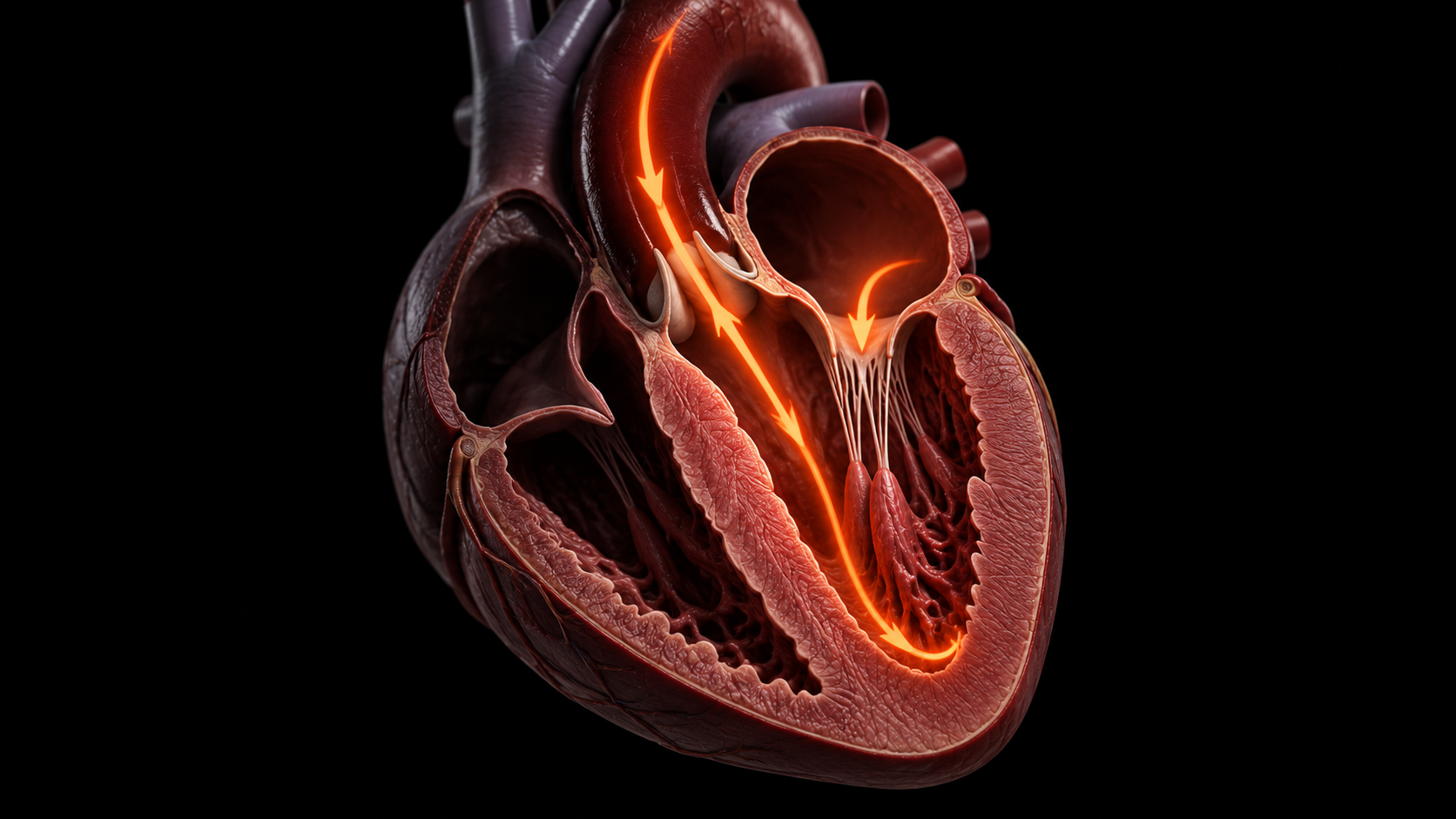
Cardiac output is determined by two and only two variables: heart rate and stroke volume. The cardiac output formula is CO = HR x SV. Heart rate is the number of cardiac contractions per minute. Stroke volume is the volume of blood ejected with each contraction, measured in milliliters. Every other factor in the cardiovascular system, including venous return, preload, afterload, and contractility, operates through one or both of these two variables.
At rest, a healthy adult produces roughly 5 liters of cardiac output per minute: a heart rate of approximately 70 beats per minute multiplied by a stroke volume of approximately 70 milliliters per beat. At maximal aerobic exercise, this number increases substantially. In untrained adults, maximal cardiac output reaches approximately 20 to 22 liters per minute. In elite endurance athletes, values of 35 to 40 liters per minute have been measured (Ekblom & Hermansen, 1968). The difference is not primarily explained by heart rate, because maximal heart rates do not differ substantially between trained and untrained individuals of the same age. The difference is almost entirely explained by stroke volume.
Stroke volume itself is determined by three factors. Preload is the degree to which the ventricle fills with blood before contracting: more filling produces a more forceful ejection, a relationship described by the Frank-Starling mechanism. Contractility is the intrinsic force-generating capacity of the heart muscle. Afterload is the resistance the heart must pump against to eject blood into the arterial system. Of these three, preload is the most directly modifiable through aerobic conditioning, primarily because sustained endurance training expands plasma volume and increases venous return to the heart.
STROKE VOLUME MECHANICS
Preload
The degree of ventricular filling before each contraction. More filling produces more forceful ejection via the Frank-Starling mechanism. This is the most directly trainable factor.
Contractility
The intrinsic force-generating capacity of the heart muscle per contraction. Improved by sympathetic nervous system activation during exercise.
Afterload
The resistance the heart must pump against to eject blood into the arterial system. Elevated in hypertension; lowered by peripheral vasodilation during exercise.
The Fick Equation: How Oxygen Actually Gets From Your Heart to Your Muscles
The connection between cardiac output and aerobic performance is made explicit by the Fick principle. The equation states that oxygen consumption (VO2) equals cardiac output multiplied by the arteriovenous oxygen difference, or a-vO2 diff. The arteriovenous oxygen difference is the gap between the oxygen content of arterial blood leaving the heart and the oxygen content of venous blood returning from the working muscles. It reflects how much oxygen the muscles extract per unit of blood delivered.
This equation has a direct practical consequence. VO2max, the most commonly used measure of aerobic capacity, is the product of two things: how much blood the heart can pump and how much oxygen the muscles can pull from that blood. A given VO2max can be achieved by different combinations, including high cardiac output with modest extraction or modest cardiac output with high extraction.
In untrained individuals, both variables improve with aerobic training. The peripheral musculature adapts by increasing mitochondrial density and the capacity to extract oxygen from delivered blood (a-vO2 diff), while the cardiovascular system simultaneously develops higher cardiac output. In trained athletes, however, the a-vO2 diff is already near its physiological ceiling. Oxygen extraction per unit of blood cannot increase substantially beyond what a trained muscle already achieves. Further improvements in VO2max in this population come almost entirely from increases in cardiac output, with stroke volume as the primary driver (Bassett & Howley, 2000).
For the aerobically trained athlete, improving sustained aerobic capacity is primarily a cardiac problem. The muscles are not the bottleneck. The lungs, in the absence of specific respiratory pathology, are not the bottleneck.
The implication is direct: for the aerobically trained athlete, improving sustained aerobic capacity is primarily a cardiac problem. The muscles are not the bottleneck. The lungs, in the absence of specific respiratory pathology, are not the bottleneck. The volume of blood the heart can deliver per minute is.
Stroke Volume vs Cardiac Output: The Lever That Actually Moves the Ceiling
If cardiac output determines the ceiling, and cardiac output equals heart rate multiplied by stroke volume, then the question is which of the two variables is more important to improve. For trained athletes, the answer is stroke volume.
Maximal heart rate is largely determined by age. The commonly cited approximation of 220 minus age is rough, but the underlying trend is real: maximal heart rate declines by approximately one beat per year through adulthood and cannot be significantly raised through training. Stroke volume, however, is highly trainable and responds substantially to the right training stimulus.
When ventricular dimensions are compared between trained and untrained individuals using cardiac MRI, elite endurance athletes show left ventricular volumes that are substantially larger than those of sedentary or recreationally active individuals (Scharhag et al., 2002). This directly translates to more blood ejected per beat, higher cardiac output at any given heart rate, and more oxygen delivered to working muscle per unit of time.
HEART RATE
Fixed by age
Declines approximately one beat per year through adulthood. Cannot be significantly raised by training. The pacing variable — not the performance ceiling.
STROKE VOLUME
Highly trainable
Responds substantially to cardiac remodeling from sustained aerobic training. The primary performance lever. Explains the difference in cardiac output between trained and elite athletes.
Two athletes with the same maximal heart rate can have substantially different maximal cardiac outputs depending on how much their training has developed their stroke volume. The athlete with the higher stroke volume delivers considerably more oxygen per minute, which is why well-trained athletes can sustain high aerobic outputs at relatively moderate heart rates. Heart rate monitors track heart rate. The variable that determines performance ceiling is stroke volume, and heart rate does not reveal stroke volume directly.
What Happens Inside the Heart During Sustained Exercise
The behavior of stroke volume across exercise intensities is not linear, and understanding it matters for how athletes interpret their physiological responses during training and competition.
At the onset of exercise, both heart rate and stroke volume rise quickly. Increased muscular activity drives more blood back toward the heart through the venous system, raising preload. By the Frank-Starling mechanism, a more filled ventricle contracts with greater force, ejecting more blood per beat. Simultaneously, the sympathetic nervous system increases heart rate and cardiac contractility. Both variables are rising, and cardiac output climbs steeply.
In individuals with lower aerobic training status, stroke volume tends to plateau at relatively moderate intensities, around 40 to 50 percent of maximal oxygen consumption. Beyond that point, further increases in cardiac output come primarily from continued increases in heart rate, while stroke volume levels off or declines slightly as the shorter filling time at high heart rates limits how completely the ventricle can fill before contracting.
In trained endurance athletes, this plateau is less pronounced or may not occur at all. Research examining elite distance runners found that stroke volume continued rising across a broad range of intensities, up to near-maximal effort (Zhou et al., 2001). The cardiac remodeling that occurs through sustained endurance training produces a larger and more compliant ventricular chamber, allowing the heart to fill adequately even as heart rate climbs. This capacity sustains stroke volume into high-intensity work, extending the point at which cardiac output can continue increasing rather than relying solely on rising heart rate.
Central vs Peripheral: Where the Actual Limit Sits
A fundamental question in exercise physiology concerns where aerobic performance ultimately fails. When performance degrades during a sustained effort, is the limiting factor in the muscles or in the cardiovascular system's ability to deliver oxygen to those muscles?
In untrained and moderately trained individuals, the answer is genuinely mixed. The muscles can represent a real bottleneck, either through inadequate mitochondrial density to process delivered oxygen or through metabolite accumulation that disrupts muscle contraction. For these individuals, peripheral training interventions, including interval work and lactate threshold training, address actual limitations in the system.
In aerobically trained athletes, the physiology shifts substantially. Well-trained muscles are equipped with high mitochondrial density, efficient fiber recruitment patterns, and a strong capacity to extract oxygen from delivered blood. The a-vO2 diff is near its ceiling. What limits performance in this population is the cardiovascular system's capacity to deliver oxygenated blood, primarily through cardiac output. Two athletes with identical peripheral muscle physiology, identical enzyme activity, identical fiber type distribution, will perform differently at sustained high output if their stroke volumes differ. The higher-stroke-volume athlete delivers more oxygen per minute, and that oxygen delivery determines how long and how fast they can sustain the effort.
The primary ceiling on sustained aerobic performance, for athletes who have built a meaningful aerobic foundation, is located in the heart's output capacity.
This does not mean peripheral training is irrelevant for trained athletes. It remains important for lactate buffering, neuromuscular efficiency, and event-specific adaptations. The primary ceiling on sustained aerobic performance, for athletes who have built a meaningful aerobic foundation, is located in the heart's output capacity. Training the peripheral system without addressing the central supply moves a variable that is no longer the binding constraint.
How Endurance Training Improves Cardiac Output: The Overview
Endurance training drives several distinct cardiovascular adaptations, each contributing to improved cardiac output through different mechanisms. They respond to different aspects of the training stimulus and develop on different timescales.
The most significant adaptation is structural: the ventricular chambers enlarge, allowing the heart to fill with more blood per beat and eject more per contraction. A second adaptation is the expansion of plasma volume, the fluid component of blood. Increased plasma volume raises preload by delivering more blood to the heart with each venous return cycle, and by the Frank-Starling mechanism, greater filling produces greater ejection even without any change to the heart's structural dimensions (Convertino, 2007). A third adaptation involves ventricular compliance, the ease with which the ventricle relaxes and fills during diastole. Training improves compliance, allowing more complete filling even as heart rates rise during exercise. A fourth is the resting bradycardia that develops with sustained aerobic conditioning: lower resting heart rate at the same or higher cardiac output reflects a larger stroke volume per beat, delivered at a lower metabolic cost to the heart itself.
TRAINING ADAPTATION OVERVIEW
Ventricular Chamber Enlargement
Eccentric hypertrophy increases end-diastolic volume and stroke volume. The primary structural mechanism.
Plasma Volume Expansion
More circulating fluid raises preload via the Frank-Starling mechanism, increasing stroke volume without structural change.
Improved Ventricular Compliance
Faster, more complete diastolic filling even as heart rate rises during high-intensity work.
Resting Bradycardia
Lower resting heart rate at equal or higher cardiac output. Reflects greater stroke volume per beat and reduced metabolic cost to the heart.
These four adaptations are distinct and do not develop equivalently from the same training stimuli. Understanding them separately informs how training load and intensity allocation affect cardiac output development.
Eccentric Cardiac Hypertrophy: How the Heart Actually Grows
The structural adaptation that most directly raises the stroke volume ceiling is eccentric cardiac hypertrophy. This term describes a pattern of cardiac remodeling in which the ventricular chambers enlarge in internal volume while the heart wall thickness stays proportional or increases only modestly. The result is a larger chamber, not a thicker wall.
This is physiologically distinct from concentric hypertrophy, the pattern associated with chronic high blood pressure. In concentric hypertrophy, wall thickness increases substantially while chamber volume does not, producing a heart that must work harder to eject the same volume per beat. The adaptations are mechanistically opposite, and their cardiovascular consequences differ accordingly. Athlete's heart, characterized by eccentric hypertrophy, is an adaptation to volume load. Hypertensive hypertrophy is an adaptation to pressure load (Maron & Pelliccia, 2006).
In eccentric hypertrophy, the enlarged ventricular chamber fills with more blood during diastole. By the Frank-Starling mechanism, this greater filling stretches the ventricular wall and generates greater contractile force during systole. More blood enters per beat and more blood exits per beat. Stroke volume increases without requiring any increase in contractility. This is why the structural changes associated with athlete's heart improve performance: the heart delivers more oxygen per beat at any given heart rate, raising the cardiac output ceiling without additional metabolic cost per contraction.
The training stimulus that most reliably produces this pattern of remodeling is sustained, moderate-intensity aerobic work conducted over months. The key driver appears to be prolonged elevation of cardiac output rather than peak cardiac output, which is why long-duration aerobic sessions create a more pronounced volume-load stimulus than high-intensity intervals of the same total work. High-intensity interval training and anaerobic conditioning drive metabolic and peripheral adaptations more directly than structural cardiac remodeling.
Stroke volume increases without requiring any increase in contractility. The heart delivers more oxygen per beat at any given heart rate, raising the cardiac output ceiling without additional metabolic cost per contraction.
Cardiovascular Drift: What Cardiac Output Does During Sustained Exercise

Cardiovascular drift refers to a specific pattern of cardiovascular behavior that occurs during prolonged exercise at a constant external workload: heart rate progressively rises while stroke volume progressively declines, even though the pace or power output has not changed (Coyle & González-Alonso, 2001).
The mechanism begins with plasma volume. As exercise continues, sweat loss removes fluid from the circulation, and fluid shifts occur from the plasma into active tissue. Plasma volume falls. Less fluid is available to return to the heart through the venous system, which reduces preload. By the Frank-Starling mechanism, lower preload reduces end-diastolic volume, which reduces the force of ventricular contraction, which reduces stroke volume per beat. The cardiovascular system responds by increasing heart rate to partially compensate for the lost stroke volume. This compensation is incomplete: cardiac output falls modestly over the course of a prolonged effort even as heart rate climbs.
The experience at the athlete level is a progressive increase in perceived difficulty at a constant pace. The muscles are receiving less oxygen per minute than at the start of the effort. To sustain the same mechanical output, they draw more heavily on anaerobic energy pathways, accumulating metabolites that accelerate the fatigue that produces the wall. This is not a mental phenomenon, though it manifests in perceived exertion. It is a cardiac one, driven by the decline in stroke volume through the mechanism described above.
EARLY EFFORT
Stable cardiac output
Stroke volume maintained. Heart rate at target. Full muscle oxygen delivery. Plasma volume stable.
EXTENDED EFFORT
Cardiac output falling
Plasma volume reduced. Stroke volume declining. Heart rate rising to compensate. Muscle oxygen delivery decreasing.
Heat substantially amplifies cardiovascular drift. In warm conditions, blood must be redirected to the skin to support thermoregulation through convective heat loss and evaporative sweating. Cutaneous blood flow competes directly with muscle blood flow for the heart's total cardiac output at any given moment. The result is a greater effective reduction in muscle oxygen delivery than occurs in cool conditions at the same pace and hydration status. The interaction between heat, sweat loss, plasma volume reduction, and competitive redistribution of cardiac output to the skin explains why sustained performance degrades faster in hot environments at identical objective workloads (González-Alonso et al., 2008).
Fluid intake during sustained efforts directly counteracts drift by maintaining plasma volume and thereby slowing the decline in preload and stroke volume. This is the physiological rationale for hydration in endurance performance. It is not about thirst or comfort. It is about preserving the preload that allows the heart to maintain stroke volume across the duration of the effort.
Fluid intake during sustained efforts directly counteracts drift by maintaining plasma volume and thereby slowing the decline in preload and stroke volume.
Three Ways Athletes Misread Their Cardiovascular System
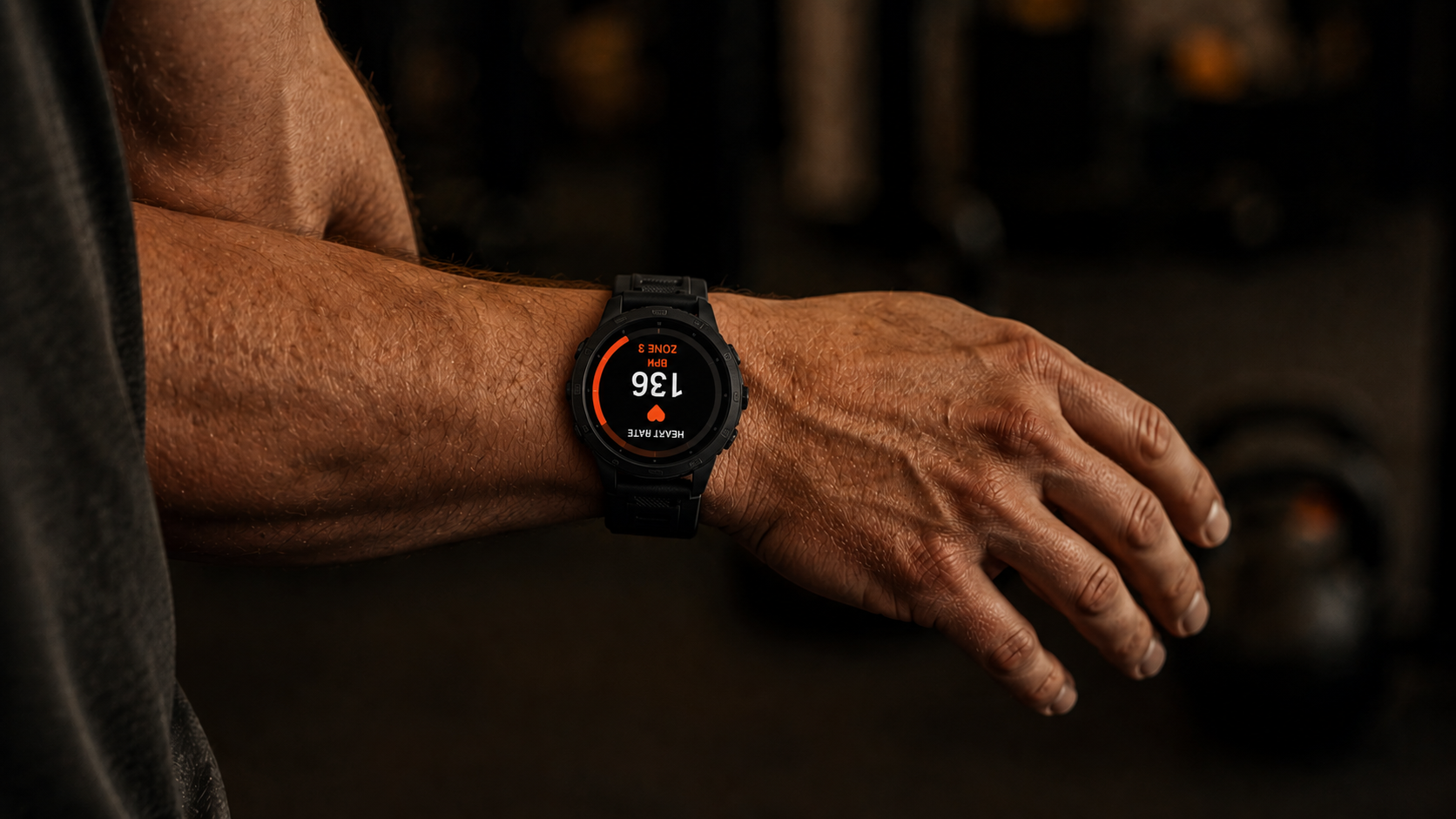
The mechanisms described above are clear in principle but frequently misread in practice. Three specific errors recur. The first is treating heart rate as a direct measure of effort rather than as the output of a system trying to maintain cardiac output. Heart rate is not an independent variable. It rises during a constant-workload sustained effort not because the effort is increasing but because stroke volume is falling and the heart is increasing rate to compensate. An athlete who reads rising heart rate as a signal to reduce effort is responding to the compensation mechanism rather than the underlying cause. When cardiovascular drift is the driver, the relevant intervention is preload management: hydration strategy and pacing relative to heat load, not simply reducing power output or pace.
The second error is attributing central performance limits to peripheral causes. When performance degrades during a sustained aerobic effort, the sensation is peripheral: heavy legs, impaired muscle coordination, burning from metabolite accumulation. These are real experiences and represent genuine changes in muscle physiology. In trained athletes, however, the upstream cause is frequently a reduction in oxygen delivery rather than an exhaustion of the muscle's intrinsic capacity. Directing training volume toward peripheral interventions, additional leg work, more high-intensity sessions, addresses the downstream expression of the problem without moving the binding constraint. For trained athletes, the cardiac output ceiling is the primary thing to develop.
The third error is conflating a single VO2max measurement with a complete picture of cardiovascular fitness. VO2max is a useful and well-validated metric, but it is measured at maximal intensity in a brief test and does not directly capture what happens to cardiac output during sustained, prolonged efforts. An athlete's VO2max may remain stable across a training period while their cardiovascular drift has slowed substantially, because they have improved plasma volume stability, stroke volume maintenance, or ventricular compliance at sustained effort. These are performance-relevant improvements that VO2max does not directly measure.
ERROR 4.1
Misreading Heart Rate
Rising heart rate during a constant-workload effort signals declining stroke volume, not increasing effort. The correct response is preload management — hydration and pacing — not pace reduction.
ERROR 4.2
Peripheral Misattribution
Heavy legs and muscle fatigue are downstream of reduced oxygen delivery. In trained athletes, the upstream cause is frequently cardiovascular, not muscular. Adding leg volume doesn't move the cardiac ceiling.
ERROR 4.3
Conflating VO2max With Cardiovascular Fitness
A stable VO2max score doesn't capture improvements in cardiovascular drift resistance, stroke volume maintenance, or ventricular compliance at sustained effort — all of which are performance-relevant.
An athlete who reads rising heart rate as a signal to reduce effort is responding to the compensation mechanism rather than the underlying cause.
How to Train the Right System and How to Gauge Your Progress
The cardiovascular mechanisms described in this article converge on a consistent implication for training: the stimulus that produces structural cardiac remodeling is sustained moderate-intensity aerobic work conducted over time. The key driver of eccentric cardiac hypertrophy is prolonged elevation of cardiac output. This means long-duration aerobic sessions, conducted at intensities that keep cardiac output elevated without reaching maximum, create the volume-load stimulus that drives ventricular chamber enlargement and the associated increase in stroke volume.
For athletes who have already developed meaningful aerobic capacity, the peripheral musculature is no longer the binding constraint. The muscles in a trained athlete are already efficient. Adding more high-intensity interval work develops lactate buffering, anaerobic capacity, and race-pace neuromuscular patterns, which are real and valuable adaptations for specific events. It does not move the cardiac output ceiling that limits sustained aerobic performance. That ceiling moves through cardiac remodeling, which requires the specific stimulus of sustained, moderate-intensity cardiac loading over an extended period.
The practical question that follows is how to gauge progress in cardiac output, since the variable itself is not routinely accessible outside clinical or research settings. In those settings, cardiac output is measured by thermodilution via pulmonary artery catheter, by Doppler echocardiography, or by indirect Fick methods applied with measured VO2 and known hemoglobin values. These are research and clinical tools.
HOW CARDIAC OUTPUT IS ASSESSED
Research Setting — Thermodilution
Most accurate method. Requires pulmonary artery catheter. Invasive and not practical for training athletes.
Clinical Setting — Doppler Echocardiography
Non-invasive. Validated for cardiac dimensions and function in athletes. Available through sports medicine and cardiology.
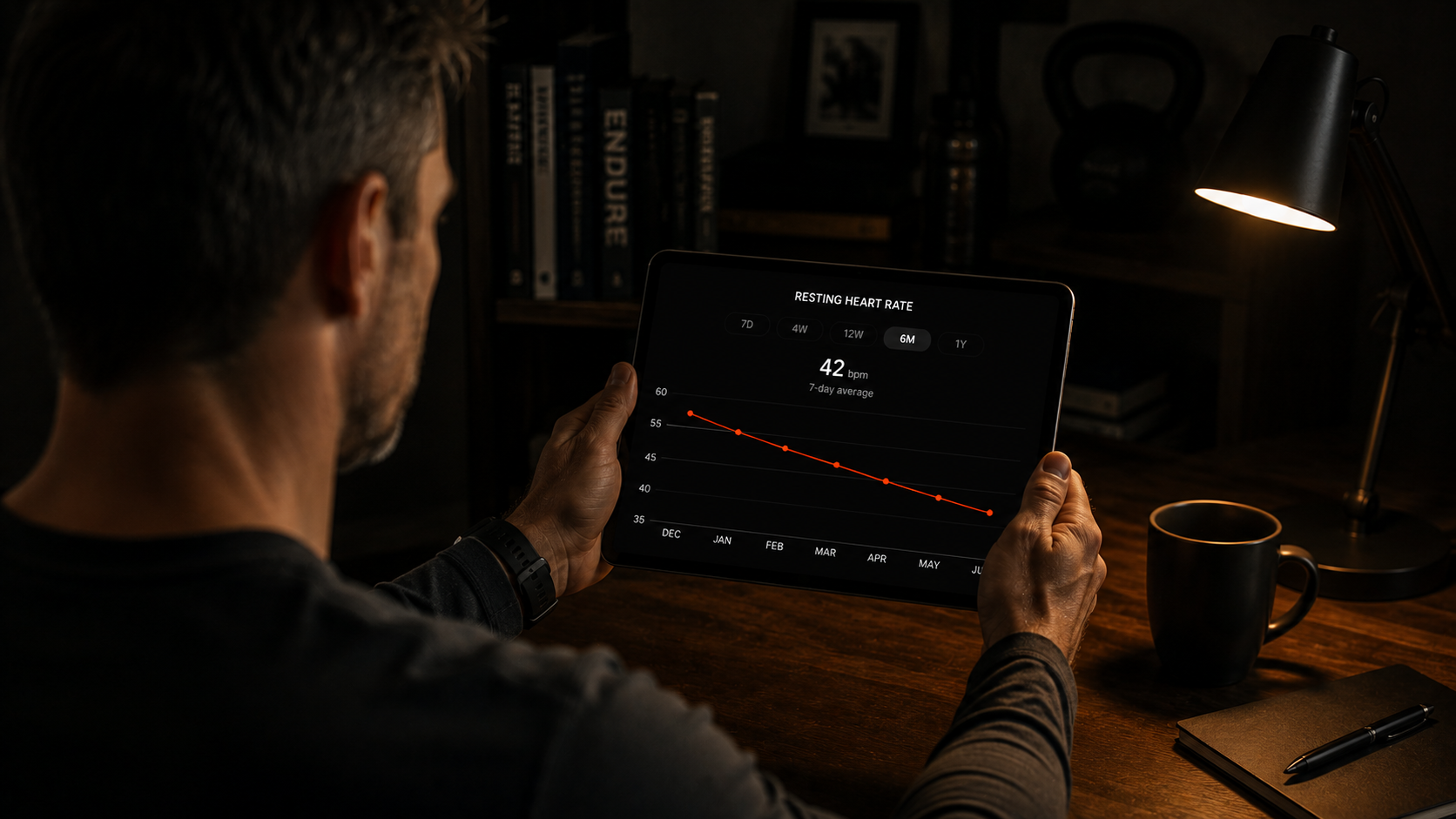
Training Proxy — Resting Heart Rate
Tracked over months under consistent conditions. Declining rate at stable cardiac output reflects rising stroke volume per beat. Most accessible proxy.
Wearable Estimate — Optical Sensor
Provides stroke volume estimates with limited accuracy. More useful for tracking relative trends within one athlete over time than for comparing absolute values between athletes.
The absence of a direct cardiac output readout does not reduce the relevance of the mechanism. Knowing that stroke volume is the variable that moves the performance ceiling, and that the training stimulus to develop it is prolonged moderate-intensity aerobic work, provides sufficient information to make better-informed decisions about how training time and effort are allocated. A declining resting heart rate tracked through the fitness-fatigue model over weeks is the most accessible proxy available, and understanding what it represents, higher stroke volume per beat at lower metabolic cost, converts a simple number into a meaningful signal.
Knowing that stroke volume is the variable that moves the performance ceiling, and that the training stimulus to develop it is prolonged moderate-intensity aerobic work, provides sufficient information to make better-informed decisions about how training time and effort are allocated.
Frequently Asked Questions
What is cardiac output and why does it matter for aerobic performance?
Cardiac output is the volume of blood the heart pumps per minute, calculated as heart rate multiplied by stroke volume. For aerobically trained individuals, it is the primary ceiling on oxygen delivery to working muscles. When cardiac output cannot increase further, sustained aerobic performance cannot increase further, regardless of muscle strength or breathing efficiency.
Is heart rate or stroke volume more important for endurance performance?
Stroke volume is the more trainable and performance-relevant variable for trained athletes. Maximal heart rate is largely fixed by age and declines roughly one beat per year through adulthood. Stroke volume responds substantially to sustained endurance training through structural cardiac remodeling. The difference in cardiac output between fit and elite athletes is explained almost entirely by stroke volume, not heart rate.
What is cardiovascular drift and why does it make long efforts harder?
Cardiovascular drift is the progressive rise in heart rate and decline in stroke volume during prolonged exercise at a constant workload. Sweat loss reduces plasma volume, lowering the blood returning to the heart and reducing stroke volume per beat. The heart compensates with a higher rate, but cardiac output falls slightly, oxygen delivery decreases, and perceived difficulty at a fixed pace increases as a direct result.
How does endurance training improve cardiac output?
Endurance training improves cardiac output primarily through eccentric cardiac hypertrophy, which enlarges the ventricular chambers and increases stroke volume per beat. Training also expands plasma volume, raising preload by delivering more blood to the heart per cycle. Both adaptations are most strongly driven by sustained moderate-intensity aerobic work that keeps cardiac output elevated over long durations.
How can athletes gauge improvements in cardiac output without clinical equipment?
Direct cardiac output measurement requires clinical tools such as echocardiography or thermodilution. Accessible proxies include resting heart rate tracked over months: a declining resting rate at stable or improved cardiac output indicates higher stroke volume per beat. Wearable optical sensors provide stroke volume estimates but with limited accuracy. Relative trends within a single athlete over time are more reliable than absolute values.
Bottom Line
Cardiac output, the volume of blood the heart pumps per minute, is the primary ceiling on sustained aerobic performance in trained individuals. It is determined by heart rate and stroke volume. Heart rate is largely fixed by age. Stroke volume is highly trainable and responds to the right stimulus, making it the variable that separates athletes who continue improving their aerobic ceiling from those who plateau.
Stroke volume develops through eccentric cardiac hypertrophy, a structural enlargement of the ventricular chambers driven by sustained, moderate-intensity aerobic loading over time. During prolonged efforts, it declines progressively through cardiovascular drift, as plasma volume losses reduce preload and the heart compensates by increasing rate rather than volume per beat. This compensation is incomplete. Cardiac output falls, oxygen delivery to muscle falls, and perceived difficulty at a fixed pace increases as a direct physiological consequence.
Most aerobically active people attribute their performance limits to the wrong system. The sensation of failure is peripheral, but the mechanism is central. Understanding that the ceiling is located in the heart's output capacity, that it responds to a specific training stimulus, and that it degrades in a predictable way during prolonged efforts gives the analytically minded athlete something more useful than a training tip: a working model of what is actually happening, and why.
The sensation of failure is peripheral, but the mechanism is central.
Your aerobic ceiling is set by your heart, not your legs. Stroke volume is the variable that moves it — and it responds to a specific training stimulus.
Long-duration moderate-intensity aerobic work produces the ventricular remodeling that raises cardiac output. Understanding this changes how you allocate training time, not how hard you try.
Mydos Performance
— What Actually Limits Performance Series —
What Is Cardiac Output and Why It Determines Sustained Performance
Stroke volume, cardiovascular drift, and why your legs aren't the problem
· By Ricardo Londono, ·