
Are Energy Drinks Bad for You?

Energy drinks can make a person feel sharper, more capable, and more willing to keep pushing even when the underlying system has not improved. That is why the question “are energy drinks bad for you” is too blunt to be the real starting point for this topic. It collapses toxicology, dose, context, and performance tradeoffs into a single moral label that does not explain why the experience can feel useful in the short term and costly later (as in the case of a caffeine crash).
For a serious adult under sustained load, the more precise question is different. The useful question is why can a drink produce a real change in alertness and output tolerance without increasing underlying energy capacity. That distinction matters because perceived energy and real capacity are related, but they are not the same thing (Graham 2001; Doherty & Smith 2005).
This article is about that gap. Energy drinks can create a temporary state in which perception and chemical signaling change faster than physiology and adaptation can. Arousal rises, fatigue signals are muted, and output can increase temporarily, yet the tissues, fuel stores, sleep state, and recovery status that support repeatable performance may be unchanged. Once that concept is clear, the crash stops looking like a separate failure and starts looking like the the energy bill coming due.
FELT ENERGY
A change in how the nervous system perceives effort
A temporary change in how the nervous system perceives and tolerates effort. Arousal rises. Fatigue signals are muted. Output can increase — for a time.
REAL CAPACITY
The underlying ability to produce repeatable work
Determined by substrate availability, oxygen delivery, mitochondrial function, tissue readiness, and recovery status. Slower to build. Durable.
These are related. They are not the same thing.
Energy drinks create a temporary state in which signaling changes faster than physiology can adapt.
How Do Energy Drinks Work?
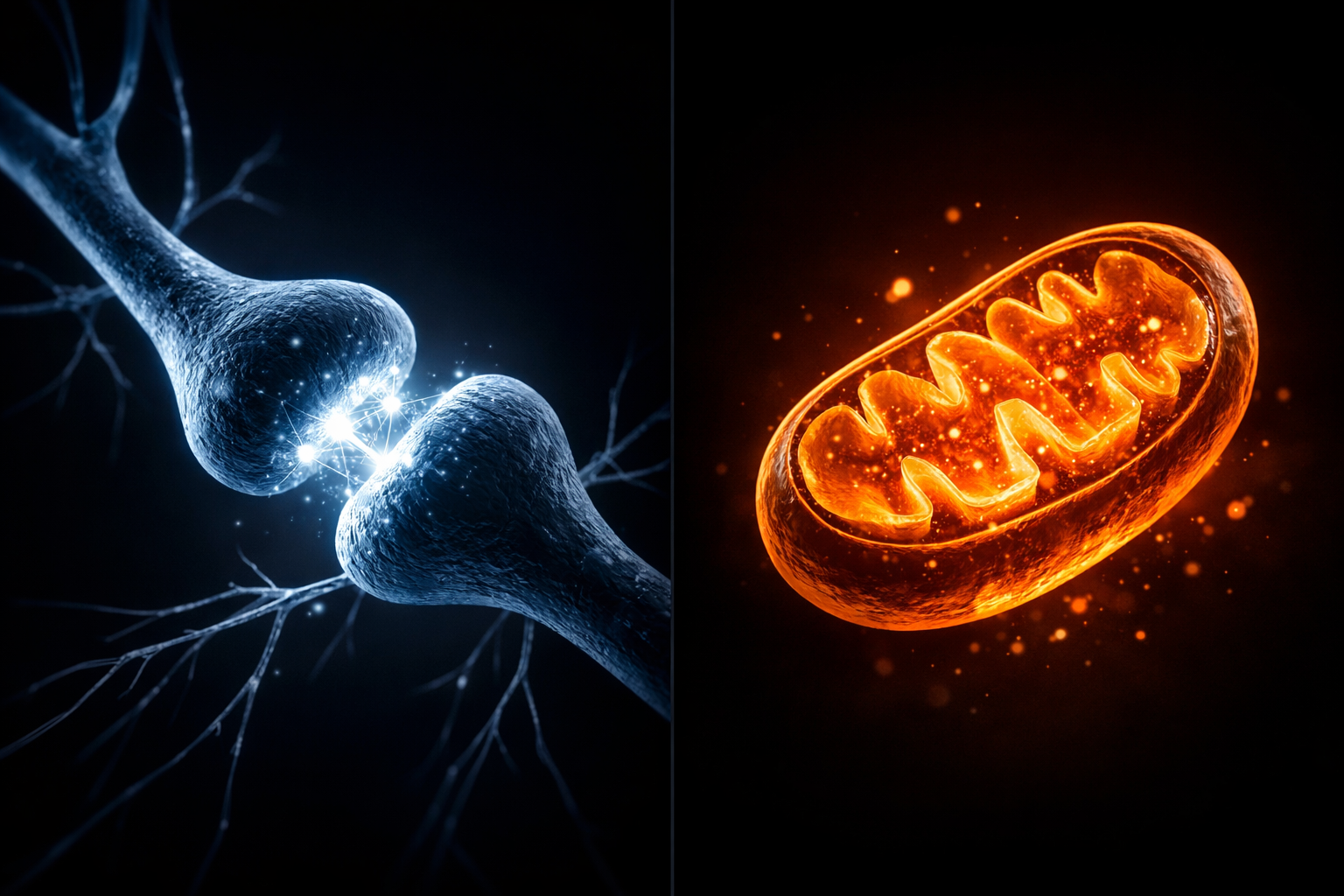
Energy drinks work by changing signaling first. In many formulations, caffeine is the main reason the user feels more awake, more engaged, and less constrained by fatigue signals in the short term. Sugar can also matter in some products, and other compounds may influence the experience at the margins, but caffeine is the central driver of the effect this article is trying to explain.
That distinction matters because signaling effects and capacity effects are different categories. A signaling effect changes what the nervous system notices, permits, or prioritizes in the moment. A capacity effect changes the underlying ability to produce repeatable work through improved substrate availability, oxygen delivery, mitochondrial function, tissue readiness, or recovery status. Energy drinks mainly act in the first category, which is why they can feel strong before they prove durable.
This cause and effect structure is what holds the whole article together. If a drink changes alertness, arousal, and output tolerance without building new capacity, then the later drop is not mysterious. It is the expected result of spending from a system whose limits were masked more effectively than they were changed.
Do Energy Drinks Actually Give You Energy?
Energy is one of the least precise words in performance language. It can refer to calories, ATP turnover, wakefulness, motivation, subjective drive, or the feeling that effort is easier to tolerate. When people say an energy drink “gives energy,” they are often mixing these categories together and using one word for several different processes.
If the question is whether energy drinks create new physiological capacity, the answer is no. They do not build mitochondrial density in an afternoon, refill glycogen by stimulating the brain, or reverse sleep loss because arousal rose for a few hours. What they can do is change how existing resources are allocated, perceived, and spent. They can make a person feel more able to act before the underlying limits that govern repeatable output have materially changed.
That is why stimulation and capacity need to stay separate in the reader’s mind. Substrate availability describes what fuel is present and accessible. ATP turnover describes the rate at which energy currency is being used and regenerated at the cellular level. Arousal describes nervous-system state. Perceived effort describes how hard a given task feels. Those variables interact, but they are not interchangeable. A better short-term feeling does not prove that the system itself became more robust.
Borrowed energy is a change in present output or output tolerance that pulls against future freshness. Sustained energy is the result of systems that can support repeatable work with less mismatch between what is demanded and what can actually be supplied.
Caffeine Blocks Adenosine Receptors
The central nervous system mechanism that explains most of the acute effect begins with adenosine. Adenosine is a signaling molecule involved in sleep-wake regulation, and its influence becomes more relevant as wakefulness is prolonged and fatigue pressure rises (Porkka-Heiskanen & Kalinchuk 2011). Under those conditions, adenosine signaling helps shift the system toward sleepiness, reduced alertness, and greater sensitivity to the cost of continued effort.
Caffeine changes that signal by acting as an adenosine receptor antagonist (Reichert et al. 2022). In practical terms, that means it interferes with one of the pathways through which fatigue pressure becomes subjectively obvious. The result is not new energy entering the system. The result is that one layer of fatigue-related signaling is muted, delayed, or made less salient to the person experiencing it.
That altered signaling state has downstream effects. Wakefulness can improve, vigilance can rise, and a given workload may feel more tolerable than it did before caffeine was present (Doherty & Smith 2005). This is one reason acute caffeine use can improve performance in defined settings. A person may pace harder, maintain attention longer, or continue working at a higher level because the cost signal is being interpreted differently.
Even here, restraint matters. Adenosine blockade is the central driver of the acute effect, but it is not the only downstream pathway in play. Caffeine also interacts with broader arousal systems, and the final subjective experience depends on dose, timing, sleep status, habitual use, and the context in which the stimulant is being used. The main point is narrower than popular language makes it sound. Caffeine changes fatigue signaling.
TWO CATEGORIES OF EFFECT
Signaling Effect
Changes what the nervous system notices, permits, or prioritizes in the moment. Does not alter underlying physiology. Fast-acting. Temporary.
Capacity Effect
Changes the underlying ability to produce repeatable work — through improved substrate availability, oxygen delivery, mitochondrial function, tissue readiness, or recovery status. Slower to build. Durable.
Energy drinks act primarily in the first category.
Energy drinks mainly act in the first category, which is why they can feel strong before they prove durable.
Borrowed energy is a change in present output or output tolerance that pulls against future freshness.
The Caffeine Crash
A caffeine crash is the period when the borrowed-output state starts to fall away and the baseline fatigue state becomes harder to ignore. That is a better way to define the experience than saying the drink “stopped working” in some abstract sense. The immediate effect was always a temporary modification of signaling. Once that modification weakens, the system has to operate with less masking and with whatever fatigue, sleep pressure, or fuel strain was present underneath it.
This is why the crash often feels disproportionate to the person experiencing it. The contrast is between a short-lived period of improved alertness and the underlying state that was already there, sometimes with additional cost layered on top from harder pacing, longer wakefulness, or more aggressive task engagement. The fall is experienced as sleepiness, irritability, reduced concentration, lower drive, and a general sense that effort became expensive very quickly (Rogers 2013; Urry & Landolt 2015).
Those symptoms vary with context. Dose matters, because a larger stimulant input can produce a larger shift in perceived state. Timing matters, because using caffeine against high sleep pressure creates a different pattern than using it when the person is already reasonably recovered. Habit matters, because tolerance changes how large the acute effect feels. Formulation matters as well, especially when a product contains sugar that can change the time course of the subjective rise and fall. The crash is not a separate story from the lift. It is part of the same story.
Crashing From Energy Drinks
Crashing from energy drinks makes more sense once the mismatch model is stated directly. Output and output tolerance rise first. Capacity does not rise at the same speed, and may not rise at all in any meaningful way over the relevant time window. That means the person can spend harder from a system whose underlying readiness is largely unchanged.
When the acute masking effect begins to fade, the baseline fatigue state becomes easier to feel again. If the person used the stimulant to extend wakefulness, push through training fatigue, maintain concentration through sleep debt, or work at a higher pace than normal, the contrast can feel abrupt. The drink did not manufacture a new reserve. It made the existing reserve feel easier to deploy for a while, and it reduced the friction that would normally tell the person to back off sooner.
Sugar can complicate this picture without changing the main argument. In a sugar-containing energy drink, glucose can contribute to the subjective rise and then to a different kind of rise-and-fall pattern, especially in people who are sensitive to rapid changes in blood glucose or who consumed the drink in a particular nutritional context. Even then, the caffeine mechanism and the glucose mechanism should be kept separate. One is primarily a change in fatigue signaling and arousal. The other is a change in substrate handling. Combining them can intensify the feeling, but they are not the same process.
Energy Drink Crash Framing
An energy drink crash can feel more aggressive than an equivalent caffeine experience from another source because the context around the dose is often more aggressive. The drink may be consumed quickly, the total dose may be large, and the user may be reaching for it at exactly the moments when baseline fatigue is already high. That pattern is common during long work blocks, before late-day energy drink taken to salvage focus, after poor sleep, or during days when a person is trying to maintain output across too many competing demands.
That context matters because stimulants are experienced inside a living schedule, not in isolation. A late-day energy drink taken to salvage focus may improve the next few hours while pushing sleep onset later or reducing sleep quality afterward (Gardiner 2023; Barnard 2022). The next morning then begins with higher sleep pressure, making another stimulant feel necessary. The crash is part of that loop, and the loop becomes easier to understand once the question changes from “why did my energy disappear” to “what was being covered up or borrowed against in the first place.”
How Long to Reset Caffeine Tolerance
Tolerance develops because repeated exposure changes the response to the same input. Over time, the same dose can produce a smaller subjective lift, which is why people begin asking how long to reset caffeine tolerance. The question itself is evidence of adaptation. A tool that worked cleanly at one point is no longer producing the same signal change at the same magnitude.
The literature on mechanism is not equally deep at every level of detail, but there is enough support for cautious language here. Repeated caffeine exposure is associated with tolerance, and adenosine-related adaptation is one plausible part of that process (Ammon 1991; Sawynok 1995). The practical consequence is straightforward even when the cellular details are discussed carefully. If the same dose produces less alertness and less reduction in perceived cost, the user is pushed toward either accepting a weaker effect or escalating dose.
That is where diminishing returns matter. Higher habitual intake can preserve the habit while reducing the distinctive acute benefit that originally made the tool feel valuable. The person then experiences a narrower gap between baseline and stimulated state, more dependence on routine intake to feel normal, and less clarity about whether caffeine is adding performance or merely helping reverse part of withdrawal or accumulated fatigue. It only needs to show why repeated use changes the meaning of the same dose.
Caffeine in Pre Workout Supplements

Caffeine in pre workout supplements belongs in this discussion because it represents the narrow case where the tradeoff can be acceptable by design. If the goal is a defined bout of acute performance and the cost is understood in advance, caffeine can be a rational tool (Southward et al. 2018). That is different from treating it as a daily foundation for stable energy across work, family, and training.
The distinction is strategic rather than moral. A competition day, a key training session, or a specific performance demand may justify accepting a later cost. A normal Tuesday that already contains incomplete recovery, work demands, and the need to sleep well again the next night is a different context. The same molecule is involved, but the decision framework is not the same. Acute performance support and durable daily energy are different problems, and confusing them is where the stimulant starts to look more useful than it really is.
FOUR CONTEXT VARIABLES THAT SHAPE THE CRASH
3.1
Dose
A larger stimulant input produces a larger shift in perceived state — and a larger contrast when the effect fades.
3.2
Timing
Caffeine used against high sleep pressure creates a different pattern than use when the person is already reasonably recovered.
3.3
Habit
Tolerance changes how large the acute effect feels — and how noticeable the withdrawal is.
3.4
Formulation
Sugar in the product can alter the time course of the subjective rise and fall through a separate substrate-handling mechanism.
The core logic remains the same across all four. The crash is part of the same story as the lift.
The immediate effect was always a temporary modification of signaling.
The drink did not manufacture a new reserve.
Common Mistakes: Mistaking Stimulation for Capacity

The first mistake is interpreting immediate lift as proof that capacity improved. If a person drinks caffeine and then trains harder, works longer, or feels more mentally available, the result is easy to misread. The feeling is real, and the performance change may also be real, but the mechanism still matters. A real short-term effect does not automatically mean the underlying system became more resilient or better recovered.
The second mistake is treating the crash as a separate problem that appeared out of nowhere. In many cases the crash is simply the other side of the same event. The person borrowed against a masked fatigue state, spent more aggressively than the baseline condition justified, and later met the system without the same degree of signal suppression. That should change how the event is interpreted. The lift and the drop are linked, even when the person experiences them as unrelated episodes.
The third mistake is answering tolerance with escalation. Once the same dose feels weaker, the tempting response is to add more caffeine or add more occasions of use. That can preserve the routine while reducing clarity about what is being gained. If the baseline problem is sleep debt, accumulated training fatigue, or extended cognitive load, then escalating stimulation mainly increases the amount of masking applied to a problem that still exists underneath.
The fourth mistake is using a stimulation tool to cover for a capacity problem. Sleep debt, inadequate recovery, poor fuel timing, and sustained overload are capacity problems because they reduce the system’s ability to support repeatable output. Caffeine can change how those problems feel for a time. It cannot convert them into strengths. That is why repeated reliance often makes a schedule feel more manageable in the moment and less stable across the week.
FOUR MISTAKES
4.1
Interpreting Lift as Improved Capacity
A real short-term effect does not mean the underlying system became more resilient or better recovered.
4.2
Treating the Crash as a Separate Event
The lift and the drop are linked. The crash is the other side of the same event — not a new problem that appeared out of nowhere.
4.3
Answering Tolerance with Escalation
Higher dose or more frequent use preserves the routine while reducing clarity about what is actually being gained.
4.4
Using a Stimulation Tool to Cover a Capacity Problem
Caffeine can change how capacity problems feel. It cannot convert them into strengths.
A real short-term effect does not automatically mean the underlying system became more resilient or better recovered.
What This Means in Practice: How to Have More Energy
How to have more energy becomes a different question once energy is defined more carefully. If the goal is durable output, the answer cannot be reduced to a stimulant that changes signaling for a few hours. Durable energy means sleep pressure is lower because actual sleep was sufficient, fuel availability is more appropriate to demand, recovery status supports the next effort rather than competing with it, and training adaptation has shifted what the system can sustain before cost signals rise sharply.
This is why capacity-building variables deserve a different category from borrowed-output tools. Sleep improves the conditions under which alertness, vigilance, reaction time, and decision quality can recur. Recovery restores tissue and nervous-system readiness after training and long work demands. Fuel availability affects whether the three energy systems have accessible substrate support. Training adaptation changes what pace or workload the system can sustain before cost signals rise sharply. Those are >slower levers, but they are also the levers that change the baseline rather than merely changing how the baseline feels.
That does not make caffeine irrelevant. It places caffeine in the right box. A stimulant can be useful as an acute modifier of signaling and perceived effort. It cannot serve as evidence that a person has solved the deeper issue of insufficient capacity for current demands. For someone carrying real adult load, this distinction is practical. The question is less about eliminating every stimulant and more about refusing to confuse temporary permission with actual readiness.
The signaling change is real, which is why the effect works. The capacity problem is also still there, which is why the effect fails later, and in some cases the stimulant encouraged the person to spend more from a system that needed restoration rather than persuasion. That is the right framework for deciding what kind of energy problem is actually present on a given day.

FOUR CAPACITY-BUILDING VARIABLES
Sleep
Improves the conditions under which alertness, vigilance, reaction time, and decision quality can recur. Lowers sleep pressure. The primary recovery mechanism.
Recovery
Restores tissue and nervous-system readiness after training and long work demands. Enables the next effort to begin closer to baseline.
Fuel Availability
Determines whether the task has accessible substrate support. Affects what pace or workload the system can sustain before cost signals rise.
Training Adaptation
Changes what the system can actually sustain before cost signals rise sharply. The slowest lever — and the most durable.
These are slower than stimulants. They are also the only levers that change the baseline rather than how the baseline feels.
Those are slower levers, but they are also the levers that change the baseline rather than merely changing how the baseline feels.
The question is less about eliminating every stimulant and more about refusing to confuse temporary permission with actual readiness.
Frequently Asked Questions
What does a caffeine crash feel like?
The caffeine crash is a period of sleepiness, reduced concentration, low drive, and increased perception of effort that follows the stimulant’s acute phase. It reflects the underlying fatigue state becoming more visible as adenosine signaling resumes, not a new problem, but the same fatigue that was temporarily masked.
How long does a caffeine crash kick in?
Onset depends on dose, timing, individual metabolism, and baseline fatigue level. The acute effect of caffeine typically peaks within 30 to 60 minutes and begins declining over the following two to four hours as the drug is metabolized and adenosine-blocking activity weakens.
Do energy drinks actually give you energy?
Energy drinks do not create new physiological capacity. They change how the nervous system perceives and tolerates existing fatigue by blocking adenosine receptors, which temporarily reduces the salience of effort and sleepiness. Felt energy and actual energy capacity are related but not the same thing.
Why does caffeine tolerance develop?
Repeated caffeine use is associated with adaptive changes in adenosine receptor sensitivity, which reduce the magnitude of the acute effect over time. The same dose that previously produced a clear alertness change produces a smaller or shorter shift once tolerance is established.
Does caffeine improve performance or just make effort feel easier?
Both effects occur but they are not the same mechanism. Caffeine reduces rating of perceived exertion, which can allow harder pacing or longer sustained effort. It does not directly increase VO2 max or underlying work capacity. The performance improvement, when it occurs, operates through altered effort perception rather than an expanded physiological ceiling.
Bottom Line: Real Energy vs Borrowed Energy
The useful distinction at the end of this article is between changing the signal and changing the system. Energy drinks can make fatigue less salient, effort more tolerable, and output easier to maintain for a period, and those effects are real enough to matter, which is exactly why they are so easy to overinterpret.
Real energy, in the durable sense, is different. It comes from a system that can support the required work with less mismatch between demand and readiness. Borrowed energy comes from spending more effectively against a limit that still exists. Once that model is clear, the caffeine crash stops looking like bad luck or personal weakness. It becomes what it usually was all along: the delayed visibility of a cost that was present from the beginning.
It becomes what it usually was all along: the delayed visibility of a cost that was present from the beginning.
Energy drinks change the signal. They do not change the system. Once that distinction is clear, the crash stops looking like a failure and starts looking like the bill.
Felt energy and real capacity follow different rules. A stimulant can make existing resources easier to spend — it cannot manufacture new ones. The difference matters most when the schedule is long and the margin for recovery is thin.
Mydos Performance
— Sustained vs Borrowed Energy Series —
Caffeine Crash Explained
Why Energy Drinks Work (and Fail)
By Ricardo Londono · 4/8/26