
The Problem With Chasing Energy

There is a reliable pattern in how high-performing people manage cellular energy production and fatigue. An 8 AM coffee becomes a 10 AM coffee becomes a pre-training espresso. The doses increase. The timing shifts earlier to avoid the caffeine crash. And the crash comes anyway, usually at the worst possible moment. This is not a discipline problem or a question of which brand or dose to try next. It is a mechanism problem: what caffeine actually does in the brain, and why doing more of it produces diminishing returns rather than a stable energy baseline.
The answer requires a distinction most people have not been offered. There is a difference between feeling awake and having energy. These are not the same biological state, and treating them as interchangeable is the source of a strategy that reliably fails over time. Caffeine produces the former. It has no mechanism to produce the latter. This article explains why, and what that means for anyone whose energy strategy is built around stimulants.
There is a difference between feeling awake and having energy.
What Caffeine Actually Does in the Brain
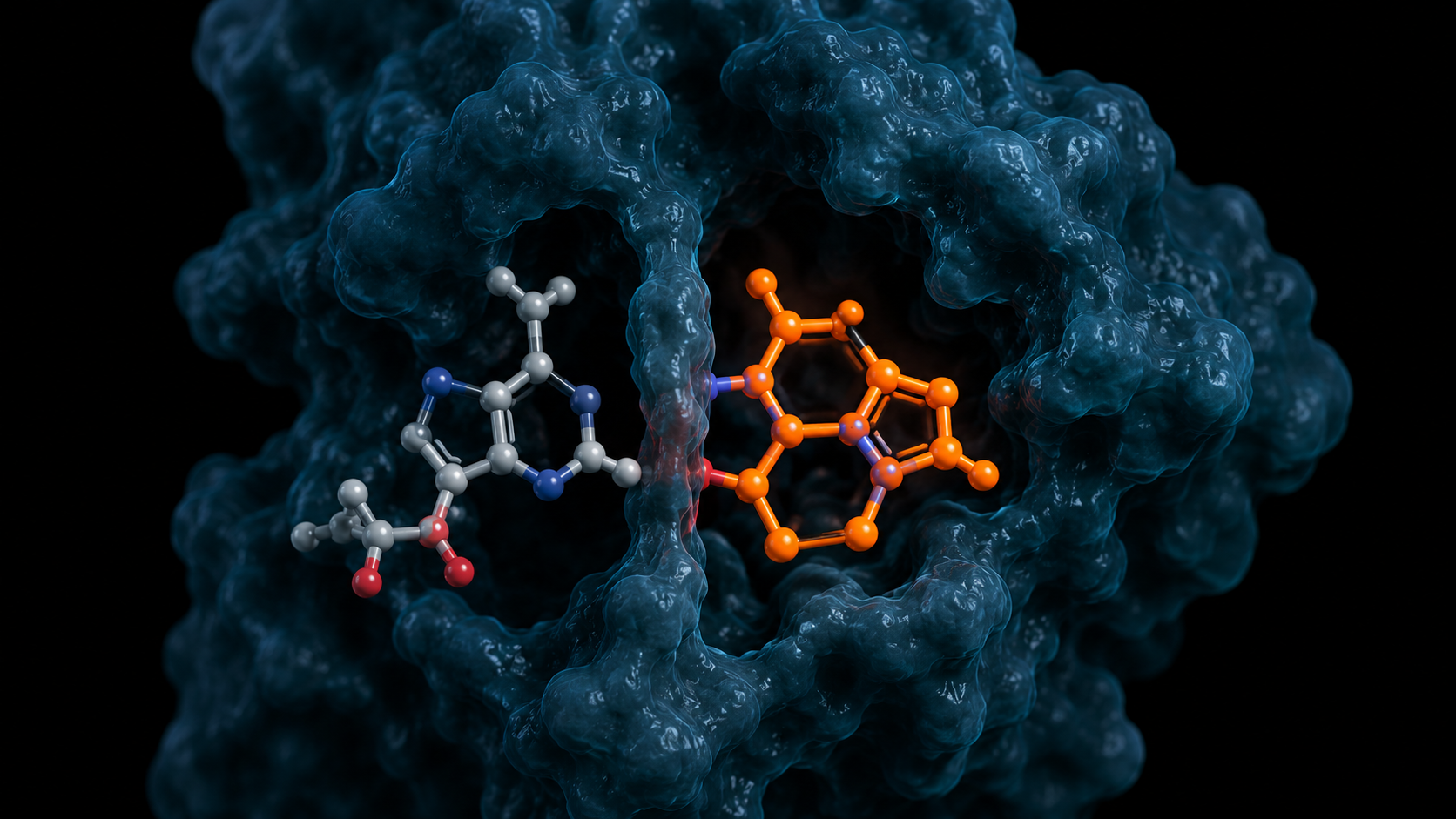
Caffeine does not generate energy. It blocks the reception of a fatigue signal.
As cells throughout the body perform metabolic work, they produce adenosine as a byproduct of ATP hydrolysis. Adenosine accumulates in the brain over the course of the day and binds to specific receptors, particularly A1 and A2A adenosine receptors, progressively reducing neural activity and producing the biological sensation of tiredness. This is the mechanism of sleep pressure: adenosine buildup is the brain's method of tracking how long it has been operating and signaling that it needs rest. (Fredholm et al. 1999)
The Adenosine Mechanism
Caffeine's arousal effects operate primarily through A2A adenosine receptors, which are concentrated in the striatum and influence dopamine signaling pathways involved in motivation and locomotor activity. When A2A receptors are blocked, the downstream effect is an increase in dopaminergic tone, which contributes to the perceived increase in energy and drive. (Ferré 2008) This is why caffeine feels like energy: it produces a neurochemical state that the brain interprets as readiness and arousal, because the inhibitory influence of adenosine has been temporarily removed.
WHAT CAFFEINE DOES
Blocks the Signal
Caffeine occupies adenosine receptor binding sites without activating them. The brain registers heightened arousal while adenosine continues to accumulate behind the block.
WHAT ADENOSINE REPRESENTS
The Biological Cost of Wakefulness
Adenosine builds continuously during waking hours, signaling that the brain needs restorative sleep. Caffeine cannot clear it. Only sleep can.
The problem with sustained receptor blockade is that the brain treats it as a signal to compensate. Preclinical research indicates that chronic caffeine exposure causes upregulation of adenosine receptor expression, an increase in the number and density of receptors in specific brain regions as a compensatory neuroadaptation. More receptors means that when caffeine is absent, the same amount of adenosine produces a stronger signal than it did before caffeine use began. This is the neurological basis of both caffeine tolerance and caffeine withdrawal: the brain's sensitivity to adenosine has been recalibrated upward, and the baseline state of fatigue has been systematically worsened.
What Adenosine Sleep Pressure Actually Is
Sleep pressure is a measurable biological state defined by the accumulation of adenosine in the brain during waking hours. Sleep researchers describe this as Process S within the two-process model of sleep regulation: a homeostatic pressure that builds continuously during wakefulness and dissipates during sleep. (Borbély et al. 2016)
Adenosine does not accumulate as a malfunction. It accumulates as the direct biological cost of being awake, tracking the metabolic work the brain has performed and signaling that restorative processes, including glymphatic clearance, synaptic pruning, and memory consolidation, are overdue. Caffeine does not alter this accumulation. It prevents the brain from registering the signal. When caffeine clears, the full weight of accumulated adenosine becomes apparent simultaneously, and that recognition produces the characteristic caffeine crash.
Caffeine does not clear adenosine from the brain. It masks the signal that adenosine would otherwise send, while the adenosine continues to accumulate.
Two Types of Fatigue: Why This Distinction Matters
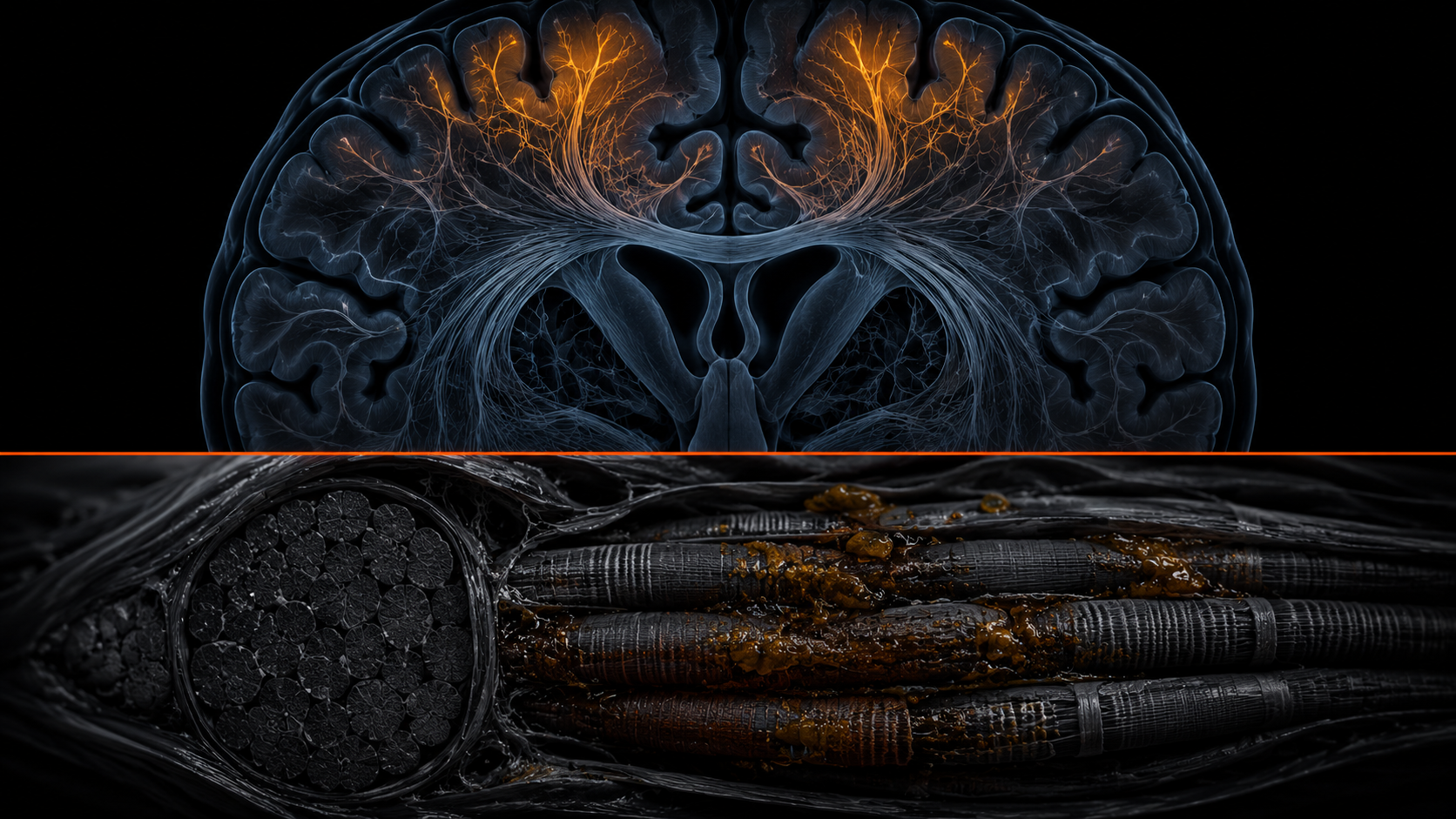
The strategy of blocking adenosine is plausible only if fatigue is a single, neurologically driven phenomenon. It is not.
Central fatigue refers to the decline in performance that originates in the central nervous system. It involves the brain's reduced capacity to generate and sustain motor output, and it is associated with factors including adenosine accumulation, depletion of monoamine neurotransmitters, and reduced voluntary activation of motor neurons. Caffeine can partially address this category of fatigue, because adenosine blockade is one of its primary drivers. (Gandevia 2001)
Peripheral fatigue refers to the loss of contractile force at the level of the muscle itself, caused by substrate depletion, accumulation of metabolic byproducts such as hydrogen ions and inorganic phosphate, and failure of the excitation-contraction coupling mechanism. Caffeine has no meaningful effect on peripheral fatigue.
THE THREE TYPES OF FATIGUE
CENTRAL FATIGUE
Originates in the CNS. Involves reduced neural drive to the muscles, adenosine accumulation, and monoamine depletion. Caffeine partially addresses this type by blocking the adenosine signal.
PERIPHERAL FATIGUE
Originates in the muscle. Caused by substrate depletion, hydrogen ion accumulation, and excitation-contraction failure. Caffeine has no effect here.
METABOLIC FATIGUE
Cellular energy substrate depletion: glycogen, phosphocreatine, NAD+, and mitochondrial output capacity. Entirely outside caffeine's mechanism of action.
Metabolic fatigue, understood as the actual depletion of cellular energy substrates including glycogen, phosphocreatine, and the cofactors required for mitochondrial function, sits entirely outside caffeine's mechanism of action. A person who is metabolically depleted does not lack adenosine receptor blockade. They lack the substrates and mitochondrial capacity required to produce ATP at the rate their activity demands. A high-performer who is simultaneously sleep-deprived, metabolically under-recovered, and in a demanding training phase exists in all three of these states at once. Caffeine addresses the first, partially and temporarily. It does nothing for the other two.
A person who is metabolically depleted does not lack adenosine receptor blockade.
Where Energy Actually Comes From
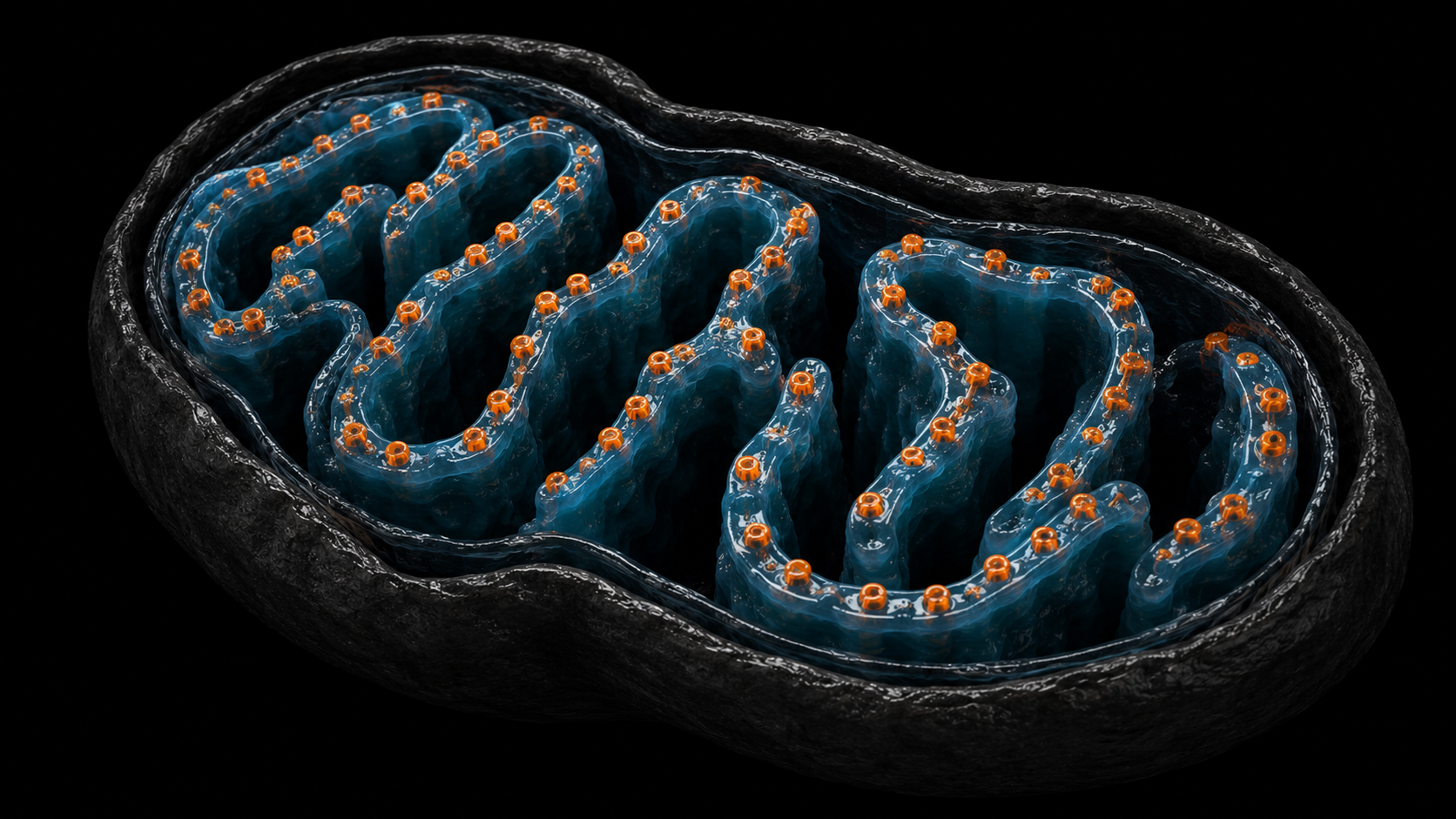
ATP (adenosine triphosphate) is the molecule that powers cellular work. Every muscle contraction, every neural firing, every biochemical reaction in the body runs on ATP. When cells need more energy, they produce more ATP. When they cannot, performance degrades at the level of the work itself, regardless of how awake a person feels.
The primary site of ATP production is the mitochondria, organelles present in every cell that convert oxygen and fuel substrates, primarily glucose and fatty acids, into ATP through oxidative phosphorylation. The electron transport chain, a series of protein complexes embedded in the inner mitochondrial membrane, drives this process by passing electrons from fuel substrates to oxygen and generating the proton gradient that powers ATP synthesis.
The rate at which mitochondria can produce ATP is determined by substrate availability, oxygen delivery and utilization capacity, mitochondrial density within the cell, and the availability of cofactors such as NAD+ that enable the electron transport chain to function. When any of these variables becomes limiting, ATP production falls below demand, and cellular fatigue occurs in a form that no adenosine receptor antagonist can address.
WHAT DETERMINES MITOCHONDRIAL OUTPUT
SUBSTRATE AVAILABILITY
The fuel supply: glucose and fatty acids that mitochondria convert into ATP via the electron transport chain.
OXYGEN UTILIZATION CAPACITY
The rate at which oxygen can be delivered and used in oxidative phosphorylation. Determined by cardiovascular function and cellular oxygen uptake.
MITOCHONDRIAL DENSITY
The number of mitochondria per unit of muscle tissue. Increases with sustained aerobic training. Declines with inactivity.
COFACTOR AVAILABILITY
NAD+ and related molecules that enable the electron transport chain to accept electrons and complete ATP synthesis.
This is the mechanistic gap between stimulants and actual energy production. Caffeine increases arousal by blocking adenosine signaling. It does not increase substrate availability, mitochondrial density, oxygen utilization capacity, or NAD+ availability. A person with caffeine in their system and a depleted mitochondrial substrate pool is operating with heightened arousal and reduced capacity to produce the ATP that arousal requires.
Caffeine does not increase substrate availability, mitochondrial density, oxygen utilization capacity, or NAD+ availability.
The Caffeine Crash, Explained
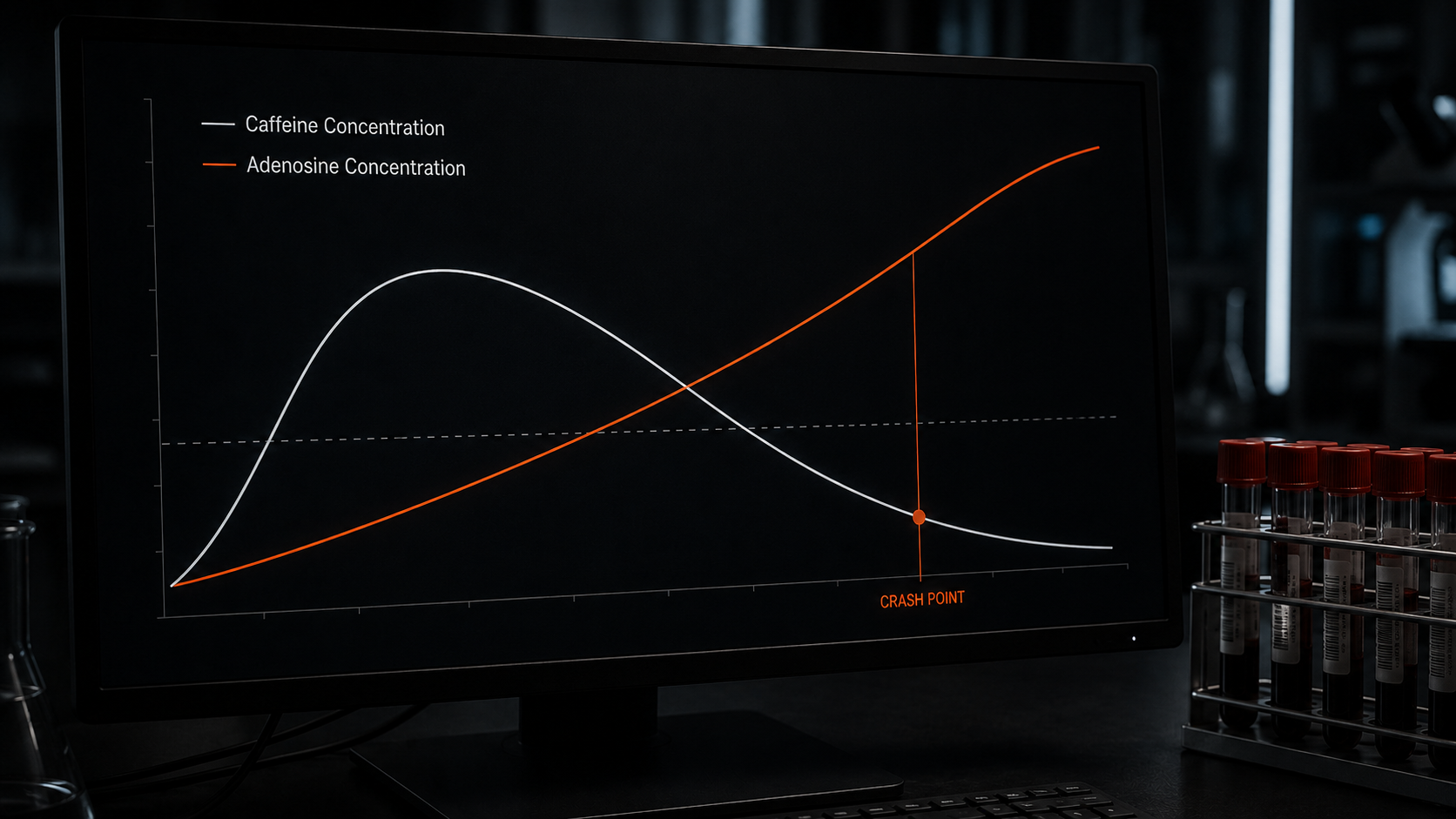
The caffeine crash is the direct consequence of deferred adenosine recognition. Caffeine has a half-life of approximately five hours in most adults, though this varies substantially based on genetics, liver enzyme activity, and factors such as smoking status. (Nehlig 2018)
~5 HRS
CAFFEINE HALF-LIFE IN MOST ADULTS
Range: 2–10 hours depending on genetics and liver enzyme activity. Source: Nehlig 2018.
As caffeine is metabolized and its plasma concentration falls, adenosine receptors become progressively available again. The adenosine that has been accumulating throughout the period of caffeine blockade, unimpeded and uncleared, then binds to those receptors in greater quantity than was present before the dose was taken. The result is a rapid shift from blocked adenosine signaling to heavily active adenosine signaling, and the brain registers a fatigue state that corresponds to the full duration of wakefulness since the last sleep period. For someone who took caffeine in the morning after insufficient sleep and maintained activity through the afternoon, the crash does not represent a return to baseline. It represents a drop below baseline, because the accumulated adenosine load exceeds what would have been present had no caffeine been taken.
This is why the caffeine crash is worst in people with the heaviest sleep debt, the latest dosing times, and the longest periods of activity. The crash is the system's accurate state, briefly delayed by receptor blockade but not diminished by it.
The crash is the system's accurate state, briefly delayed by receptor blockade but not diminished by it.
Caffeine doesn't clear adenosine — it delays when you feel it
While caffeine blocks the receptor, adenosine keeps accumulating behind the block. When caffeine clears roughly five hours later, that backlog registers all at once.
Caffeine blocking the signal — adenosine accumulating unseenHow Stimulants Become Self-Perpetuating
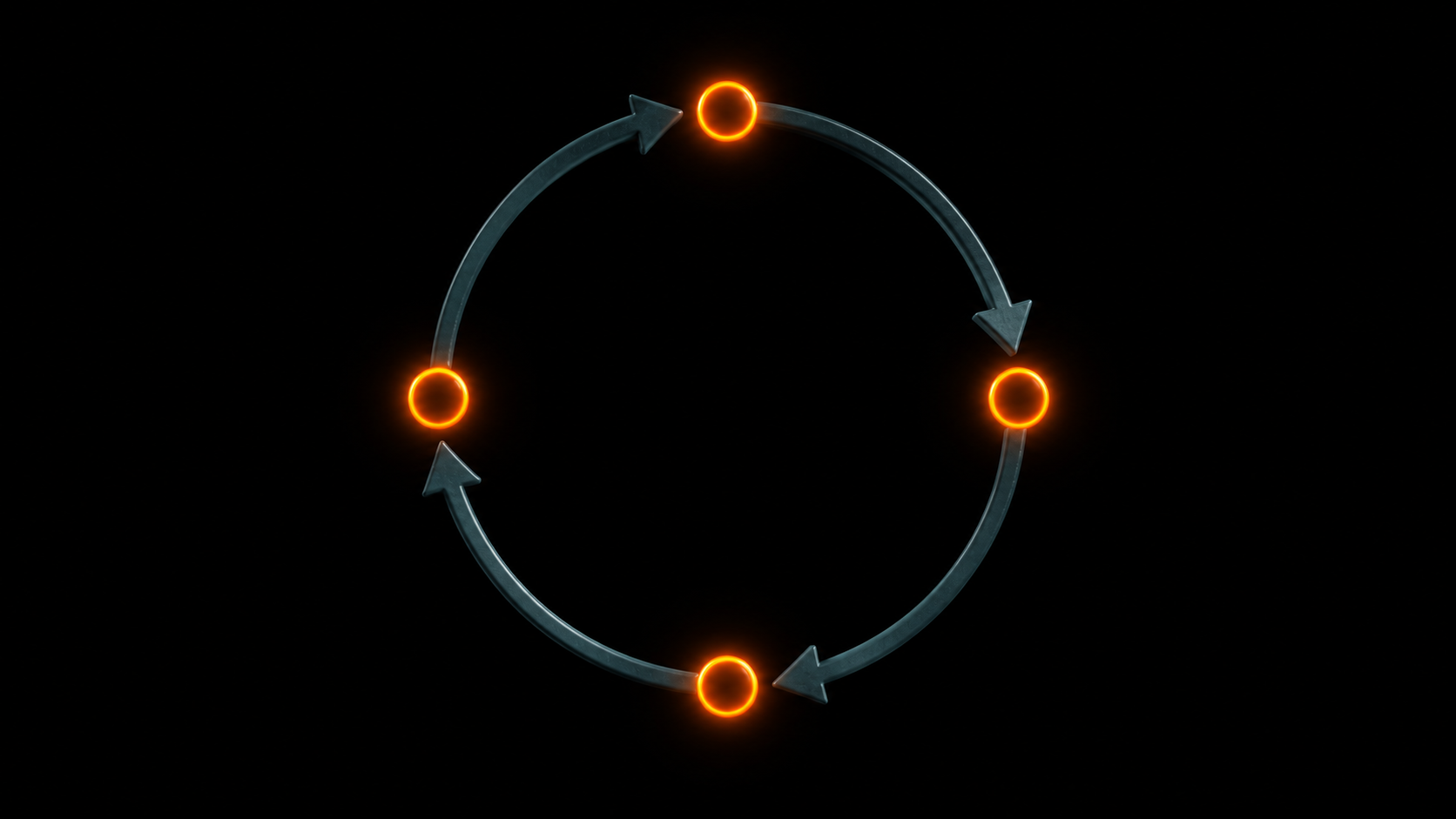
Caffeine withdrawal symptoms, including fatigue, headaches, and difficulty concentrating when regular caffeine use is interrupted, are often interpreted as evidence that caffeine provides a real benefit that disappears when it is removed. The mechanism tells a different story.
6.1
Caffeine blocks adenosine receptors
Adenosine cannot bind. The brain registers arousal. The fatigue signal is muted.
6.2
Brain upregulates adenosine receptor density
The brain compensates for sustained blockade by producing more receptor sites.
6.3
Higher dose required for the same effect
More caffeine is now needed to block the greater number of receptors. Tolerance is established.
6.4
Baseline fatigue worsens
With caffeine absent, the upregulated receptor system produces a stronger adenosine signal than it did before caffeine use began.
With chronic caffeine use, the brain upregulates adenosine receptor expression in response to sustained blockade, a finding supported by preclinical research. When caffeine is absent, even temporarily, the higher receptor density means that a normal adenosine load produces a stronger fatigue signal than it would in a caffeine-naive person. The withdrawal symptoms are not the absence of caffeine causing harm. They are the upregulated system registering ordinary adenosine levels with elevated intensity.
Fatigue worsens over time with continued caffeine use because receptor density continues to increase. More caffeine is required to achieve the same degree of blockade. The baseline fatigue state, the state that exists before the morning dose, becomes progressively worse. The caffeine is managing a problem it is partly responsible for creating, and escalating the dose extends the cycle without resolving it.
Fatigue worsens over time with continued caffeine use because receptor density continues to increase.
The Systemic Cost Most People Miss
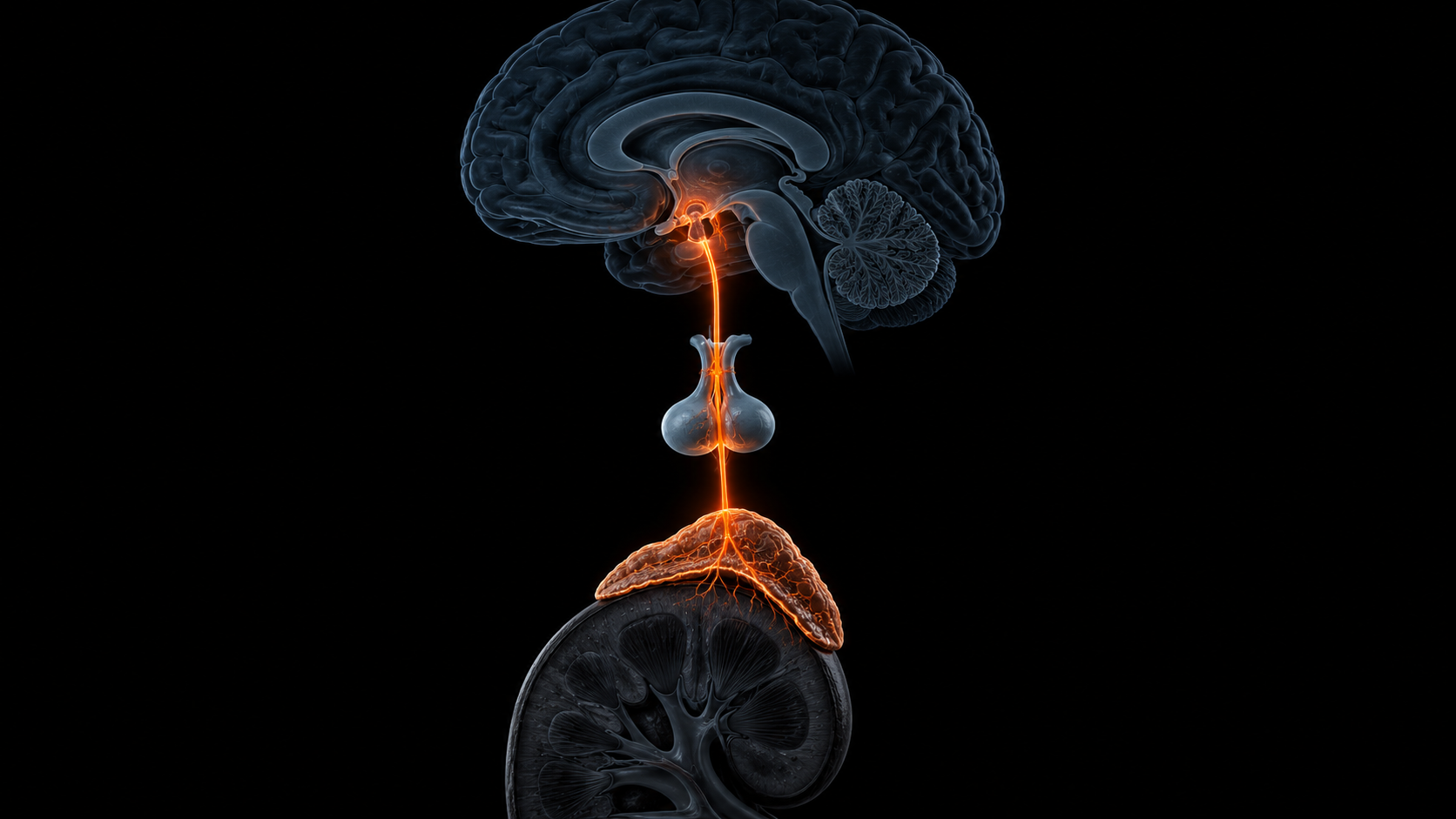
Adenosine receptor antagonism is caffeine's primary mechanism, but it is not the only way caffeine affects the body's energy systems. Caffeine also activates the hypothalamic-pituitary-adrenal axis, producing a stress hormone response that includes elevated cortisol. In a controlled human study, caffeine doses of 300 and 600 mg per day significantly elevated salivary cortisol across waking hours, and this response did not fully habituate with regular use. (Lovallo et al. 2006)
MORNING CAFFEINE
Added to a Cortisol Peak
Cortisol already peaks in the morning as part of the natural awakening response. Caffeine taken at this time adds HPA stimulation to an already elevated cortisol baseline.
AFTERNOON CAFFEINE
Cortisol Extended Into Evening
Afternoon caffeine sustains cortisol elevation beyond its natural decline window, disrupting sleep architecture and delaying the adenosine clearance that sleep would otherwise accomplish.
Cortisol follows a natural diurnal pattern with a morning peak, the cortisol awakening response, followed by a gradual decline through the day. Caffeine taken in the morning adds to an already elevated cortisol state. Caffeine taken in the afternoon, which many people use to address the post-lunch energy decline, sustains cortisol elevation into the evening.
Elevated evening cortisol disrupts sleep architecture and delays sleep onset. Caffeine also partially maintains adenosine receptor blockade during the early part of the sleep period as plasma concentration declines, which delays the adenosine clearance that sleep would otherwise accomplish. The combined effect is reduced sleep quality and restorative depth, meaning the following morning begins with more accumulated sleep pressure than adequate sleep would have cleared. The cost of afternoon caffeine is not paid in the afternoon; it is paid over the subsequent night and the following day.
The cost of afternoon caffeine is not paid in the afternoon; it is paid over the subsequent night and the following day.
Afternoon caffeine doesn't just add alertness — it delays sleep onset
Cortisol naturally peaks in the morning and declines through the day. An afternoon dose extends that elevation into the evening, pushing back the sleep onset that clears the day's adenosine load.
Morning dose only — cortisol declines normally through the dayCommon Patterns That Deepen the Problem

Three patterns consistently compound the mechanisms described above, and each is common among people who train seriously while managing demanding careers.
THREE PATTERNS THAT DEEPEN THE PROBLEM
COMPENSATING FOR SHORTENED SLEEP
Caffeine masks the adenosine load from incomplete sleep without enabling glymphatic clearance, growth hormone release, or synaptic pruning. Sleep debt carries forward, compounding each night.
STACKING DOSES ACROSS THE DAY
Each additional dose extends the period of adenosine accumulation behind the blockade. The crash that follows is proportional to the total accumulated load, not just the final dose.
TRAINING WITHOUT SUFFICIENT RECOVERY
Caffeine reduces subjective tiredness without restoring physiological readiness. Objective performance under sleep deprivation remains significantly impaired regardless of perceived alertness.
Using caffeine to compensate for shortened sleep is the most prevalent. The logic is understandable: sleep was insufficient, a demanding day follows, caffeine restores functional alertness. What caffeine does in this scenario is mask the adenosine that accumulated during the truncated sleep period without enabling the restorative processes that sleep would have completed, including glymphatic clearance of metabolic waste and growth hormone release. The sleep debt carries forward, slightly larger each night. Research on chronic sleep restriction demonstrates that cognitive deficits accumulate progressively even at modest levels of sleep reduction, and that people in sleep-restricted states are often poor judges of their own degree of impairment. (Van Dongen et al. 2003) Caffeine reduces the subjective experience of impairment more than it restores objective performance.
Stacking caffeine doses across the day extends the period during which adenosine accumulates behind the blockade. Each subsequent dose delays recognition of the total accumulated load. The crash, when it arrives, reflects a longer uninterrupted period of adenosine accumulation than a single morning dose would produce, and the subsequent fatigue signal is proportionally larger.
Using caffeine before training as a substitute for sufficient sleep and physical recovery creates a different kind of cost. Caffeine increases arousal and motor drive, and its ergogenic effects under conditions of adequate sleep are real and well-documented. Under conditions of sleep deprivation, however, caffeine's performance benefits narrow substantially. Sleep deprivation impairs cognitive and motor performance at a severity that is frequently underestimated, with decrements that in some tasks approach the equivalent of significant blood alcohol concentration. (Williamson and Feyer 2000) Training under the impression of physiological readiness because caffeine has attenuated subjective tiredness is different from training under conditions of actual physiological readiness. The distinction matters for training quality and for recovery after the session. Cumulative training stress without adequate recovery is the mechanism behind overtraining syndrome.
Caffeine reduces the subjective experience of impairment more than it restores objective performance.
What This Information Changes
The mechanism does not support the conclusion that caffeine is harmful or that anyone should stop using it. It supports a more accurate model of what caffeine does and what it cannot do, which allows for a more deliberate decision about how to use it.
Caffeine is an effective tool for acute, time-limited arousal. In specific windows, a competition, a high-stakes presentation, a training session where subjective readiness matters, it does what it is designed to do: temporarily block adenosine signaling and allow the nervous system to operate without the dampening effect of accumulated sleep pressure. This is a legitimate and well-supported application.
CAFFEINE'S ROLE
Acute Signal Blockade
Effective for time-limited arousal in specific performance windows. Temporarily blocks adenosine signaling to allow the nervous system to operate without the suppressive effect of accumulated sleep pressure.
WHAT CAFFEINE CANNOT REACH
The Energy-Production System
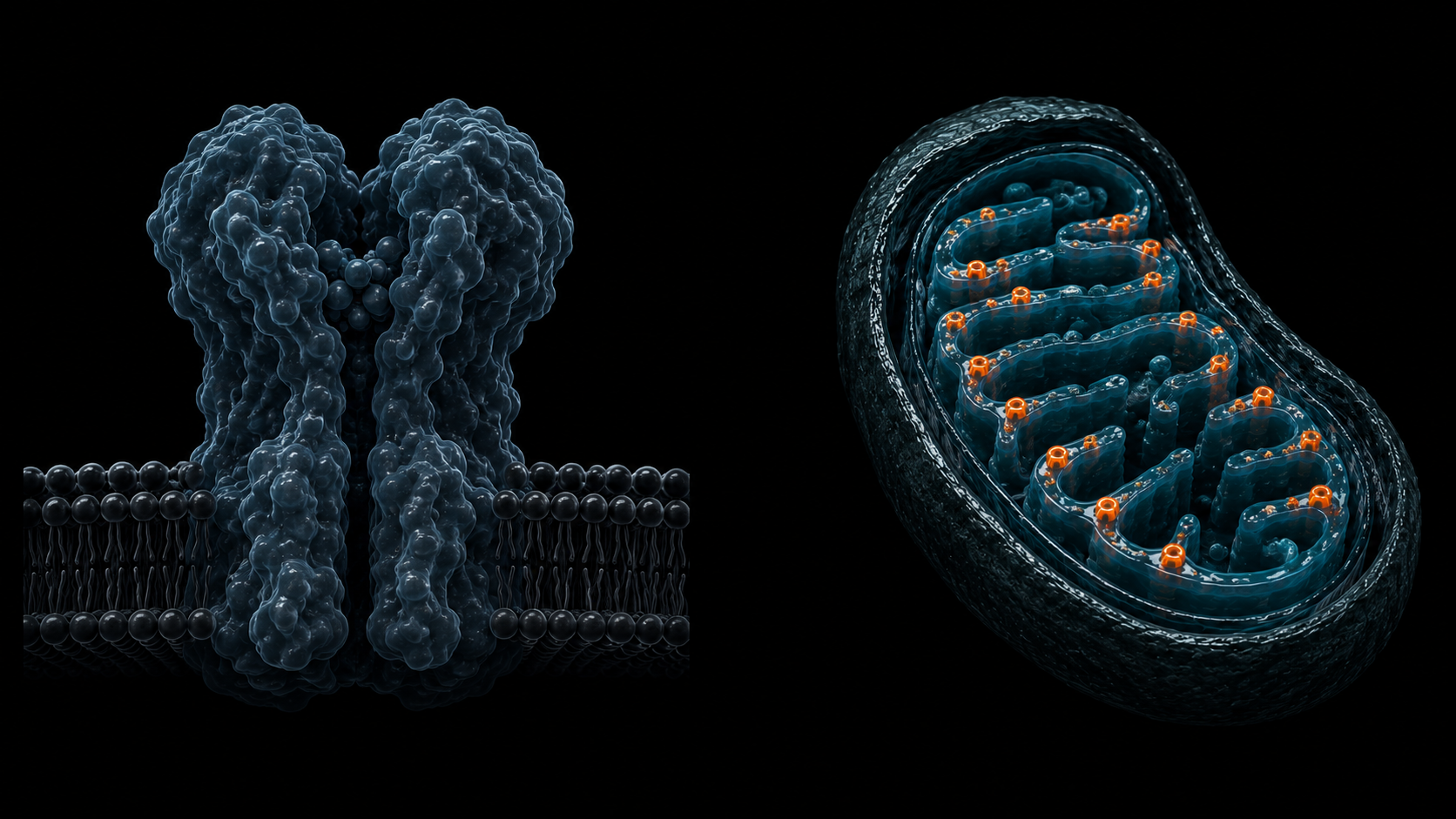
Caffeine does not produce ATP, support mitochondrial function, improve oxygen utilization, or restore NAD+ availability. These systems respond to sleep, training adaptation, and substrate availability, not to adenosine receptor blockade.
What caffeine is not is an energy system. It does not produce ATP. It does not support mitochondrial function, oxygen utilization capacity, or the substrate availability that determines how much actual cellular work can be performed. When fatigue is metabolic rather than adenosine-driven, caffeine produces the subjective experience of alertness in a system that lacks the cellular resources to deliver on it. The mismatch between perceived readiness and actual physiological capacity is not something caffeine resolves.
The systems that determine genuine, sustainable energy output respond to different inputs entirely. Sleep pressure is resolved by sleeping, not by blocking its perception. Mitochondrial capacity develops through training adaptation, recovery completeness, and substrate availability. NAD+ and other cofactors involved in ATP synthesis are maintained through cellular health, not through adenosine receptor blockade. These systems are not alternatives to stimulants in the sense of performing the same function. They are the actual energy-production infrastructure that stimulants have no mechanism to reach.
The mismatch between perceived readiness and actual physiological capacity is not something caffeine resolves.
Frequently Asked Questions
Why do I crash after caffeine?
The caffeine crash occurs because caffeine blocks adenosine receptors rather than clearing adenosine from the brain. While caffeine is active, adenosine continues to accumulate. When caffeine clears, roughly five hours after intake, accumulated adenosine floods unblocked receptors simultaneously, producing a fatigue state that can fall below the pre-caffeine baseline.
Why am I still tired after caffeine?
Caffeine only addresses fatigue that originates from adenosine accumulation in the brain. If tiredness comes from metabolic depletion, poor sleep quality, or insufficient physical recovery, caffeine has no mechanism to address those states. It produces subjective alertness while the underlying physiological deficit remains unresolved.
How does caffeine affect cortisol?
Caffeine stimulates cortisol secretion through the hypothalamic-pituitary-adrenal axis, and this response does not fully habituate with regular use. Caffeine taken in the afternoon sustains cortisol elevation into the evening, disrupting sleep architecture and delaying the adenosine clearance that would otherwise occur during sleep, which compounds fatigue the following day.
Why does caffeine stop working over time?
With chronic use, the brain increases adenosine receptor density as a compensatory adaptation to sustained blockade. More receptors mean a higher caffeine dose is required for the same effect. Baseline fatigue also worsens over time because the upregulated system produces a stronger adenosine signal than it did before caffeine use began.
Can caffeine make up for lost sleep?
Caffeine masks the fatigue signal that sleep deprivation produces by blocking adenosine receptors, but does not restore what sleep accomplishes: glymphatic waste clearance, synaptic pruning, and memory consolidation. Research shows that sleep-deprived people using caffeine overestimate their functional capacity while objective performance remains significantly impaired. For a full breakdown of what sleep does for athletic performance, see how much sleep athletes need.
The Bottom Line
Caffeine intercepts the signal that fatigue sends. It does not change the conditions that produced the signal.
This is worth understanding clearly because the signal is useful information. The fatigue that adenosine accumulation represents is the brain accurately tracking the metabolic cost of wakefulness and the restorative work still owed. The fatigue that metabolic depletion represents is the body accurately tracking that ATP production is failing to meet demand. Both signals are real, and blocking one of them does not address the other.
What the caffeine crash reveals is not that caffeine has worn off. It reveals the state the system was actually in during the hours the block was in place.
What the caffeine crash reveals is not that caffeine has worn off. It reveals the state the system was actually in during the hours the block was in place. That information is more useful than it might initially appear, because it describes the gap between the state caffeine created and the state the underlying biology was in. A person who understands that gap is in a better position to decide how to close it, which is a question the caffeine itself is not equipped to answer. The fitness-fatigue model offers a practical framework for thinking about how training load and recovery interact to determine readiness over time.
Caffeine intercepts the fatigue signal. Sleep and mitochondrial health are what produce the energy behind it.
Every time caffeine defers the signal without resolving the source, the gap between how functional a person feels and how functional they are gets slightly wider. Understanding the mechanism is the prerequisite for closing it.
Mydos Performance
— Sustained vs Borrowed Energy Series —
The Caffeine Crash: Why Stimulants Don't Fix Fatigue
Blocking the signal is not the same as building the system.
· By Ricardo Londono, MD/PhD ·