
The Problem With How Athletes Think About Fading Late in a Session

Muscle fatigue during workout is not a steady, linear decline. Athletes who train seriously tend to notice a specific pattern: early efforts feel controlled; late efforts at the same intensity feel categorically different. Form degrades. Decision speed drops. Power that was accessible in round one requires more input to generate in round five, and the margin for technical precision narrows precisely when precision matters most.
The usual explanation is conditioning: if fitness were higher, the late rounds would hold. This is not exactly wrong, but it is incomplete in a way that has practical consequences. Conditioning is a real variable, but it operates through specific mechanisms, and understanding those mechanisms changes how a training program addresses late-session decline. Attributing it vaguely to fitness level, or to mental toughness, removes the mechanism from view and with it the leverage points for improving performance.
Why do muscles fatigue so quickly during a workout, and why does that fatigue compound with each successive effort rather than accumulate as one linear variable? The answer involves two distinct biological systems. One is peripheral: the muscle itself, where metabolic products accumulate and key energy substrates deplete. The other is central: the nervous system, where the brain's command signal to the working muscle progressively diminishes. Both systems degrade under sustained load. Neither fully resets between rounds. Together, they ensure that each subsequent effort begins from a physiologically different state than the one before it.
Together, they ensure that each subsequent effort begins from a physiologically different state than the one before it.
What Causes Muscle Fatigue During Workout: Why One Explanation Isn't Enough
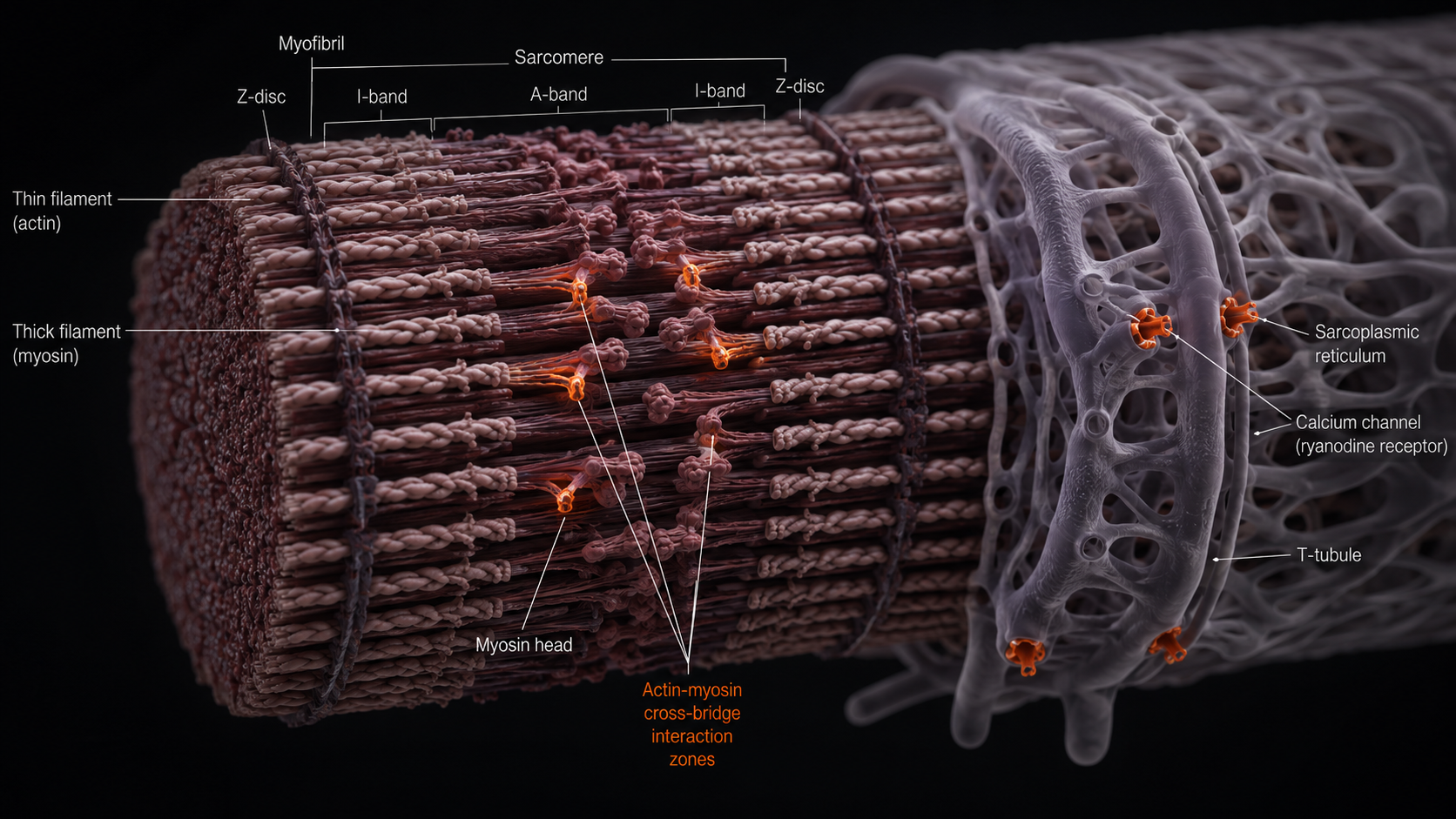
Muscle fatigue during workout emerges from at least two distinct processes running simultaneously, and the distinction matters because each responds differently to training, nutrition, and rest. The first is peripheral: what changes inside the muscle fiber itself over the course of sustained effort. The second is central: what changes in the nervous system's command signal to those fibers.
In common use, "muscle fatigue" usually refers to the peripheral side: the burning sensation, the reduced force, the cellular depletion. This is a reasonable starting point, but it accounts for only part of the performance loss that accumulates within a session. Peripheral depletion explains why a muscle produces less force than it did five minutes ago. It does not fully explain why the brain simultaneously reduces how hard it commands the muscle to contract. Both phenomena occur at once, and both contribute to why later rounds weigh more than earlier ones.
Most explanations of what causes muscle fatigue during exercise focus on a single mechanism, most commonly lactic acid, and treat it as the complete story. The actual picture involves at least four overlapping processes: phosphocreatine depletion, metabolic byproduct accumulation, calcium cycling impairment, and progressive central drive reduction. These processes interact, but they are not the same mechanism, and they do not resolve on the same timeline. The sections below address each in sequence.
2.1
Phosphocreatine Depletion
The muscle's fastest ATP buffer exhausts within 10–15 seconds of near-maximal effort, releasing inorganic phosphate as a direct byproduct with immediate effects on contractile function.
2.2
Inorganic Phosphate Accumulation
Pi impairs the actin-myosin cross-bridge cycle, reducing the force produced per contraction cycle at the molecular level.
2.3
Sarcoplasmic Reticulum Calcium Impairment
Elevated Pi disrupts SR calcium release, degrading the trigger signal from nerve to muscle fiber even when the motor nerve fires normally.
2.4
Central Drive Reduction
The CNS progressively reduces the motor command signal in response to afferent feedback from the working muscle, independent of peripheral contractile capacity remaining.
How Does Lactic Acid Cause Muscle Fatigue: Why That Question Has the Wrong Target
The historical explanation attributed fatigue to lactic acid accumulating in the muscle and producing the burning sensation associated with high-intensity effort. The evidence does not cleanly support this as the primary mechanism. (Westerblad 2002). The more precise story begins earlier in the metabolic chain.
Phosphocreatine is the muscle's fastest energy buffer, the system it recruits when ATP demand outpaces what oxidative metabolism can supply in real time. During a sprint, a maximal punch sequence, or a heavy strength set, phosphocreatine begins depleting within the first few seconds and is substantially exhausted within 10 to 15 seconds of near-maximal effort. (Casey & Greenhaff 2000). It is fast and effective, but it is finite, and its byproduct matters as much as its depletion.
When phosphocreatine is split to resynthesize ATP, inorganic phosphate (Pi) is released as a direct product. As Pi accumulates in the muscle fiber, it impairs force production through two distinct pathways. First, elevated Pi interferes with the actin-myosin cross-bridge cycle, the molecular interaction between contractile proteins that generates mechanical force. (Allen et al. 2008). The cross-bridge still forms, but it produces less force per cycle under elevated Pi conditions. Second, Pi interacts with the sarcoplasmic reticulum, the intracellular organelle responsible for releasing the calcium ions that trigger each contraction. Under high Pi concentrations, SR calcium release is impaired: the signal from nerve to muscle fiber loses fidelity even when the nerve itself is firing normally. (Allen et al. 2008).
Under high Pi concentrations, SR calcium release is impaired: the signal from nerve to muscle fiber loses fidelity even when the nerve itself is firing normally.
Hydrogen ion accumulation from anaerobic ATP hydrolysis does contribute to fatigue, but its role is more conditional than the lactic acid narrative suggests. Acidosis affects enzyme function and calcium sensitivity, but at physiological temperatures the direct effect of H+ on cross-bridge force production is considerably smaller than the Pi effect. (Allen et al. 2008). The lactic acid explanation persisted partly because lactate, the conjugate base that accumulates alongside H+ in the muscle, is measurable and correlates with high-intensity effort. Correlation produced a causal story that the evidence has since substantially revised.
The practical consequence is this: the metabolic products that accumulate during high-intensity effort, principally inorganic phosphate and secondarily H+, directly impair both the mechanical output and the calcium signaling apparatus of the muscle fiber. This impairment is present before any subjective sense of extreme fatigue becomes pronounced, and it does not disappear the moment effort stops.
Central Fatigue: Why the Nervous System Reduces Drive When Muscles Still Have Capacity
A second fatigue mechanism operates during high-intensity exercise that is independent of what is happening inside the muscle itself: the central nervous system progressively reduces the drive it sends to working motor neurons. This is central fatigue, and it is distinct from peripheral failure in an important way. Under peripheral fatigue, the muscle is limited by what it can produce per neural command. Under central fatigue, the number and intensity of those commands is itself reduced, and the muscle does not receive the full recruitment signal it did at the session's start.
A second fatigue mechanism operates during high-intensity exercise that is independent of what is happening inside the muscle itself: the central nervous system progressively reduces the drive it sends to working motor neurons.
The distinction can be measured directly. The interpolated twitch technique applies a brief external electrical stimulus to the muscle during a maximal voluntary contraction and measures whether additional force is produced in response. If the muscle generates extra force from the external stimulus, it possesses contractile capacity that the nervous system is not currently accessing. This technique has demonstrated that voluntary activation of working muscles declines measurably during sustained high-intensity effort, even when peripheral contractile capacity remains partially available. (Gandevia 2001).
The interpolated twitch technique measures the gap between drive and capacity
During a maximal voluntary contraction, a brief electrical stimulus is applied to the muscle. If it produces extra force, the nervous system wasn't accessing all the contractile capacity available. Repeated testing shows voluntary activation declining during sustained high-intensity effort — even while peripheral capacity remains partially available (Gandevia 2001).
Sustained maximal voluntary contraction beginsWhat drives the central reduction is, in large part, feedback from the muscle itself. Group III and IV sensory nerve endings within the working muscle respond to the accumulating metabolic environment: rising Pi concentrations, falling pH, potassium efflux, and other chemical markers of intense effort. These afferents transmit signals upstream to the brain and spinal cord that progressively modulate motor output downward. (Amann et al. 2010). This is a regulated response, not a failure of will. The nervous system receives accurate information from the periphery and adjusts its output signal accordingly.
The motor unit dimension adds another layer to this process. As effort continues and fatigue accumulates, the slow-twitch Type I motor units, which are the most oxidatively efficient and the most resistant to fatigue, begin losing their ability to sustain their contribution. The nervous system responds by recruiting Type IIa and eventually Type IIx fast-twitch motor units to maintain force output. (Enoka & Duchateau 2008). These units generate substantial force but depend more heavily on anaerobic metabolism, fatigue faster, and produce more of the Pi and H+ that accelerates peripheral impairment. By late rounds, the same apparent output is being produced by a metabolically more expensive pool of motor units than in round one.
By late rounds, the same apparent output is being produced by a fundamentally different and metabolically more expensive pool of motor units than in round one.
Why Rest Between Sets Doesn't Return You to Full Capacity
Rest between sets slows and partially reverses the accumulation described above, but within the time windows typical of most training or competition, neither peripheral depletion nor central fatigue fully clears. Each subsequent effort begins from a slightly more compromised state than the one before it, which is what gives the fatigue floor its upward slope across a session.
Phosphocreatine replenishment begins the moment effort stops, following a predictable recovery curve. Roughly half of depleted PCr is resynthesized within approximately 30 seconds of rest. About 85 to 90 percent recovers within 3 minutes. Full resynthesis, with Pi clearance approaching resting baseline, requires 6 to 8 or more minutes. (Casey & Greenhaff 2000). In most training contexts, the rest between sets or between competitive rounds falls between 60 and 180 seconds. At these intervals, the athlete begins each successive effort with meaningful phosphocreatine capacity still depleted from the previous one. Over multiple rounds, this compound deficit grows.
Inorganic phosphate clears more slowly than phosphocreatine resynthesizes, because its removal depends on rephosphorylation through oxidative metabolism rather than the rapid enzymatic resynthesis pathway that rebuilds PCr. This means that even as PCr partially recovers during a rest period, elevated Pi concentration persists within the muscle fiber. The cross-bridge impairment and the SR calcium release deficit enter the next round at a higher baseline than they held before the first one began.
Each subsequent effort begins from a slightly more compromised state than the one before it, which is what gives the fatigue floor its upward slope across a session.
Central fatigue recovery follows the same partial pattern. The afferent signals that drove the CNS to reduce motor output during effort do not dissipate immediately when effort ends. Motor command for the next round begins at a lower setpoint than it did for the first one, and the muscle is receiving that reduced command while also starting from a mechanically impaired baseline.
The practical model is a floor that rises with each effort. Round one begins at resting state; round two begins at a measurable metabolic elevation; each subsequent round adds to that baseline. This is not metaphor. It describes the actual chemical and neural state of the muscle at the start of each effort, and the gap between the athlete's early-session capacity and their late-session capacity is the direct expression of how high that floor has risen. (Gandevia 2001).
Round one begins at resting state; round two begins at a measurable metabolic elevation; each subsequent round adds to that baseline.
This is not metaphor. It describes the actual chemical and neural state of the muscle at the start of each effort, and the gap between the athlete's early-session capacity and their late-session capacity is the direct expression of how high that floor has risen.

What Extreme Fatigue During Workout Is Actually Showing You

When extreme fatigue during workout becomes visible, what is observable is not a general loss of capacity. It is the downstream signature of the specific mechanisms already described, manifesting in measurable ways across the athlete's output. The form breakdown in a fatigued fighter, the shortened range of motion in a fatigued lifter, the slowed reaction time in a fatigued endurance athlete: each reflects a distinct physiological event rather than a generic energy deficit.
Technical breakdown is the most visible consequence of central fatigue progressing in combination with peripheral impairment. As motor unit recruitment shifts toward fast-twitch units and the quality of motor drive from the CNS begins to decline, the nervous system's capacity to execute precise, coordinated movement patterns is compromised. A punch that requires the activation of a specific sequence of shoulder, hip, and core motor units at precise timing intervals becomes harder to replicate accurately when the recruitment pattern is shifting and the timing signals are being generated by a command system that is itself operating below full capacity. The movement remains; its precision does not. (Enoka & Duchateau 2008).
Cognitive performance is also affected through a related pathway. Physical and cognitive demands draw on shared neural resources: as the motor system accumulates fatigue, the neural substrate governing attentional focus and decision speed degrades in parallel. Research on the interaction between cognitive demand and physical performance confirms that these systems compete for common resources (Marcora et al. 2009). This is why a fatigued athlete makes strategic errors in late rounds that they would not make early in the session: the machinery for rapid decision-making shares neural resources with the fatigued motor system, and both are degraded simultaneously.
PRODUCTIVE FATIGUE
Output quality holds.
Movement pattern remains representative of the target skill. Peripheral and central fatigue are present; precision is maintained. This is the state in which late-session adaptation develops.
DEGRADED OUTPUT
Form breaks down.
Motor recruitment pattern degrades past the point where output is representative. Additional volume adds recovery cost without equivalent adaptive return.
The distinction that matters in practice is between productive effort in a fatigued state and output that has degraded below the threshold where it drives useful adaptation. Training for durability intentionally involves working in a fatigued state, because that is the physiological context in which late-session adaptation develops. The signal that this boundary has been crossed is form breakdown at a level that no longer produces a representative movement, combined with cognitive errors that would not occur earlier in the session. Additional volume beyond that boundary does not develop the system further; it stresses a system that is already failing to produce accurate output and adds unnecessary recovery cost without equivalent training return.
This is why a fatigued athlete makes strategic errors in late rounds that they would not make early in the session: the machinery for rapid decision-making shares neural resources with the fatigued motor system, and both are degraded simultaneously.
Where Athletes Misread Muscle Fatigue: What It Costs Them

The most consequential errors with fatigue during workout are rarely errors of effort. They are errors of interpretation, each derived from treating late-session physiological decline as something other than a measurable, mechanism-driven event.
MISREAD 1
Mental Weakness
Attributing late-round decline to a failure of will when the actual constraint is elevated Pi, impaired SR calcium cycling, and reduced CNS motor drive — mechanisms that do not respond to effort.
MISREAD 2
Stimulant Masking
Using caffeine or similar compounds to override fatigue signals changes perceived exertion without clearing inorganic phosphate, restoring PCr, or repairing calcium cycling.
MISREAD 3
Rest Period Equivalence
Treating a 60-second rest and a 3-minute rest as interchangeable when they produce approximately 50% vs. 85–90% PCr recovery — a metabolically meaningful difference.
The first is attributing late-round failure to mental weakness. When an athlete cannot maintain early-session output in round five, the instinct is to prescribe more willpower or more volume. Both prescriptions address the wrong variable. The actual constraint is a muscle operating under elevated Pi concentration with degraded SR calcium cycling and a central motor drive signal that has been progressively reduced by accurate afferent feedback from the periphery. Pushing harder through that state does not clear Pi. It adds to the metabolic accumulation that is already limiting output and can extend the recovery timeline before the system is capable of producing quality work in the next session.
The second is using stimulants to override fatigue signals. Caffeine and related compounds can attenuate perceived exertion and provide temporary support to central motor drive, which is why they are extremely useful as performance tools within the appropriate context. What they do not accomplish is clearing inorganic phosphate from the muscle fiber, restoring phosphocreatine levels, or repairing SR calcium cycling. Using them to push through late-round fatigue changes the subjective interpretation of the accumulated state without changing the state itself. Performance may appear to hold while movement quality quietly degrades, which is a different problem from the one the stimulant was meant to solve.
The third is treating all rest periods as equivalent. A 60-second rest and a 3-minute rest are not interchangeable from a metabolic standpoint. The PCr recovery and Pi clearance timelines documented in the previous section make this precise: the gap between those two rest windows is the difference between roughly 50 and 85 to 90 percent PCr recovery, and between substantially different levels of residual Pi in the muscle fiber. Session design that assumes full or near-full recovery from any standardized rest period will systematically underestimate the fatigue state the athlete carries into each subsequent effort.
Using them to push through late-round fatigue changes the subjective interpretation of the accumulated state without changing the state itself.
A 60-second rest and a 3-minute rest are not interchangeable from a metabolic standpoint.
How Long Should You Rest Between Sets: What the Mechanism Actually Says
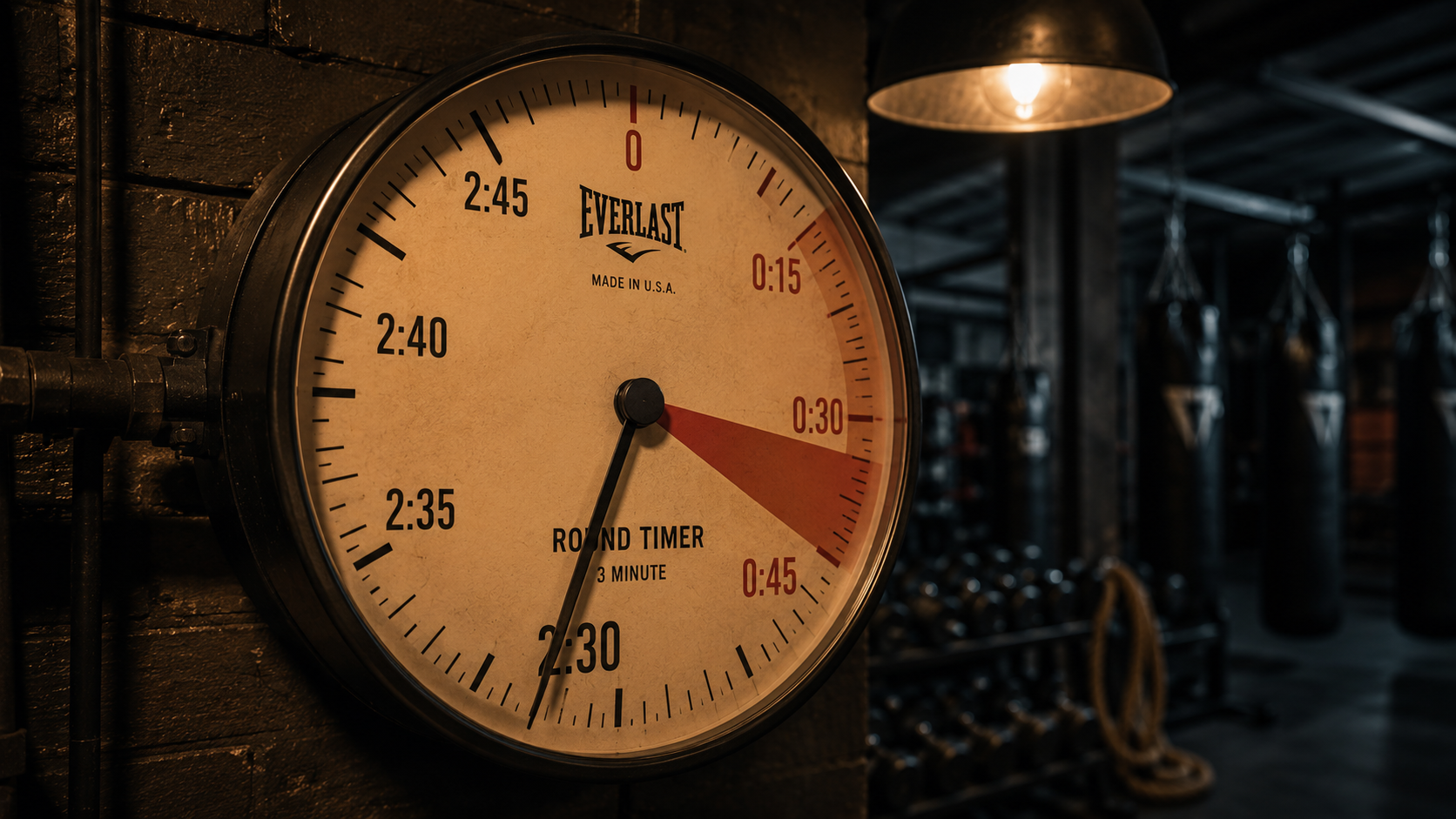
The question of how long you should rest between sets is, at its core, a question about which physiological signal the session is designed to send. The mechanism provides a framework for thinking through this, though the answer varies by training goal and cannot be reduced to a single number.
The phosphocreatine recovery timeline establishes the floor. A 90-second rest window allows approximately 70 to 75 percent PCr recovery. Three minutes restores 85 to 90 percent. Full recovery, with Pi clearance approaching resting baseline, requires 6 to 8 or more minutes. (Casey & Greenhaff 2000). If the training goal is maximal force output per set, as in strength training or power development, longer rest windows minimize the carry-forward PCr deficit and Pi accumulation that would otherwise reduce the quality of output in each subsequent set. Under shorter rest conditions in this context, the athlete produces lower output without a compensating adaptive stimulus.
70–75%
PCR RECOVERY AT 90 SEC
85–90%
PCR RECOVERY AT 3 MIN
6–8 min
FULL RECOVERY + PI CLEARANCE
A 60-second rest and a 3-minute rest are not the same recovery
PCr recovery and Pi clearance both run on the clock, not on the rep count. Sixty seconds of rest gets a muscle back to roughly 50% PCr recovery; three minutes gets it to 85–90%. A standardized short rest between sets systematically underestimates the fatigue an athlete carries into the next effort.
Set ends — PCr recovery and Pi clearance beginIf the training goal involves adaptation to sustained output under accumulating fatigue, the calculation reverses. Deliberate use of shorter, biochemically insufficient rest windows is the mechanism through which metabolic conditioning occurs. The athlete trains by working from an elevated fatigue floor, and specific adaptations develop over time: higher capacity for buffering metabolic byproducts, more efficient oxidative PCr resynthesis between efforts, and motor unit cycling patterns that allow the system to manage accumulation across multiple rounds. The deliberate exposure to the fatigued state is the training signal.
Strength and power development favor longer rest because the goal is maximal output quality per set. Metabolic conditioning favors shorter rest because the goal is adaptation to the compromised state that shorter rest produces. Both are valid training goals; the rest period is the variable that specifies which one is being addressed at a given point in the program. Understanding which mechanism is operating during each rest window makes it possible to program rest periods that match the adaptive target, rather than selecting a number based on what feels comfortable.
Deliberate use of shorter, biochemically insufficient rest windows is the mechanism through which metabolic conditioning occurs.
The rest period is the variable that specifies which one is being addressed at a given point in the program.
Frequently Asked Questions
What is the most common cause of muscle fatigue during exercise?
Inorganic phosphate accumulation is the primary driver, not lactic acid. During high-intensity effort, rapid ATP turnover and phosphocreatine depletion are associated with a sharp rise in inorganic phosphate. That Pi then interferes with force production by impairing cross-bridge function and calcium release, both of which reduce muscular force output directly and without requiring subjective fatigue to manifest first.
Why doesn't rest between sets completely reset muscle fatigue?
Phosphocreatine replenishment is partial within typical rest windows: roughly 85 to 90 percent at 3 minutes, with full recovery requiring 6 to 8 minutes or more. Inorganic phosphate clears more slowly than PCr resynthesizes, meaning each successive set begins with residual metabolite accumulation and partially impaired calcium cycling from the previous effort. The fatigue floor rises with each round.
What two things are lacking when your muscles are fatigued?
Two key resources are reduced during high-intensity fatigue: phosphocreatine, the rapid ATP buffer that depletes within 10 to 15 seconds of near-maximal effort, and available calcium at the muscle fiber level, which is impaired when inorganic phosphate disrupts sarcoplasmic reticulum function. Both reduce force production directly, and neither clears immediately during typical intra-set rest windows.
Does muscle fatigue during a workout mean you had a good session?
Whether muscle fatigue indicates a productive session depends on the quality of output produced under that fatigue. Productive late-session effort, where movement quality remains representative despite accumulated peripheral and central fatigue, drives adaptation. Output that has degraded to form failure does not provide the same adaptive stimulus and adds unnecessary recovery cost without equivalent training return.
The Fatigue Floor Rises: What to Do With That
The physiological reality of muscle fatigue during workout is that later rounds are not simply the same work performed under harder conditions. They are a different event. The metabolic environment in which each subsequent effort is produced has shifted: Pi has accumulated and only partially cleared, phosphocreatine remains partially depleted, SR calcium cycling is impaired at baseline, and central motor drive is operating at a lower setpoint than it held at the session's start. The same external output from a meaningfully different internal state requires more of the system to produce, and the system is capable of less.
Session design involves managing the rate at which the fatigue floor rises and the quality of output that remains accessible at each elevation of that floor. An athlete treating all sets or rounds as equivalent units is not accounting for the fact that the fifth unit is produced from a physiologically more expensive state than the first, and that the return on that fifth unit depends heavily on whether the rest architecture has created the conditions for representative output or for degraded output at high effort.
The fatigue floor rising across a session is not a problem to be solved by applying more effort. It is the structure of the challenge. Training for durability means developing the capacity to produce high-quality output from a progressively elevated floor, which is a specific adaptation that responds to specific training inputs. Strategies that act on the underlying mechanisms, including supplementation that supports oxidative capacity or phosphocreatine availability (such as creatine for PCr availability or cordyceps-based formulations for their proposed effects on mitochondrial ATP supply), are relevant to the degree that they slow the rate at which the floor rises, not to the degree that they disguise the floor's existence. Understanding the mechanism clearly is what determines whether training, rest, and recovery decisions are aligned with what the system actually requires.
The fatigue floor rising across a session is not a problem to be solved by applying more effort. It is the structure of the challenge.
The fatigue accumulating across a session is not one variable — it is a compound state of depleted PCr, elevated Pi, impaired SR calcium cycling, and a central motor drive that has been progressively dialed down. Every successive effort is produced from a more expensive physiological starting point.
The floor does not reset between rounds. Understanding what is building on it — and how fast — changes how training is designed, not just how hard an athlete is willing to push through it.
Mydos Performance
— Fatigue, Recovery and Durability Series —
Muscle Fatigue During Workout: Why Later Rounds Weigh Different
Phosphocreatine Depletes. Inorganic Phosphate Accumulates. CNS Drive Drops. Here Is What That Costs You.
· By Ricardo Londono, MD/PhD ·