
When Your Muscles Aren't the Limiting Factor

Peripheral muscle fatigue is typically where the analysis of a poor performance ends. The legs felt heavy, the output dropped, and the assumption is that something in the contractile machinery gave way. This framing is incomplete in a way that matters practically.
Peripheral muscle fatigue refers specifically to the decline in contractile capacity at or below the neuromuscular junction. It encompasses the cellular disruptions that impair a muscle fiber's ability to generate force: changes in calcium handling, accumulation of metabolic byproducts, and depletion of local energy substrates. It is a real and measurable phenomenon, and it occurs during exercise. What is less accurate is the assumption that it is always the first or primary system to reach its limit during sustained high-intensity work. In many prolonged efforts, peripheral fatigue compounds an already degraded energy environment rather than triggering the decline.
What tends to fail first is the rate at which cells can produce ATP, the energy currency that powers every muscle contraction. When demand outpaces ATP production, performance output drops before the contractile apparatus reaches structural failure. This reduction is actively regulated by the central nervous system, which monitors the cell's metabolic state and adjusts motor output accordingly, not only in response to what the muscle has already lost.
COMMON ASSUMPTION
Muscles give out first
Performance declines when the muscle's contractile capacity is exhausted — the legs burn, the arms fail, and output drops.
THE MECHANISM
Energy production fails first
ATP production rate falls behind demand. The CNS detects this and reduces motor output before the contractile apparatus reaches structural failure.
For an analytically minded athlete, this means a performance decline mid-session or mid-competition is not reliable evidence that the muscles are spent. It may indicate that the energy delivery system has crossed a threshold, and the body is managing that crossing in a way that registers as performance loss before any significant muscle burn or contractile failure appears. The distinction has real implications for how that decline should be interpreted and addressed, beginning with understanding the two categories of fatigue that exercise science has established.
When demand outpaces ATP production, performance output drops before the contractile apparatus reaches structural failure.
The Two-Fatigue Framework: Central vs. Peripheral
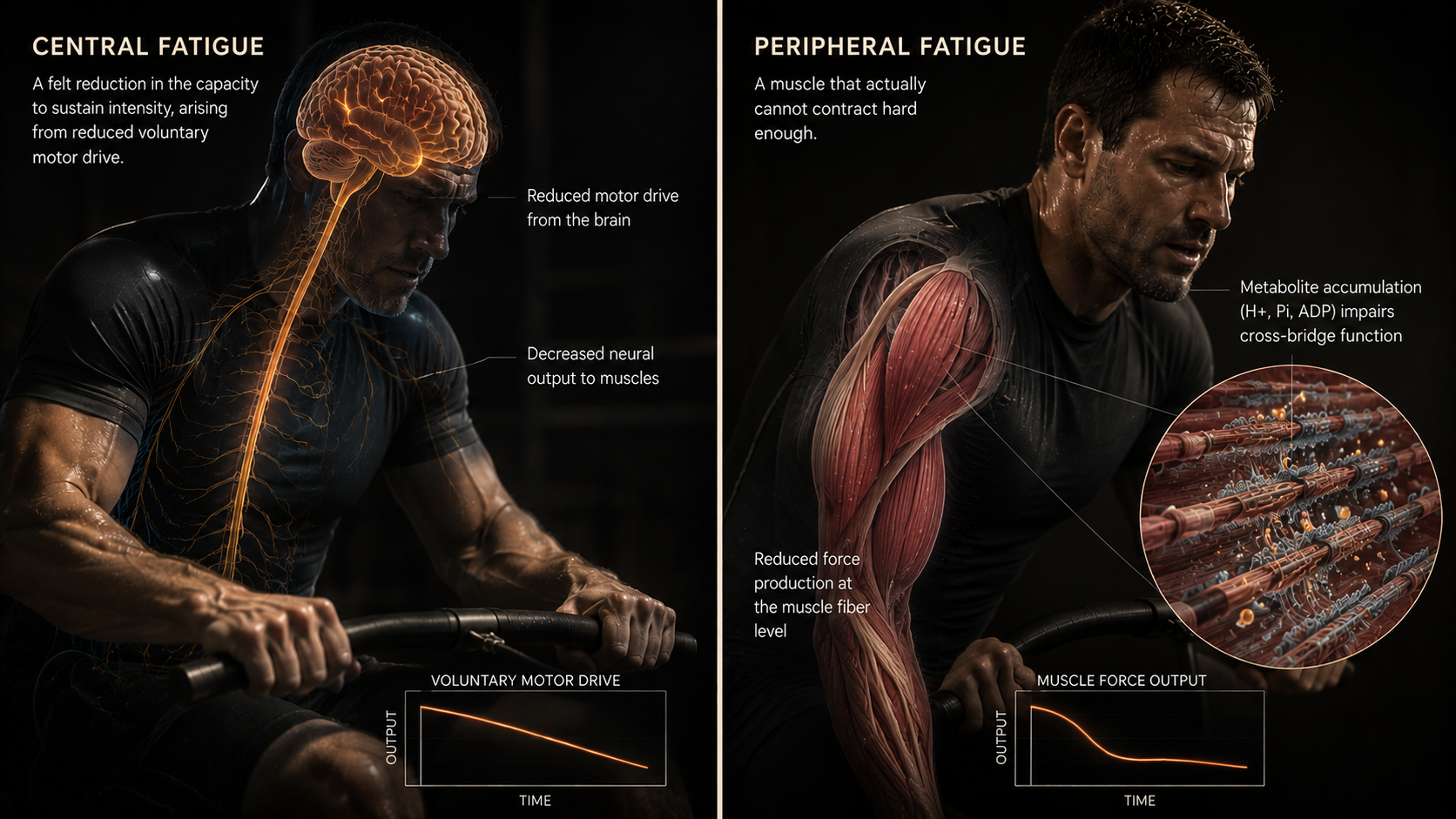
Exercise scientists distinguish two categories of fatigue based on where in the chain of command the failure originates (Gandevia 2001).
Central fatigue refers to a reduction in the voluntary neural drive from the brain and spinal cord to the working muscle. When central fatigue develops, the nervous system reduces motor unit recruitment or firing rate, and the muscle produces less force, not because it cannot, but because the signal telling it to contract is diminished. This is measurable using a technique called twitch interpolation, which superimposes an electrical stimulus on a voluntary contraction to assess how much additional force the muscle could produce if fully activated.
Peripheral muscle fatigue refers to a decline in the contractile capacity of the muscle itself, arising from changes at or below the neuromuscular junction. Even with a full voluntary neural signal, the fatigued muscle cannot produce the same force it could when fresh. This is a failure of the mechanical and chemical apparatus that converts neural input into contractile force, and it can be present without any structural damage to the fiber.
The central nervous system does not wait for the muscle to reach mechanical failure before it begins managing the load.
Both types coexist during exercise, and neither operates in isolation. The important distinction for understanding performance is that during sustained submaximal efforts, which represent the majority of real-world athletic work, central regulatory changes often reduce output before peripheral contractile failure is complete. The central nervous system does not wait for the muscle to reach mechanical failure before it begins managing the load. It is doing so throughout the effort, continuously integrating signals from the metabolic environment and adjusting output in response (Gandevia 2001).
Central fatigue manifests as a felt reduction in the capacity to sustain intensity, arising from reduced voluntary motor drive. Peripheral muscle fatigue manifests as a muscle that actually cannot contract hard enough. The mechanisms driving each type, and the conditions that accelerate or slow their development, are what the following sections address.
Energy Systems and the Hidden Ceiling
THE THREE ATP PATHWAYS
0–10 seconds. Highest power output. Rapid resynthesis but limited total capacity. The first pathway to exhaust.
Glycolysis
10 seconds to ~2 minutes. Faster than aerobic, but generates H+ and Pi as byproducts. Duration-limited by metabolic accumulation.
Oxidative Phosphorylation
2+ minutes. Sustains ATP production long-term but rate-limited by mitochondrial capacity, oxygen delivery, and substrate availability.
The body never truly runs out of energy in the chemical sense. It runs out of the capacity to produce energy fast enough. That distinction is at the center of why performance has a ceiling that is frequently reached before peripheral muscle fatigue is complete.
ATP is not stored in meaningful quantities inside the muscle cell. The working muscle draws on three pathways to resynthesize it continuously: the phosphocreatine (PCr) system, which operates in the first five to ten seconds of maximal effort and provides rapid but limited ATP output; glycolysis, which takes over between roughly ten seconds and two minutes, producing ATP faster than oxidative metabolism can but generating metabolic byproducts in the process; and oxidative phosphorylation, the aerobic pathway, which can sustain ATP production for extended periods but is rate-limited by oxygen delivery, mitochondrial capacity, and substrate availability. Understanding how the body draws on these exercise energy systems at different intensities explains why the rate of supply, not the total amount stored, is the performance variable that matters (Hargreaves & Spriet 2020).
The performance ceiling is set by the rate of ATP resynthesis, not the total amount of substrate available. An athlete can have adequate glycogen stores and sufficient aerobic capacity on paper and still reach the limit of what the energy system can produce at the intensity they are demanding. When ATP production rate falls short of demand, the cell cannot maintain the rate of cross-bridge cycling required for the current output level, and force production drops. This occurs before the muscle fiber reaches contractile failure in any structural sense.
The performance ceiling is set by the rate of ATP resynthesis, not the total amount of substrate available.
For training loads that extend beyond two minutes at high intensity, the aerobic system is doing the majority of the ATP production work. How well that system functions, specifically how efficiently mitochondria can produce ATP from available substrate at the required rate, determines where the performance ceiling sits. Expanding aerobic capacity in this context means expanding the rate at which cells can meet energy demand before the metabolic environment begins to impair force production, which is a different goal from improving cardiovascular fitness in the general sense.
What Metabolic Fatigue Actually Means
Metabolic fatigue is a term that often gets used loosely to mean tired from working hard. Mechanistically, it refers to something more specific: the accumulation of metabolic byproducts that impair either ATP production efficiency or contractile function, occurring at a rate that outpaces the cell's ability to clear or buffer them.
Three mechanisms are well-established contributors. Hydrogen ion accumulation: as glycolysis accelerates under high demand, proton production increases faster than intracellular buffering can handle, reducing pH. This inhibits the glycolytic enzyme phosphofructokinase and impairs actin-myosin cross-bridge cycling at the level of the contractile protein (Fitts 1994). The muscle does not stop working, but it produces less force per unit of neural input. Inorganic phosphate (Pi) accumulation: when ATP is hydrolyzed to ADP during contraction, Pi is released into the cytosol. Elevated Pi reduces the calcium sensitivity of the contractile apparatus, meaning the muscle requires a higher calcium concentration to achieve the same force output (Allen et al. 2008). This mechanism operates independently of how the athlete perceives effort. ADP accumulation: as ATP is consumed faster than it is resynthesized, ADP rises, which itself feeds back to slow the rate of ATP production through product inhibition and further constrains the energy supply.
Each of these changes is measurable at the cellular level, and each reduces the efficiency of energy delivery to the contractile machinery through a distinct mechanism. The result from the outside is the same: force output declines, pace drops, power falls. The muscle is not broken. The chemistry of energy production has shifted into a state where sustaining previous output levels requires resources the cell cannot supply at the required rate.
The chemistry of energy production has shifted into a state where sustaining previous output levels requires resources the cell cannot supply at the required rate.
The central nervous system monitors these metabolic signals throughout the effort and responds to them. As pH drops, glycogen status shifts, and metabolite concentrations rise, the brain integrates that information through metabolic sensors and adjusts motor drive in response. This regulation is protective rather than a failure of will. The reduction in motor output that follows is the body managing energy resources across the total duration of an effort, constraining current output to preserve the capacity to continue.
What Actually Triggers Peripheral Muscle Fatigue
The cellular triggers for peripheral muscle fatigue are distinct from metabolic fatigue, though they overlap during prolonged or high-intensity work. Calcium handling disruption is one of the primary mechanisms. Muscle contraction requires calcium to be released from the sarcoplasmic reticulum (SR), bind to troponin on the actin filament, and trigger cross-bridge formation with myosin. At the end of each contraction, the SR must reuptake that calcium to allow relaxation. During sustained exercise, the rate of SR calcium release decreases, which means each motor nerve impulse triggers a smaller calcium transient, and the resulting force is lower than it was at the start of the effort (Allen et al. 2008). This occurs before any structural damage to the fiber and can be present without any subjective sense of muscular distress.
Substrate availability at the fiber level is a second mechanism with implications that are frequently overlooked. Intramyofibrillar glycogen, the glycogen stored within the myofibril itself in close proximity to the sarcoplasmic reticulum, plays a specific role in SR calcium release that is independent of overall fuel status. Depletion of this local glycogen pool impairs SR calcium release even when systemic glycogen stores are not fully exhausted (Ortenblad et al. 2013). An athlete who arrives at a session with suboptimal carbohydrate intake may therefore have compromised SR calcium cycling not because they are broadly low on fuel, but because the specific substrate that supports this localized mechanism has been depleted.
Reactive oxygen species (ROS) produced during exercise contribute a third mechanism. Moderate ROS production during effort falls within normal physiological range and does not significantly impair contractile function. At higher concentrations, particularly during prolonged or high-load exercise, ROS can oxidize contractile proteins directly, reducing their capacity to generate force independently of the metabolic environment (Powers & Jackson 2008).
Peripheral muscle fatigue and delayed-onset muscle soreness are different processes driven by different mechanisms, and the distinction matters for interpreting recovery. DOMS involves structural micro-damage to the muscle fiber and develops 24 to 48 hours after a novel or high-load bout. Peripheral muscle fatigue is a functional decline in contractile capacity that develops during exercise, primarily through calcium handling disruption and metabolite accumulation, and is substantially reversible within minutes to hours. An athlete can accumulate significant peripheral fatigue during a session, enough to measurably reduce force output, without crossing the structural damage threshold that produces soreness.
What These Mechanisms Look Like During Performance

The cellular events described above produce observable performance patterns that any athlete working at high intensity will recognize if they understand what they are reading.
The clearest signal is progressive output decline without proportional increases in perceived muscular effort. Power drops on a sustained interval before the legs register any meaningful burn. Pace slips during a long run before fatigue localizes in any specific muscle group. Striking output falls in the later rounds of sparring before the arms feel physically spent. In each case, the contractile system has enough mechanical capacity to continue, but the energy delivery rate and the metabolic environment have reached a state where maintaining previous output is no longer possible at the rate the task requires.
HOW THE ATHLETE READS IT
Ready for the next round
Perceived exertion has normalized, heart rate is down, the athlete feels capable of the next effort.
THE CONTRACTILE STATE
Peripheral deficits persist
Calcium handling and force output are still measurably below pre-effort baseline. The second effort begins with accumulated contractile fatigue, not a clean slate.
Recovery from peripheral muscle fatigue is not instantaneous and does not correspond directly to how the athlete feels. Research measuring central and peripheral neuromuscular function after exhaustive exercise documents that peripheral deficits in muscle force production persist substantially beyond the initial recovery window (Carroll et al. 2017). Significant peripheral fatigue can remain measurable for 20 or more minutes post-effort, even as perceived exertion and heart rate return toward baseline. Central fatigue typically resolves more quickly than peripheral fatigue under the same conditions.
Recovery from peripheral muscle fatigue is not instantaneous and does not correspond directly to how the athlete feels.
This asymmetry has direct relevance for repeated-bout training: interval sessions, competition rounds, or consecutive high-intensity training days. An athlete who feels ready at the start of the second effort may have normalized their perceived exertion while still carrying peripheral neuromuscular deficits from the previous one. The performance decline in that second effort is not motivational. It is a consequence of incomplete contractile recovery compounded by whatever metabolic state has accumulated across the session.
The performance decline in that second effort is not motivational. It is a consequence of incomplete contractile recovery compounded by whatever metabolic state has accumulated across the session.
Substrate availability operates as a parallel variable throughout. An athlete who begins a session with suboptimal glycogen stores will encounter a lower energy ceiling before metabolic strain begins accumulating. This does not manifest as a subjective sense of fuel depletion. It means the threshold at which metabolic fatigue begins compounding is reached earlier in the session, at a point where the athlete still feels capable of higher output. The next section identifies the specific misreads that follow when this picture is not understood.
Where Athletes Misread This Signal

The cellular picture described above produces several patterns of misinterpretation that lead to identifiable training and recovery errors. Each one follows logically from the wrong mental model of what caused the performance to drop.
The first is attributing a performance decline to motivation or mental state when the actual cause is metabolic or peripheral. The appropriate response to a motivational problem is different from the appropriate response to inadequate substrate management or incomplete recovery from prior peripheral fatigue. Treating a metabolic limitation as a psychological one delays the correct intervention and often results in training harder into a deficit rather than adjusting the conditions that created it.
The second misread is concluding that training was insufficient because there is no soreness the following day. The absence of soreness the next morning means the structural damage threshold was not crossed. It says nothing about the degree of contractile or metabolic strain that occurred during the effort. These are different things with different implications for how much recovery time is actually required.
4.1
MISREAD #1: MOTIVATION
Attributing a metabolic or peripheral performance drop to a mental state. The correct intervention is different for each.
4.2
MISREAD #2: SORENESS AS PROXY
Concluding training was insufficient because no soreness appears. Absence of DOMS says nothing about contractile or metabolic stress.
4.3
MISREAD #3: UNIFORM FUELING
Applying the same substrate and recovery strategy regardless of training type. Metabolically demanding sessions require different management.
4.4
MISREAD #4: MORE EFFORT
Increasing intensity when performance drops due to energy system limits. This accelerates metabolite accumulation and extends recovery.
The third is applying uniform fueling and recovery strategies regardless of the nature and intensity of the preceding training. A session that is metabolically demanding, depleting glycogen significantly and generating metabolite accumulation, requires different substrate management than one that is mechanically demanding but metabolically modest. Treating both identically in terms of carbohydrate timing leaves a predictable gap in recovery quality that compounds across a training week.
Treating a metabolic limitation as a psychological one delays the correct intervention and often results in training harder into a deficit rather than adjusting the conditions that created it.
The fourth involves training into a compounding metabolic deficit. When performance drops due to energy system limitations, the instinct in some athletes is to increase effort to compensate. This is counterproductive when the limiting variable is substrate availability or metabolite accumulation. Additional intensity accelerates both processes and extends the recovery window required afterward, with no corresponding performance benefit during the session itself. What follows from correcting these misreads is a set of practical adjustments with a clear mechanistic basis.
The absence of soreness the next morning means the structural damage threshold was not crossed. It says nothing about the degree of contractile or metabolic strain that occurred during the effort.
Applying This to How You Train and Recover

The cellular picture of fatigue described in this article changes how several familiar training variables should be understood. Each application derives directly from the mechanisms, not from general training advice.
Pacing during sustained effort is the most immediate application. When output begins to fall during a session, the cell is communicating that ATP production rate is no longer keeping pace with demand. Reducing intensity in response to this is an accurate reading of a metabolic signal, not evidence of mental weakness. An athlete who continues at previous output despite declining energy production capacity is accelerating metabolite accumulation, depleting intramyofibrillar substrate faster, and extending the recovery window required after the session, without any corresponding performance gain during it.
Substrate management is a direct input to contractile function, not only to energy availability in a general sense. Because intramyofibrillar glycogen specifically supports SR calcium release, arriving at training with adequate carbohydrate intake affects the peripheral fatigue threshold at the fiber level. An athlete who trains with suboptimal carbohydrate intake is not simply lower on fuel. The contractile apparatus itself has less support for calcium cycling, and peripheral muscle fatigue will develop earlier in the session regardless of how capable the athlete feels at the start.
FOUR LEVERS — WHAT ACTUALLY CHANGES PERFORMANCE
Pacing
Reducing intensity when output declines is a metabolic signal response, not a failure. ATP demand cannot exceed production rate without accumulating deficit.
Substrate
Intramyofibrillar glycogen supports SR calcium release. Adequate carbohydrate intake is contractile management, not just fuel.
Recovery Intervals
Peripheral neuromuscular deficits persist 20+ minutes post-effort. Rest interval length is a mechanical decision.
Aerobic Capacity
Expanding the aerobic ceiling raises the intensity at which metabolic fatigue begins. This is rate management, not cardio.
Inter-effort recovery deserves more mechanical precision than it typically receives. The relevant question is not whether the athlete feels ready for the next set or round. It is whether enough time has elapsed for peripheral neuromuscular deficits to recover meaningfully. Given that peripheral fatigue can persist for 20 or more minutes after a high-intensity effort, training structures that allow 90 seconds between maximal efforts may be producing cumulative peripheral fatigue across the session in ways the athlete cannot perceive until output fails to meet the target in later sets.
Substrate management is a direct input to contractile function, not only to energy availability in a general sense.
Aerobic capacity is worth reframing from a cardiovascular fitness variable to an energy production rate variable. The upper boundary of oxidative phosphorylation determines at what intensity metabolic fatigue begins to accumulate. A higher aerobic ceiling means more work can be done before the energy system reaches the limits of its rate capacity. Training this system is training the rate at which the cell can meet demand before the metabolic environment begins to impair force production.
Aerobic capacity is worth reframing from a cardiovascular fitness variable to an energy production rate variable.
Frequently Asked Questions
What is the difference between central and peripheral fatigue?
Central fatigue originates in the central nervous system as reduced voluntary motor drive: the brain and spinal cord send a diminished signal to the muscle even though the muscle retains contractile capacity. Peripheral muscle fatigue originates at or below the neuromuscular junction as a decline in the muscle's ability to generate force. Both occur during exercise; peripheral fatigue typically recovers more slowly post-effort than central fatigue does.
Can peripheral muscle fatigue occur without muscle soreness?
Yes. Peripheral muscle fatigue is a functional decline in contractile capacity, driven by calcium handling disruption and metabolite accumulation, that develops during exercise and resolves within minutes to hours. Delayed-onset muscle soreness involves structural micro-damage and appears 24 to 48 hours post-session. An athlete can accumulate significant peripheral fatigue during training without crossing the damage threshold that produces soreness.
How long does peripheral muscle fatigue last after a hard session?
Recovery depends on effort intensity and duration, but significant contractile deficits can persist for 20 or more minutes after exhaustive exercise (Carroll et al. 2017). An athlete who begins a second maximal effort after a short rest period may still carry meaningful peripheral fatigue from the first, reducing achievable output even when perceived exertion has normalized.
The Bottom Line
Performance decline has a cellular address. In most sustained and high-intensity athletic efforts, the limiting variable is not the contractile capacity of the muscle fiber but the rate at which the working cell can produce ATP and maintain the chemical conditions required to sustain output.
Peripheral muscle fatigue is part of the picture, but the body reaches other limits first. The energy system reaches its rate capacity. The metabolic environment around the contractile apparatus shifts in ways that impair efficiency. The central nervous system reads those shifts and adjusts motor output before the muscle itself has reached structural failure.
The diagnostic question changes as a result of understanding this. Asking whether muscles are tired after a performance decline is asking the wrong question in most cases. The more precise question is whether the energy delivery system was able to meet the demands placed on it, and what variables would change that calculation. Substrate availability before the session, aerobic system capacity, recovery intervals between efforts, and load management within a session all directly affect that answer. These are trainable and manageable variables. The muscle's contractile capacity is, in most cases, not the constraint that was crossed.
The more precise question is whether the energy delivery system was able to meet the demands placed on it, and what variables would change that calculation.
Your muscles rarely give out before your energy system does. Train the system that actually fails first.
Performance decline is a cellular event, not a muscular one. The rate at which your cells produce ATP determines where your ceiling sits — and that ceiling is trainable.
Mydos Performance
— Cellular Energy & Fuel Systems Series —
Why Performance Can Decline Even Without Peripheral Muscle Fatigue
Cellular ATP production, not muscle failure, sets the real performance ceiling
· By Ricardo Londono, MD/PhD ·