
The Problem Isn't Just Fuel: What Glycogen Depletion Actually Does

Glycogen depletion is commonly understood as a fuel problem: stores run low, output falls, and the session ends earlier than planned. That framing is accurate, but incomplete. The more precise account is that as glycogen falls, the nervous system begins to register continued effort as increasingly costly. That change in cost registration is what produces the cascade of effects that serious athletes recognize but often misread: pace that feels harder at the same speed, focus that narrows, decision-making that slows, and a drive to reduce output that arrives well before the body has actually reached its mechanical limits.
The distinction matters because it changes the diagnosis. A person who understands glycogen depletion as a simple fuel-volume problem will look for ways to push through what feels like a motivation issue. A person who understands it as a system-level constraint in how the nervous system prices continued effort will recognize the signal for what it is. Two competing theoretical frameworks account for this mechanism, both well-established in exercise physiology: Noakes's central governor model (Noakes 2000) and Marcora's psychobiological model (Marcora 2008), (Marcora et al. 2009). They differ in their mechanistic specifics, but converge on the same functional prediction: the brain regulates exercise output by tracking the cost of continued effort, and fuel availability is one of the inputs into that calculation.
COMMON FRAMING
Fuel Runs Low
Stores deplete, output falls, the session ends early. The problem is a volume problem.
PRECISE FRAMING
Cost of Effort Rises
As glycogen falls, the nervous system prices continued output as more expensive. The signal arrives before the fuel runs out.
This article follows a single causal chain: repeated effort drives glycogen use, declining glycogen reduces the fuel buffer available to both muscle and liver, and that reduction causes the nervous system to treat continued output as more expensive. The result is what most people describe as fatigue. Not all fatigue, and not always, but a specific, physiologically grounded category of it that tends to show up in the final third of hard training sessions, in the late afternoon after a demanding workday combined with morning training, and during prolonged competitive efforts with inadequate fueling.
The more precise account is that as glycogen falls, the nervous system begins to register continued effort as increasingly costly.
The brain regulates exercise output by tracking the cost of continued effort, and fuel availability is one of the inputs into that calculation.
How Much Glycogen Can the Body Store?

The body stores carbohydrate as glycogen in two separate reservoirs: skeletal muscle and the liver. They behave differently, serve different functions, and deplete through different mechanisms. Understanding that distinction is the foundation of everything that follows.
Muscle glycogen is the larger reservoir. In a trained adult, skeletal muscle holds roughly 300 to 500 grams of glycogen, though the exact figure depends on muscle mass, training status, and recent carbohydrate intake (Hargreaves 2021). This glycogen is stored within the muscle fibers themselves and is accessible only to those fibers during contraction. Muscle tissue has no mechanism to export glycogen to other muscles or to the bloodstream. When a specific muscle group is working, it draws on its own local glycogen supply, and that supply is not replenished by glycogen held elsewhere in the body.
Liver glycogen is the smaller but functionally distinct reservoir, holding roughly 80 to 120 grams in a fed adult (Hargreaves 2021). Unlike muscle, the liver can break down its glycogen and release the resulting glucose into the bloodstream. This is the liver's primary contribution to fuel availability during exercise: it acts as a buffer for blood glucose, maintaining circulating levels as muscle glycogen is consumed. The two reservoirs are parallel, not redundant: muscle glycogen fuels local contractile work; liver glycogen sustains the systemic glucose supply that everything else depends on.
300–500g
MUSCLE GLYCOGEN CAPACITY (TRAINED ADULT)
80–120g
LIVER GLYCOGEN CAPACITY (FED ADULT)
Glycogen Depletion During Exercise: How Fuel Is Used Under Load
The rate at which muscle glycogen is consumed during exercise is not fixed. It scales with intensity. At low to moderate intensities, the body draws primarily on fat as a fuel source. As intensity increases, the contribution of glycolysis rises sharply, and at high intensities, muscle glycogen becomes the dominant substrate (Romijn et al. 1993). This is the intensity-substrate relationship that underpins the depletion mechanism: the higher the effort level, the faster glycogen is consumed.
For athletes training in combat sports, strength disciplines, or any modality that involves repeated high-intensity bouts, this has a specific consequence. Each hard round, each working set at near-maximal load, and each interval at threshold intensity draws heavily from local muscle glycogen. The rest periods between bouts allow phosphocreatine to partially recharge and allow heart rate to recover, but they do not restore glycogen. Resynthesis of muscle glycogen from scratch requires hours and an external carbohydrate source (Ivy 1991). A two-minute rest between BJJ rounds or lifting sets returns none of the glycogen burned during the preceding effort.
Muscle tissue has no mechanism to export glycogen to other muscles or to the bloodstream.
The implication is that glycogen depletion in training is progressive and asymmetric. Early rounds or early sets operate on full or near-full stores. Later efforts operate on progressively less. Research on repeated sprint performance demonstrates the expected pattern: peak power output declines across bouts in ways that track glycogen availability (Gaitanos et al. 1993). At the subcellular level, intramyofibrillar glycogen (the glycogen stored immediately adjacent to the contractile machinery) appears to be particularly critical for repeated high-intensity contractions (Ortenblad et al. 2013). This helps explain why performance in the later rounds of a sparring session or the later sets of a volume training block degrades in ways that feel qualitatively different from simple muscular fatigue: the fuel system is tracking toward a threshold, not a cliff, and the nervous system responds accordingly.
Peak Output Across Repeated High-Intensity Bouts
Round 1
Round 2
Round 3
Round 4
Round 5
Illustrative of the repeated-sprint pattern: peak output falls bout-to-bout as local glycogen is consumed and rest does not restore it (Gaitanos et al. 1993).
Glycogen depletion in training is progressive and asymmetric.
Does the Liver Store Glycogen? Yes, and That Storage Is What Keeps Blood Glucose Stable

While muscle glycogen fuels local contractile work, the liver glycogen system operates on a different axis. During sustained exercise, the liver breaks down its glycogen through a process called hepatic glycogenolysis, releasing glucose into the bloodstream at a rate calibrated to match metabolic demand (Wasserman 2009). This is the mechanism that keeps blood glucose relatively stable during prolonged effort. When liver glycogen is adequate, the liver can match glucose output to demand and maintain circulating glucose in a functional range. When liver glycogen falls, that buffer for blood glucose declines.
Only the Liver Exports Glucose
Muscle glycogen stays in the fiber that stores it. Only liver glycogen is released as glucose to supply the rest of the body.
The functional importance of this buffer is not always appreciated in discussions of exercise fuel. Blood glucose is not merely an alternative fuel source. It is the primary substrate for the brain under normal physiological conditions. A brain operating in a setting of declining blood glucose does not simply become less fueled in the way a muscle does. It registers the change. Glucose availability is one of the signals the central nervous system uses to calibrate the cost of continued effort, and declining availability shifts that calculus (Sunram-Lea et al. 2002). The effect is not equivalent to hypoglycemia in the clinical sense; the blood glucose decline seen during prolonged exercise is typically modest. But even a trend toward lower circulating glucose, in a brain that is tracking effort cost, is mechanistically relevant.
TWO GLYCOGEN SYSTEMS
MUSCLE GLYCOGEN
Fuels local contractile work. Stored within the fibers doing the work. Cannot be exported to the bloodstream or other muscles.
LIVER GLYCOGEN
Fuels the systemic blood glucose supply. Broken down and released as glucose into the bloodstream. Depletes through a separate mechanism.
CRITICAL DISTINCTION
An athlete can retain functional muscle glycogen while liver glycogen is substantially depleted — producing cognitive and effort-cost effects with no obvious muscular failure.
Liver glycogen depletes faster than is commonly assumed. The liver begins releasing glucose to the bloodstream during exercise from the earliest minutes of effort, with hepatic glycogenolysis providing the dominant source of blood glucose in the first 40 to 90 minutes of sustained activity (Wasserman 2009). An overnight fast of eight to ten hours substantially reduces hepatic stores before the first training session of the day begins. An athlete who trains in the morning in a fasted or semi-fasted state, works a full cognitive day, and then trains or competes in the afternoon may be operating with significantly compromised liver glycogen by late afternoon, even if muscle glycogen has been partially restored by a midday meal.
This is the mechanism that makes glycogen depletion a whole-system constraint rather than a local muscle problem. It is possible for an athlete to retain working muscle glycogen while their liver glycogen is substantially depleted. The muscle side of the system is functioning, but the blood glucose buffer is degraded, and the brain is operating with a signal that continuous effort is becoming more costly. The effects of that signal are the subject of the next section.
Blood glucose is not merely an alternative fuel source. It is the primary substrate for the brain under normal physiological conditions.
It is possible for an athlete to retain working muscle glycogen while their liver glycogen is substantially depleted.
Exercise and Brain Fog: How Fuel Availability Changes the Cost of Effort

The brain does not passively experience fatigue as the body exhausts its fuel. It monitors exercise and tracks the cost of continued output. Two theoretical frameworks describe this regulatory function, and while they differ in mechanism, they converge on the same prediction: the brain generates a perception of effort that reflects not only the current physiological state but also the expected cost of continuing. When fuel availability declines, that cost estimate rises.
Noakes's central governor model proposes that the brain acts as a protective regulator, reducing motor recruitment before physiological failure actually occurs (Noakes 2000). Marcora's psychobiological model proposes that conscious perception of effort is the primary determinant of voluntary exercise tolerance, and that this perception integrates multiple afferent signals including fuel status (Marcora 2008). The two models are not fully compatible, and the debate between them remains active in the exercise physiology literature. What they share is the insight that the experience of effort is generated rather than received, and that fuel availability is one of the inputs the system uses to generate it.
CENTRAL GOVERNOR MODEL (Noakes)
The brain acts as a protective regulator, reducing motor recruitment before physiological failure occurs. Effort perception is a regulatory output, not a distress signal.
PSYCHOBIOLOGICAL MODEL (Marcora)
Conscious perception of effort is the primary determinant of exercise tolerance. The brain integrates multiple inputs — including fuel status — to generate that perception.
The two models are not fully compatible. Both predict that fuel availability shifts the effort-cost signal.
As Fuel Falls, the Cost of Effort Rises
Duration of sustained effort →
The practical consequence of this mechanism is that as glycogen falls and blood glucose trends lower, the same absolute workload begins to feel harder. Rate of perceived exertion rises at an unchanged pace, power output, or load. Attention narrows. Decision-making slows. The impulse to reduce effort strengthens (Marcora et al. 2009). This is not a motivational failure. It is a physiologically generated signal from a system that is tracking its own resource state. The athlete who interprets this signal as weakness and overrides it without addressing the underlying constraint is not building mental toughness. They are ignoring a genuinely informative input. The way this signal is experienced before a training session begins is examined in detail in the article on no motivation to workout.
The post-training brain fog that many serious athletes notice after hard sessions operates through the same mechanism. A session with high glycolytic demand and inadequate fueling leaves both muscle and liver glycogen substantially reduced. In the hours following, blood glucose may be slower to restabilize than usual, and the residual signals from a depleted fuel state do not reset immediately. Cognitive sluggishness in the post-session window is consistent with the fuel-availability signal already described: the same system that was raising perceived effort cost during the session continues to reflect reduced resource availability after it ends.
An important qualification belongs here. The fuel-availability model is one mechanism among several that contribute to fatigue and cognitive decline. Sleep deprivation, dehydration, accumulated training load, and psychological stress all produce overlapping symptoms. The model described here should not be used to reduce all mental fatigue to a glycogen explanation. The claim is more precise than that: when the context includes high glycolytic demand, inadequate fueling, and progressive performance decline across a session or a day, fuel availability is a plausible and physiologically grounded contributor that deserves to be in the differential before motivation or discipline are blamed.
The experience of effort is generated rather than received, and fuel availability is one of the inputs the system uses to generate it.
Cognitive sluggishness in the post-session window is consistent with the fuel-availability signal already described: the same system that was raising perceived effort cost during the session continues to reflect reduced resource availability after it ends.
Hitting the Wall: What Acute Glycogen Depletion Feels Like in Endurance Efforts

The mechanism described above has a well-known extreme expression in endurance sport: the bonk, or hitting the wall. Cyclists and marathon runners encounter it when sustained high-output effort exhausts glycogen stores beyond the liver's capacity to maintain blood glucose. At that threshold, performance does not decline gradually. It collapses. Pace falls apart, the legs stop responding to intention, and blood glucose has fallen below the level at which the brain can sustain normal motor drive and executive function. The result is a qualitative break in the athlete's experience, not simple tiredness, but the failure of a regulatory system.
This is the dual-system failure. Muscle glycogen in working fibers is depleted to the point where force production is compromised. Liver glycogen is insufficient to sustain blood glucose at functional levels. The nervous system, operating on a signal of severe fuel deficit, has reduced motor drive to a level that cannot sustain the required pace. The result looks like a sudden collapse, but the mechanism has been building throughout the session as both systems progressively lost capacity (Wasserman 2009).
The Decline Builds, Then Collapses
Time at sustained high output →
The bonk is associated with cycling and marathon running because those modalities involve two or more hours of sustained effort at intensities that deplete glycogen at scale. The mechanism, however, is not discipline-specific. A BJJ practitioner who trains multiple long sessions on inadequate carbohydrate intake, a boxer in the late rounds of a hard sparring session under-fueled, or a strength athlete completing a high-volume session on depleted stores can encounter the same system-level failure. The external expression differs by sport, but the physiology is the same. Most serious athletes will not bonk in the clinical sense that endurance athletes describe. They will encounter the subtler signals that appear earlier in the same depletion curve.
The result looks like a sudden collapse, but the mechanism has been building throughout the session as both systems progressively lost capacity.
Glycogen Depletion Symptoms: The Subtler Signals That Are Easy to Misread
The partial depletion that precedes a full bonk produces a recognizable but less dramatic set of signals. Pace or power output drops for the same perceived effort. The legs feel heavy or unresponsive, not in the burn of acute muscular fatigue but in a deeper, less localizable way. Repeated burst efforts, the ability to accelerate out of a wrestling position, to execute a fast combination, to push through a final set of heavy pulls, deteriorate across a session in ways that do not respond to rest the way early-session fatigue does.
The cognitive signals tend to appear alongside the physical ones. Focus narrows and becomes harder to sustain. Tactical decisions in sparring become slower, and the quality of choices declines. The motivation to continue working at high intensity weakens in a way that feels different from ordinary willpower loss, more like the effort is genuinely costing more than it was an hour earlier, because it is. The nervous system's cost estimate for continued output has risen as the fuel buffer has declined, and the desire to reduce intensity is a direct expression of that recalculation.
5.1
OUTPUT DECLINE
Performance drops at unchanged perceived effort — pace, power, or burst capacity falls across the session in ways that rest does not recover.
5.2
COGNITIVE NARROWING
Focus becomes harder to hold. Tactical decisions slow. Decision-making quality declines before physical failure is obvious.
5.3
DRIVE TO REDUCE EFFORT
A specific, insistent impulse to slow down or stop arrives — not from discomfort, but from a nervous system signalling that continued output is becoming too costly.
The timing of these signals is a diagnostic cue. They tend to appear in the final third of a demanding session, not the first. Late afternoon, after a morning session plus a demanding cognitive workday, is a common window for an experienced athlete to feel inexplicably flat or mentally dulled. Across multi-day training camps or competition weeks with insufficient recovery carbohydrate, the signals can begin appearing earlier in sessions as cumulative depletion compounds. These are the same signals as the full bonk, but earlier on the same continuum. Sleep deprivation, inadequate hydration, and accumulated training load produce overlapping presentations, which is why context matters as much as symptoms when interpreting them.
How to Tell If Glycogen Is Depleted: A Practical Self-Check
There is no practical way to directly confirm glycogen depletion outside a research setting. The gold-standard methods (muscle biopsy and stable isotope tracer studies) are research tools that require laboratory conditions and invasive procedures. In practice, assessment is always a plausibility judgment based on context, not a measurement.
The most useful contextual question is not what you feel but what preceded it. High training volume plus low carbohydrate intake plus inadequate recovery between sessions establishes a context in which glycogen depletion is plausible. Adding cognitive demand across a long workday, overnight fasting before a morning session, or training across multiple days without attention to carbohydrate restoration raises that plausibility further. Fuel depletion is more probable when the conditions that cause it are present.
The nervous system's cost estimate for continued output has risen as the fuel buffer has declined, and the desire to reduce intensity is a direct expression of that recalculation.
The pattern of performance decline within a session provides additional signal. Glycogen depletion produces a progressive, continuous decline in performance quality across a session, not a sudden drop. If output at the same perceived effort tracks steadily downward from round three onward rather than plateau or crashing abruptly, the depletion model is consistent with that pattern. A rapid response to a small carbohydrate intake mid-session or immediately post-session: a noticeable improvement in output or mental clarity is suggestive of fuel-driven limitation, though not diagnostic of it.
The limits of this assessment are worth stating plainly. Dehydration and sleep deprivation produce nearly identical subjective presentations to partial glycogen depletion, including heavy legs, narrowing focus, and declining sprint performance. Overtraining syndrome and accumulated training load produce a similar profile over a longer time window. The fuel-depletion interpretation becomes more plausible when hydration and sleep are controlled for and when the training context is consistent with the depletion mechanism. It remains one explanation in a differential, not a self-confirming diagnosis.
Common Mistakes: How People Misread Fuel-Driven Fatigue

The signals of partial glycogen depletion are routinely misread, and the misreadings produce responses that address the symptom without touching the mechanism. Four patterns appear frequently enough to be worth examining directly.
The most common error is attributing the drive to reduce effort to a motivational deficit. When perceived effort rises at an unchanged workload and the impulse to slow down intensifies, it is intuitive to interpret this as a failure of will. The mechanism, as described above, does not support that interpretation. The nervous system is generating a cost signal based on available fuel. Overriding that signal by force of will does not change the fuel state. It extends output against a genuine physiological constraint, which is sometimes appropriate and sometimes not, but is a different decision than the one most people believe they are making when they tell themselves to push through.
6.1
MOTIVATIONAL MISREAD
Rising perceived effort at an unchanged workload is attributed to weak will. The mechanism: the nervous system is generating a cost signal from fuel state, not a character signal.
6.2
STIMULANT SUBSTITUTION
Caffeine is used to address what is actually a substrate constraint. The mechanism: caffeine lowers RPE by blocking adenosine receptors — it does not restore glycogen.
6.3
MISATTRIBUTED FOG
Post-training cognitive decline is attributed to overtraining or stress. The mechanism: declining blood glucose and CNS effort-cost signalling explain the same state.
6.4
UNDIFFERENTIATED FATIGUE
All late-session decline is treated as interchangeable. The mechanism: glycogen depletion, sleep deprivation, dehydration, and stress each require different responses.
A second error involves reaching for stimulants when the underlying problem is a fuel-availability constraint. Caffeine is a legitimate ergogenic agent. It reduces the perception of effort by antagonizing adenosine receptors in the brain, which lowers RPE at a given workload (Doherty & Smith 2004). What it does not do is restore glycogen or alter the hepatic glucose output mechanism. In a session where performance is declining because glycogen is running low, caffeine can produce a temporary attenuation of the effort signal, but the substrate constraint remains. The person feels as though they have solved a fuel problem when they have altered a perception, and the underlying situation is unchanged.
A third pattern is misattributing post-training cognitive impairment to overtraining, psychological stress, or accumulated life load. The fog that settles after a genuinely depleting session is real, and it often arrives in the hours when cognitive work is still required. Understanding that this state has a specific physiological basis — declining fuel availability and its downstream effects on blood glucose and CNS effort-cost signalling — explains why the fog settles. That framing is more useful than attributing it to general tiredness. The former points toward a correctable input; the latter does not.
The fourth error is treating all late-session or late-day fatigue as interchangeable. Glycogen depletion, sleep deprivation, dehydration, and psychological stress produce presentations that overlap substantially. The appropriate response to each is different. Distinguishing between them requires attention to context: training load, fueling history, sleep, and hydration. Someone who routinely defaults to a single explanation for all performance variability will mismanage some of it, regardless of which explanation they default to.
Overriding that signal by force of will does not change the fuel state.
The person feels as though they have solved a fuel problem when they have altered a perception, and the underlying situation is unchanged.
What This Means in Practice: Applying the Fuel-Availability Model
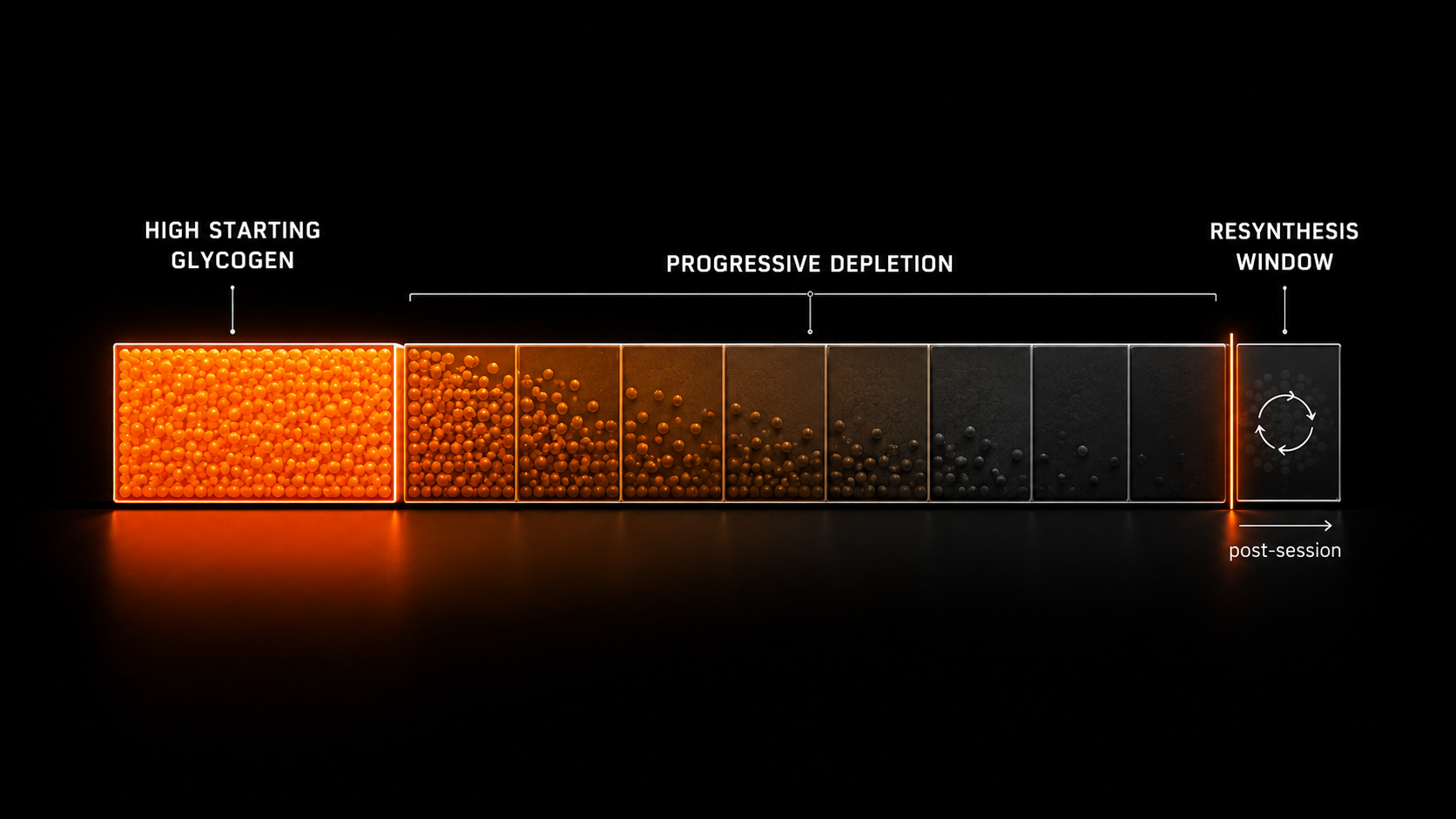
The mechanism described in this article carries one primary behavioral inference: if fuel availability shapes the nervous system's cost estimate for continued effort, then the state of glycogen stores before a training session or a cognitively demanding block of work is a variable worth attending to. This is not an argument for aggressive carbohydrate loading before every session. It is a narrower point. Training at high intensity on chronically depleted stores moves the effort-cost curve in the wrong direction earlier in the session. Recognizing that as a system-level constraint rather than a personal failing changes how the problem is approached.
The practical consequence of the resynthesis mechanism is also relevant here. Glycogen resynthesis is fastest in the hours immediately following exercise, when glucose uptake is elevated and the enzymatic machinery for glycogen synthesis is maximally active (Ivy 1991), (Burke 2011). This is not an instruction to consume carbohydrate immediately after every session. It is a description of when the window for restoring depleted stores is widest, which is relevant for anyone managing high training frequency or two-a-day sessions where the second session begins before the first has been adequately recovered from. For a complete treatment of glycogen replenishment strategy, including timing and substrate choices, see the companion article: How Long Does It Take to Deplete Glycogen Stores.
The broader application is attentional. The fuel-availability model gives a more precise vocabulary for reading fatigue. An athlete or professional who understands this mechanism can distinguish between the rising effort cost of a depleting session and the generalized tiredness of a poorly slept week. They can recognize when a morning session plus a fasted start plus an eight-hour cognitive workday has created a fuel context that will affect afternoon training or decision-making. They are less likely to reach for stimulants as a first response to what is actually a substrate problem, and less likely to assign motivational failure as the explanation for a physiological constraint. The fitness-fatigue model provides the structural framework for understanding why this constraint is particularly consequential during high-load training blocks.
Training at high intensity on chronically depleted stores moves the effort-cost curve in the wrong direction earlier in the session.
Frequently Asked Questions
What are the symptoms of glycogen depletion?
The most recognizable physical symptoms are a steady drop in pace or power output despite unchanged perceived effort, legs that feel heavy or unresponsive, and deteriorating performance in repeated sprint or burst efforts across a session. Cognitive symptoms include narrowing focus, slower decision-making, and a strengthening drive to reduce effort. These tend to appear in the final third of a demanding session.
What does glycogen depletion feel like?
Most people describe it as effort becoming progressively more expensive rather than muscles physically failing. The same pace or load begins to require more concentration and conscious drive to sustain. In the later stages, there is a specific and insistent impulse to slow down or stop, which is distinct from the general discomfort of hard training. This signal is generated by the nervous system tracking fuel availability. It is physiologically real, not a motivational problem. The central governor model explains the regulatory mechanism behind this experience.
How do you fix glycogen depletion?
Glycogen resynthesis requires carbohydrate and time. The fastest resynthesis rate occurs in the first one to two hours after exercise ends, when glucose uptake into muscle is highest. A carbohydrate source consumed promptly after a depleting session accelerates restoration. Full replenishment typically takes several hours to overnight depending on the depth of depletion and the amount of carbohydrate consumed. Partial replenishment during a session through carbohydrate intake can slow the depletion rate. For a full breakdown of timing and strategy, see how long it takes to deplete glycogen stores.
Does the liver store glycogen?
Yes. The liver stores roughly 80 to 120 grams of glycogen in a fed adult. Unlike muscle glycogen, which is used only by the muscle fibers that store it, liver glycogen is broken down and released into the bloodstream as glucose. This is the mechanism by which the liver maintains blood glucose during exercise and fasting. When liver glycogen is depleted, the body's ability to buffer blood glucose declines, which affects brain function and perceived effort cost.
Why does my brain feel foggy after exercise?
Post-exercise cognitive fog is consistent with the fuel-availability mechanism: a session with high glycolytic demand and inadequate fueling leaves both muscle and liver glycogen substantially reduced. Blood glucose may be slower to restabilize in the hours following, and the nervous system continues to reflect the reduced resource state that was producing rising perceived effort during the session. The fog typically resolves as glycogen is restored through carbohydrate intake and recovery time. If this pattern appears regularly, it may indicate a need to review the fueling context across the full training day, not just the session itself.
Bottom Line
Fatigue that feels mental is not necessarily motivational in origin. When glycogen depletion is the operative mechanism, the desire to reduce output, the narrowing of focus, the slower decision-making: all are outputs of a nervous system tracking the cost of continued effort against available fuel. That signal is real. Dismissing it as weakness misidentifies both the problem and the appropriate response.
The more useful model is precise: muscle glycogen sustains repeated high-intensity output; liver glycogen maintains the blood glucose buffer the brain depends on; when both systems decline, the nervous system raises the perceived cost of continued effort. Fatigue in this context is not a character variable. It is a physiological output from a system with finite fuel. Understanding the energy systems that produce this output gives the fuel-availability signal a precise address in the physiology. The question worth asking when performance declines is not whether the effort is sufficient, but whether the system has what it needs to price effort accurately.
The question worth asking when performance declines is not whether the effort is sufficient, but whether the system has what it needs to price effort accurately.
Fatigue that resists willpower is not always a mental failure — it may be a fuel signal. Learning to read the difference changes what you do about it.
When the same effort costs more than it did an hour ago, the first question is not whether you are trying hard enough. It is whether the system has the substrate to price effort accurately.
Mydos Performance
— Sustained vs Borrowed Energy Series —
Glycogen Depletion and Mental Fatigue: Why Effort Feels Harder When Fuel Runs Low
The physiology of effort cost — and why your fuel state changes the signal before your muscles run out.
By Ricardo Londono, MD/PhD