
The Training Session You Did Not Know You Were Wasting

Training produces a stimulus. Sleep is where the response to that stimulus actually occurs. This distinction matters because most athletes treat these two processes as if they belong to the same category, when physiologically they are opposite ends of a single loop: one generates the signal, the other executes it.
The question of how much sleep do athletes need is commonly framed as a performance optimization problem. It is more accurately understood as a biology problem. Specific hormonal, metabolic, and neurological processes are time-gated to sleep. They do not occur at reduced rates during wakefulness; they are largely absent. When sleep is shortened, the processes responsible for tissue repair, motor pattern consolidation, and glycogen resynthesis do not compress into the remaining hours. They are curtailed.
This creates a compounding problem for athletes who prioritize training volume over sleep duration. Every session adds to the repair and consolidation demand. Every night of inadequate sleep reduces the fraction of that demand that gets serviced. Over days and weeks, the athlete is generating more adaptation debt than they are paying down, and performance eventually reflects that gap in ways that look like overtraining, motivation problems, or plateaus.
TRAINING
Generates the Signal
Training creates a physiological stimulus — mechanical stress, metabolic demand, and tissue disruption that initiates the adaptation process.
SLEEP
Executes the Response
Sleep is where the hormonal, metabolic, and neurological processes that respond to that stimulus actually occur. The loop does not close without it.
This article covers the specific mechanisms that operate during sleep and why they cannot occur elsewhere. It does not cover sleep hygiene, scheduling tactics, or supplement protocols; those belong to companion articles. The goal here is to establish the physiology clearly enough that the sleep-versus-training tradeoff stops being a scheduling decision and starts being understood as a biological constraint.
Specific hormonal, metabolic, and neurological processes are time-gated to sleep. They do not occur at reduced rates during wakefulness; they are largely absent.

What Sleep Actually Does: The Architecture Overview
Sleep Stages Across One Night
Sleep is not a uniform state. It cycles through distinct stages, each associated with different physiological activity, and the distribution of those stages across the night is not random. Understanding which stage does what work is prerequisite to understanding why sleep restriction carries different costs depending on when it occurs.
Non-REM (NREM) sleep comprises three stages: N1 (light sleep, minutes), N2 (a transition stage that occupies roughly half of total sleep time in adults), and N3, commonly called slow-wave sleep (SWS) for the large, slow delta waves that characterize it on EEG. SWS is the stage where the majority of physical anabolic processes are concentrated. Growth hormone secretion, tissue repair signaling, and glycogen resynthesis are all disproportionately active during SWS.
REM sleep, the fourth stage, serves a distinct function. Its primary role is neurological rather than physical: memory consolidation, emotional processing, and motor pattern encoding occur predominantly during REM. The two stages serve different systems and are not interchangeable.
SLEEP STAGE FUNCTIONS
N1 (Light Sleep)
Brief entry into sleep. Muscle activity slows. No significant recovery or consolidation function. Duration: minutes.
N2 (Stage 2 NREM)
Transition stage comprising roughly half of total sleep time. Late-night N2 is associated with motor sequence consolidation.
N3 / Slow-Wave Sleep (SWS)
Primary window for growth hormone secretion, tissue repair, glycogen resynthesis. Concentrated in the first half of the night.
REM
Primary window for motor memory transfer, procedural memory consolidation, and neural pattern encoding. Concentrated in the second half of the night.
Sleep architecture follows a predictable pattern across the night. SWS is front-loaded: the deepest and longest slow-wave periods occur in the first half of the night. REM sleep is back-loaded: the longest REM episodes occur in the final hours before waking. This has a practical implication that most athletes are unaware of. The athlete who stays up an extra hour watching film is sleeping less and specifically reducing the early-night SWS window. The one who sets the alarm early for a training session is reducing the late-night REM window. Both represent losses, and they are losses in different systems.
Both SWS and REM are necessary for the repair and consolidation demands to be fully addressed. The question is not which stage matters more; it is what each stage does and what the specific cost of losing it is.
Hormonal Regulation During Sleep: Growth Hormone and the Anabolic Window
Growth hormone (GH) is secreted in pulses throughout the day, but the secretory pattern is far from uniform. In healthy adult men, approximately 70 percent of daily GH output occurs during early sleep, specifically in temporal association with the first episode of slow-wave sleep (Van Cauter et al. 1998). This is a mechanistic consequence of sleep-wake homeostasis: the timing of the major GH pulse follows sleep onset reliably enough that shifts in the sleep schedule shift the pulse with it. The pulse is not occurring at night by coincidence; it is entrained to the sleep period.
GH drives protein synthesis, promotes lipolysis, and initiates the hormonal signaling cascade that underlies muscle repair following training. The nocturnal GH pulse is the primary anabolic signal for the recovery process. When slow-wave sleep is curtailed, whether by sleeping fewer hours, going to bed late and compressing the early-night SWS period, or fragmenting sleep through poor sleep quality, this pulse is attenuated. The training signal does not get delayed and executed the following night. It is partially absent, and the adaptation that depended on it does not occur at its full magnitude.
When slow-wave sleep is curtailed, this pulse is attenuated. The training signal does not get delayed and executed the following night. It is partially absent, and the adaptation that depended on it does not occur at its full magnitude.
Testosterone synthesis follows a similar logic. Peak testosterone production occurs during sleep and is tied to circadian timing in a way that is sensitive to sleep restriction. A detailed treatment of the testosterone-sleep relationship is beyond the scope of this article; the mechanism warrants its own examination. The point here is that the anabolic hormonal environment of sleep is not one signal but several, and they share the same dependency on adequate sleep duration and quality.
Muscle Protein Synthesis and Glycogen Resynthesis During Sleep
Muscle repair happens during sleep in a specific mechanistic sense. Muscle protein synthesis (MPS), the process by which damaged muscle fibers are rebuilt following training stress, is not uniformly distributed across 24 hours. During sleep, the combination of elevated GH signaling, reduced mechanical load, and the body's fasted or semi-fasted metabolic state creates conditions that are disproportionately favorable for repair. The rate-limiting factors present during waking activity are reduced, and the anabolic signals discussed above are at their daily peak.
The question of whether MPS rates during sleep are directly elevated above waking-rest rates is an area of ongoing research. What is clearly established is that the hormonal environment of sleep, specifically the GH pulse and its downstream signaling effects, is the primary driver of post-exercise tissue repair. Disrupting or shortening that window disrupts the primary repair signal. The practical consequence is not that athletes fail to recover during sleep restriction; it is that recovery is systematically incomplete relative to what the training demand requires.
Glycogen stores depleted during training are replenished during recovery, with the overnight period representing the primary resynthesis window for athletes training daily or near-daily. The resynthesis process requires both substrate availability, specifically dietary carbohydrate, and adequate time. Sleep restriction compresses the available time and also, through HPA axis effects discussed in the next section, creates a hormonal environment that impairs resynthesis independent of substrate.
1.58×
INCREASED INJURY ODDS UNDER CHRONIC SLEEP RESTRICTION
Source: Gao et al. 2019 — systematic review and meta-analysis (PMID 30888337)
For athletes training multiple sessions per day or on consecutive days, this has a cumulative effect. Each night of shortened sleep reduces the glycogen restoration that occurs before the next session. The athlete may consume adequate carbohydrate and still arrive at training with partially depleted glycogen stores because the resynthesis window was insufficient. Reduced glycogen availability directly limits the intensity and volume of subsequent training, which means sleep restriction carries a performance cost that compounds through the training week, not just overnight.
Sleep restriction also increases musculoskeletal injury risk, though the mechanistic pathway involves multiple contributing factors. Incomplete tissue repair, elevated cortisol, and the coordination and reaction-time impairments discussed below all converge on a higher injury probability. The epidemiological data in athletes is consistent with this: adolescent athletes sleeping fewer hours per night have significantly higher injury rates in multivariate analysis (Milewski et al. 2014), and a systematic review and meta-analysis of the association found that chronic sleep restriction was associated with a 1.58-fold increase in the odds of sports or musculoskeletal injury (Gao et al. 2019).
Sleep and Motor Learning: Why Technique Requires Overnight Consolidation
Motor skills acquired during practice are not immediately stable. When a new movement pattern is drilled in training, the encoding of that pattern in short-term memory is labile: it can be disrupted, is vulnerable to interference, and is not yet available at the reliability the athlete will need in sparring or competition. Stabilization and enhancement of motor memories require sleep.
The evidence for this is specific and well-replicated. In one foundational experimental study, subjects trained on a motor sequence task and were tested again either after a night of sleep or after an equivalent period of wakefulness. A single night of sleep produced a 20 percent increase in motor speed without any loss of accuracy. An equivalent period of wakefulness produced no significant improvement (Walker et al. 2002). The improvement was correlated with the amount of stage 2 NREM sleep in the late portion of the night. This is not a subtle effect; it is the difference between encoding being available or not.
A single night of sleep produced a 20 percent increase in motor speed without any loss of accuracy. An equivalent period of wakefulness produced no significant improvement.
The mechanism involves transfer of motor traces from hippocampal short-term storage to longer-term cortical representation, a process that occurs during sleep, particularly during NREM sleep and late-night REM episodes (Stickgold & Walker 2007). Without this overnight transfer, the movement pattern encoded during practice remains in a more labile state. Subsequent practice sessions build on an unstable foundation, and the cumulative rate of skill acquisition is reduced.
For athletes in BJJ, boxing, or Muay Thai, where technique acquisition is the primary variable separating training partners of similar physical capacity, this mechanism is directly consequential. Every drilling session generates motor traces that require overnight consolidation before the next session begins. An athlete who compresses sleep between back-to-back training days is specifically impairing the neurological transfer process that converts practice repetitions into retained, executable skill. Recovery is slower as well, but the consolidation deficit is the more consequential cost.
The focus required to encode technique during training is also impaired by sleep restriction, through the adenosine and cortisol mechanisms examined in the next section. The athlete is simultaneously less able to encode new patterns during training and less able to consolidate the patterns they did encode afterward. Both ends of the acquisition loop are degraded.
Adenosine Clearance, the Glymphatic System, and Cortisol Dysregulation
DURING WAKING
Adenosine Accumulates
Adenosine builds progressively as a byproduct of neural metabolic activity. The glymphatic system is substantially less active. Cognitive fatigue accumulates throughout the waking day.
Adenosine level
DURING SLEEP
Adenosine Clears
The interstitial space expands roughly 60%, accelerating CSF-ISF exchange via the glymphatic system. Adenosine and other metabolic waste are cleared from the neural environment.
Adenosine level
Adenosine is the primary molecular signal for sleep pressure. It accumulates progressively during wakefulness as a byproduct of neural metabolic activity, and its accumulation is what produces the subjective experience of increasing cognitive fatigue over a waking day. During sleep, adenosine and other metabolic waste products are cleared from the brain's interstitial space through a mechanism that depends on the sleeping state to operate. Research in animal models demonstrated that sleep is associated with a roughly 60 percent expansion of the brain's interstitial space, resulting in significantly increased convective exchange between cerebrospinal fluid and interstitial fluid, which accelerates the clearance of metabolic waste including adenosine (Xie et al. 2013). This pathway, termed the glymphatic system, is substantially less active during wakefulness.
The practical consequence of incomplete glymphatic clearance is the cognitive profile associated with sleep restriction: impaired attention, slower processing, reduced pattern recognition, and what is commonly described as mental fatigue. These are not willpower failures or motivation deficits. They are the direct result of residual adenosine and metabolic debris in the neural environment. The athlete who attributes poor training focus to a bad day is often describing the physiological state produced by incomplete brain clearance from insufficient sleep the night before.
Note on translation: the glymphatic research cited above is primarily from animal models. Human evidence for sleep-dependent glymphatic clearance is consistent with the animal data and growing, but the mechanistic details are not yet as directly established in human studies. The directional claim, that sleep supports brain waste clearance and that restriction impairs it, is well supported; the specific magnitude should be interpreted with appropriate caution.
The athlete who stays up an extra hour watching film is sleeping less and specifically reducing the early-night SWS window. The one who sets the alarm early for a training session is reducing the late-night REM window.
Cortisol dysregulation is a separate and compounding mechanism. Sleep deprivation activates the hypothalamic-pituitary-adrenal (HPA) axis, elevating cortisol secretion. Acute sleep loss produces measurable elevation of cortisol levels the following evening (Leproult et al. 1997), and sustained sleep restriction produces chronic HPA activation (Balbo et al. 2010). Chronically elevated basal cortisol directly antagonizes the anabolic processes described in the preceding sections. Cortisol is catabolic: it promotes protein breakdown, suppresses GH secretion, impairs insulin signaling, and increases systemic inflammation. For an athlete already operating under high training load, adding chronic sleep restriction means running a sustained anabolic-catabolic conflict in which the catabolic side has a structural advantage during every night of insufficient sleep. The full cascade of what chronically elevated cortisol does to athletic adaptation is covered in the overtraining syndrome article.
Anabolic
Catabolic
Under chronic sleep restriction the balance tilts toward catabolism: cortisol promotes protein breakdown and suppresses the nocturnal GH pulse, giving the catabolic side a structural advantage.
Cytokine balance is also affected. Sleep restriction shifts the cytokine profile toward pro-inflammatory signaling, which amplifies the cortisol-driven catabolic environment and independently impairs recovery. A detailed examination of the cytokine pathway belongs to a companion discussion of sleep and immune function. The point is that the physiological cost of sleep restriction is not additive; the mechanisms described above interact and compound one another.
What Sleep Restriction Actually Costs an Athlete

Sleep debt functions differently from a single bad night. A useful frame, supported by the physiology described above, is to think of sleep restriction as a form of progressive underrecovery: each night of insufficient sleep leaves a larger outstanding repair-and-consolidation demand, and the next night's resources are applied to a larger backlog. Within a week of chronic sleep restriction, the GH pulse is attenuated, glycogen resynthesis windows are compressed, adenosine clearance is incomplete, and basal cortisol is elevated. These deficits occur simultaneously, not sequentially. The athlete's subjective experience of their training often does not reflect the cumulative biological picture until the degradation is substantial (Watson 2017).
The performance costs at this level of restriction are measurable across multiple systems. Aerobic endurance, maximal strength, explosive power, speed, and skill control are all impaired under sleep restriction in controlled studies. The mechanism for endurance and strength impairment involves both the metabolic deficits described earlier and increased perceived exertion under equivalent physiological load: the athlete is working harder subjectively at the same objective intensity. This is not a psychological phenomenon; it is a consequence of incomplete adenosine clearance and altered central nervous system signaling.
Sleep restriction impairs pattern recognition, reactive response speed, and tactical processing under pressure for combat sport athletes. These deficits follow directly from incomplete adenosine clearance and the degraded attentional capacity it produces. For an athlete where a fraction-of-a-second reaction to a shot or a strike is the performance variable, even modest sleep restriction carries a cost that training cannot compensate for.
The athlete is working harder subjectively at the same objective intensity. This is not a psychological phenomenon; it is a consequence of incomplete adenosine clearance and altered central nervous system signaling.
Injury risk follows a mechanistically predictable pattern. Incomplete musculoskeletal repair accumulates across restricted nights. Reduced coordination and reaction time increase exposure to contact and positional errors. Elevated cortisol impairs connective tissue maintenance. The epidemiological data confirms the association: chronic sleep restriction is associated with significantly elevated injury rates in athlete populations, with the effect holding in multivariate analysis controlling for training volume and sport type.
FIVE MEASURABLE COSTS OF CHRONIC SLEEP RESTRICTION
1
Hormonal Cascade Degradation
GH pulse attenuation, cortisol elevation, and incomplete glycogen resynthesis occur simultaneously — not in sequence — within a single week of restriction.
2
Performance Impairment Across Systems
Aerobic endurance, maximal strength, explosive power, speed, and skill control are all measurably impaired. Perceived exertion increases at the same objective intensity.
3
Cognitive and Reaction Time Deficits
Pattern recognition, reactive response speed, and tactical processing degrade under incomplete adenosine clearance. Stimulants mask the deficit without restoring the function.
4
Elevated Injury Risk
The epidemiological data shows a 1.58-fold increase in injury odds under chronic sleep restriction — driven by incomplete repair, impaired coordination, and cortisol effects on connective tissue. (Gao et al. 2019)
5
Compounded Glycogen Shortfalls
Athletes training daily or twice daily arrive at sessions with partially depleted glycogen stores even with adequate carbohydrate intake, because the overnight resynthesis window was insufficient.
Athletes training twice daily or on consecutive days face compounded glycogen shortfalls. Even with adequate carbohydrate intake, the overnight resynthesis window under sleep restriction is insufficient to fully restore stores before the next session. The athlete arrives at training with a substrate deficit that limits training quality independently of motivation or effort. This is a physiological ceiling, not a psychological one.
The recommendations that exist for combat sport athletes specifically tend to align with the broader athlete literature: habitual sleep duration below eight hours is consistently associated with performance and health impairment in trained populations. Whether a specific athlete requires eight, nine, or more hours depends on individual training load, age, recovery baseline, and non-training stressors. The eight-hour threshold is a floor, not a target, for athletes under sustained training load.
The athlete arrives at training with a substrate deficit that limits training quality independently of motivation or effort. This is a physiological ceiling, not a psychological one.
The Mistakes Athletes Make When Sleep Is Tight
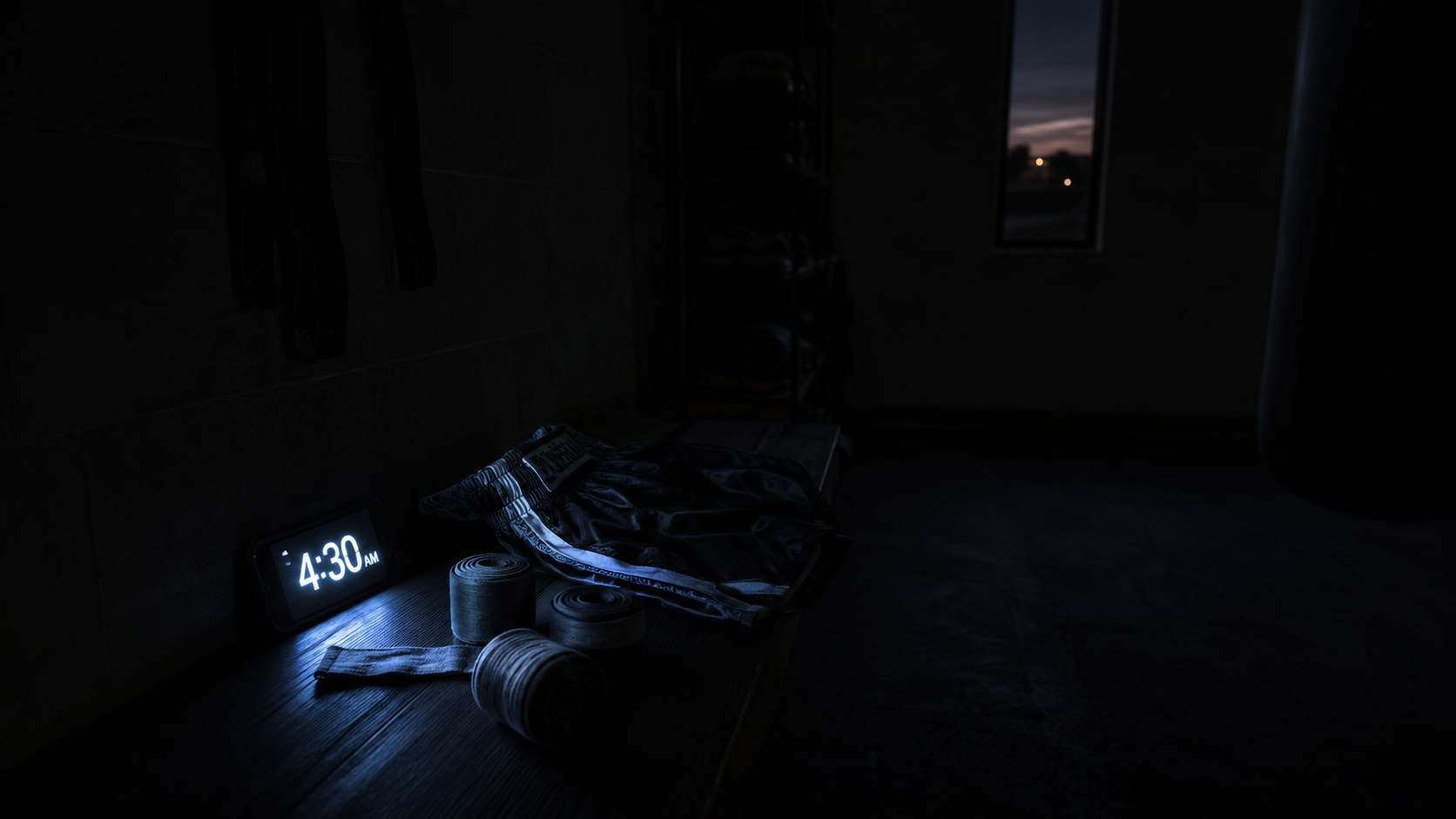
The most common error when time is limited is to trade sleep for a training session. The logic is intuitive: training is the stimulus for adaptation, so more training produces more adaptation. The physiology reverses this. An additional session generates more demand on the repair and consolidation systems. If those systems are already operating below capacity due to sleep restriction, the additional demand is not processed. The athlete accumulates stimulus without executing adaptation, which over time produces diminishing returns and elevated injury risk without the corresponding gains. This is the same mechanism that drives the fatigue component of the fitness-fatigue balance past the point that recovery can clear it.
A related error is treating weekend recovery sleep as a reset for a week of restriction. Extended sleep on Saturday and Sunday does address some of the subjective experience of sleep debt, specifically the adenosine component, because adenosine clearance is relatively rapid once adequate sleep is obtained. The anabolic and hormonal deficits accumulate differently. A week of attenuated GH pulses does not produce a proportionally larger pulse on the weekend nights; the missed secretory events are not recovered. Glycogen resynthesis shortfalls from training days mid-week are not retroactively addressed. Weekend catch-up sleep reduces the subjective fatigue burden without fully repairing the physiological deficit.
A third error involves the use of caffeine and similar stimulants to manage wakefulness under sleep restriction. Caffeine suppresses the subjective experience of sleep pressure by occupying adenosine receptors, which blocks the signal but does not address the underlying accumulation. An athlete who feels functional on five hours and two espressos is not operating at their rested baseline; they have lost the ability to accurately perceive their own deficit. Reaction time, decision-making, and skill execution are measurably impaired under sleep restriction regardless of subjective alertness. Stimulant-managed wakefulness masks the signal; it does not restore the function.
FOUR ERRORS THAT COMPOUND SLEEP DEBT
1
Trading Sleep for a Training Session
Additional training generates more demand on repair and consolidation systems already operating below capacity. The athlete accumulates stimulus without executing the adaptation that depends on it.
2
Treating Weekend Sleep as a Reset
Adenosine clears relatively quickly on recovery nights. GH pulse attenuation and glycogen resynthesis shortfalls do not recover retroactively. The subjective debt clears before the physiological debt does.
3
Managing Wakefulness with Stimulants
Caffeine occupies adenosine receptors, suppressing the sleep-pressure signal without clearing adenosine from the brain. Perceived alertness does not reflect actual reaction time and skill capacity.
4
Maintaining Training Volume Under Restriction
High-volume training under chronic sleep restriction generates stimulus that cannot be processed. Training hours are partially wasted while the recovery burden continues to grow.
The fourth error is prioritizing training volume over training quality during periods of sleep restriction. How sleep debt affects strength gains is a question with a consistent answer in the literature: restriction impairs the adaptation to training, not only the performance during it. Continuing high-volume training under chronic sleep restriction generates stimulus that cannot be fully processed, which means training hours are partially wasted while simultaneously increasing the recovery burden. Reducing training volume to a level that can be adequately recovered on available sleep is physiologically more productive than maintaining volume while restricting sleep further to accommodate it.
Stimulant-managed wakefulness masks the signal; it does not restore the function.
What This Looks Like When Applied

An athlete who understands the mechanisms described above would treat sleep differently than an athlete who understands only that sleep matters. The behavioral difference is not primarily about sleep hygiene or wind-down routines; it is about how sleep gets weighted against competing demands. If the GH pulse is the primary anabolic signal for tissue repair, and it depends on slow-wave sleep, and slow-wave sleep requires sufficient total sleep duration, then each night that falls short of adequate duration is a night where the repair signal is diminished. Training volume is not a variable that can be increased to compensate.
An athlete recovering from a period of sleep restriction faces a deficit that is real but also bounded. Adenosine clearance, the component most directly associated with the resolution of cognitive fatigue, responds relatively quickly to restoration sleep. The HPA axis takes longer to normalize. The practical implication is that feeling better after one good night of sleep does not mean full physiological recovery has occurred. Training load during a restoration period warrants reduction to allow the endocrine and metabolic deficits to close before full intensity resumes.
FAST RECOVERY
Adenosine Clearance
Associated with resolution of cognitive fatigue. Clears relatively quickly once adequate sleep is restored. One or two good nights produces meaningful subjective improvement.
Recovery speed
SLOW RECOVERY
HPA Axis Normalization
Cortisol dysregulation from chronic sleep restriction takes longer to resolve. Feeling better after one recovery night does not mean the endocrine and metabolic deficits have closed.
Recovery speed
The glycogen and carbohydrate relationship is worth noting specifically. Athletes aware of the glycogen resynthesis dynamics would treat post-training carbohydrate intake as more important, not less, during periods of restricted sleep, because the shortened overnight window makes each overnight resynthesis cycle less efficient. This is not a recommendation to eat more; it is a recognition that the timing and adequacy of carbohydrate relative to training sessions carries greater weight when the overnight resynthesis window is compressed.
The protein synthesis picture also has a practical implication that follows directly from the mechanism. Research on protein ingestion before sleep demonstrates that dietary protein consumed in the hours before sleep is available as substrate during the anabolic overnight window and supports MPS during that period. This is a timing consideration that follows logically from understanding when and under what conditions the primary anabolic processes operate.
Training volume is not a variable that can be increased to compensate.
Frequently Asked Questions
How much sleep do athletes need?
Most athletes under meaningful training load require eight to ten hours per night. The general population recommendation of seven to nine hours is calibrated for average physical and cognitive recovery demand. Athletes have elevated growth hormone secretory requirements, greater glycogen depletion, and higher motor consolidation demand, which collectively require more sleep time to service fully.
Does muscle repair happen during sleep?
Yes, though not uniformly throughout sleep. The combination of peak growth hormone secretion, reduced mechanical load, and the body's semi-fasted metabolic state during sleep creates conditions that are disproportionately favorable for muscle repair. Curtailing slow-wave sleep attenuates the primary anabolic signal and leaves tissue repair incomplete relative to training demand.
Is it better to sleep or train extra?
From a physiological standpoint, adequate sleep generally outperforms additional training when the two are in direct competition. An extra training session generates stimulus; sleep is when the adaptation to that stimulus is executed. Under sleep restriction, training stimulus cannot be fully processed. Accumulated stimulus without recovery produces diminishing returns and elevated injury risk over time. The fitness-fatigue model explains why net performance declines when fatigue outpaces the recovery window.
Does poor sleep increase injury risk?
Yes. Chronic sleep restriction is associated with a significantly higher rate of sports and musculoskeletal injuries in athlete populations. The mechanistic contributors include incomplete tissue repair across restricted nights, impaired coordination and reaction time, and cortisol-driven suppression of connective tissue maintenance. These factors converge on elevated injury probability that training volume alone does not predict.
How does lack of sleep affect reaction time?
Sleep restriction impairs reaction time through two mechanisms. Incomplete clearance of adenosine from the brain degrades processing speed and focus. Elevated cortisol from HPA axis activation further alters central nervous system signaling. Stimulants like caffeine block adenosine receptors but do not restore function, meaning subjective alertness is not a reliable indicator of actual reaction time capacity.
How Much Sleep Do Athletes Need? The Evidence-Based Answer
The current evidence consistently supports eight to ten hours as the appropriate sleep range for competitive athletes under meaningful training load (Watson 2017). This exceeds the seven-to-nine-hour recommendation for the general population, and the difference is not arbitrary. Athletes have elevated GH secretory demand, greater glycogen depletion and resynthesis requirements, higher motor consolidation load, and more cumulative tissue repair demand per week than sedentary individuals. The recommendation is calibrated to those demands.
The question of whether athletes need more than eight hours of sleep does not have a single numerical answer because the answer depends on total training load, session frequency and intensity, age-related changes in sleep architecture, and the non-training stressors the athlete is managing concurrently. Eight hours is the threshold below which the evidence consistently shows impairment. The optimal point above that threshold is individual. An athlete who trains twice daily under high load, manages a demanding professional and family schedule, and is in their late thirties or forties, a population where slow-wave sleep naturally decreases with age, faces a larger gap between sleep need and typical sleep duration than the research average assumes.
The more useful framing than a specific number is the question of whether the sleep duration an athlete is currently obtaining is sufficient to service the repair, consolidation, and hormonal functions their training load demands. Duration is a proxy for the completion of those cycles. An athlete sleeping six hours who wakes before a full cycle of late-night REM has specifically curtailed motor consolidation. An athlete going to bed late and sleeping seven hours has likely compressed or missed the early-night SWS window and attenuated the primary GH pulse. The number matters because of what the cycles within it are doing, not as a target in itself.
Duration is a proxy for the completion of those cycles. An athlete sleeping six hours who wakes before a full cycle of late-night REM has specifically curtailed motor consolidation.
How much sleep athletes need is ultimately a question about what training adaptation requires. The answer to the first question is bounded by the biological requirements of the second. Athletes who understand those requirements make sleep decisions differently, not because they are more disciplined about sleep hygiene, but because they recognize that the training hours and the sleep hours are not in competition. They are two consecutive phases of the same process — and the fitness-fatigue loop does not close without both.
Training is the stimulus. Sleep is when the adaptation executes. These are not competing priorities — they are two halves of a single biological loop, and the loop does not close without both.
How much sleep an athlete needs is not a lifestyle question. It is a function of how much physiological work the night has to do — growth hormone secretion, glycogen resynthesis, motor consolidation — and whether the time available is sufficient to complete it.
Mydos Performance
— Sustained vs. Borrowed Energy Series —
How Much Sleep Do Athletes Need? A Physiological Breakdown for Serious Athletes
The physiology of what happens after you train — and why cutting it short costs more than you think
By Ricardo Londono, MD/PhD