
The Day After: Why Feeling Ready Isn’t the Same as Being Ready

Post workout fatigue doesn't always announce itself clearly. Hard training sessions leave a signature in what your body is actually capable of doing, not always in how you feel the next morning. Consider a demanding Tuesday session: an hour of hard BJJ rounds, or four work sets of heavy squats followed by accessory volume. Wednesday arrives. Soreness is manageable or gone. Energy is back. Motivation to train has returned. Post workout fatigue next day is simply not there. Every internal signal reads: ready.
The problem is that the signals used to assess readiness and the signals that reflect actual restoration are not the same signals. Soreness, mood, energy, and motivation are produced by a specific set of physiological processes: inflammatory marker resolution, metabolite clearance, and the return of neurological arousal. These processes can resolve well before force production, glycogen stores, and autonomic nervous system balance have returned to baseline. The feeling of being ready and the biological state of being ready can, and frequently do, diverge.
Post workout fatigue is not always experienced as fatigue. Incomplete recovery is fully compatible with feeling energized, motivated, and functional in the early part of a training session or workday. What the rest of this article explains is which biological systems lag behind perception, what those systems require to actually reset, and how the gap between feeling fine and being recovered shows up differently at the gym and at work.
The feeling of being ready and the biological state of being ready can, and frequently do, diverge.
What Post-Workout Fatigue Actually Is, and Why You Don’t Always Feel It
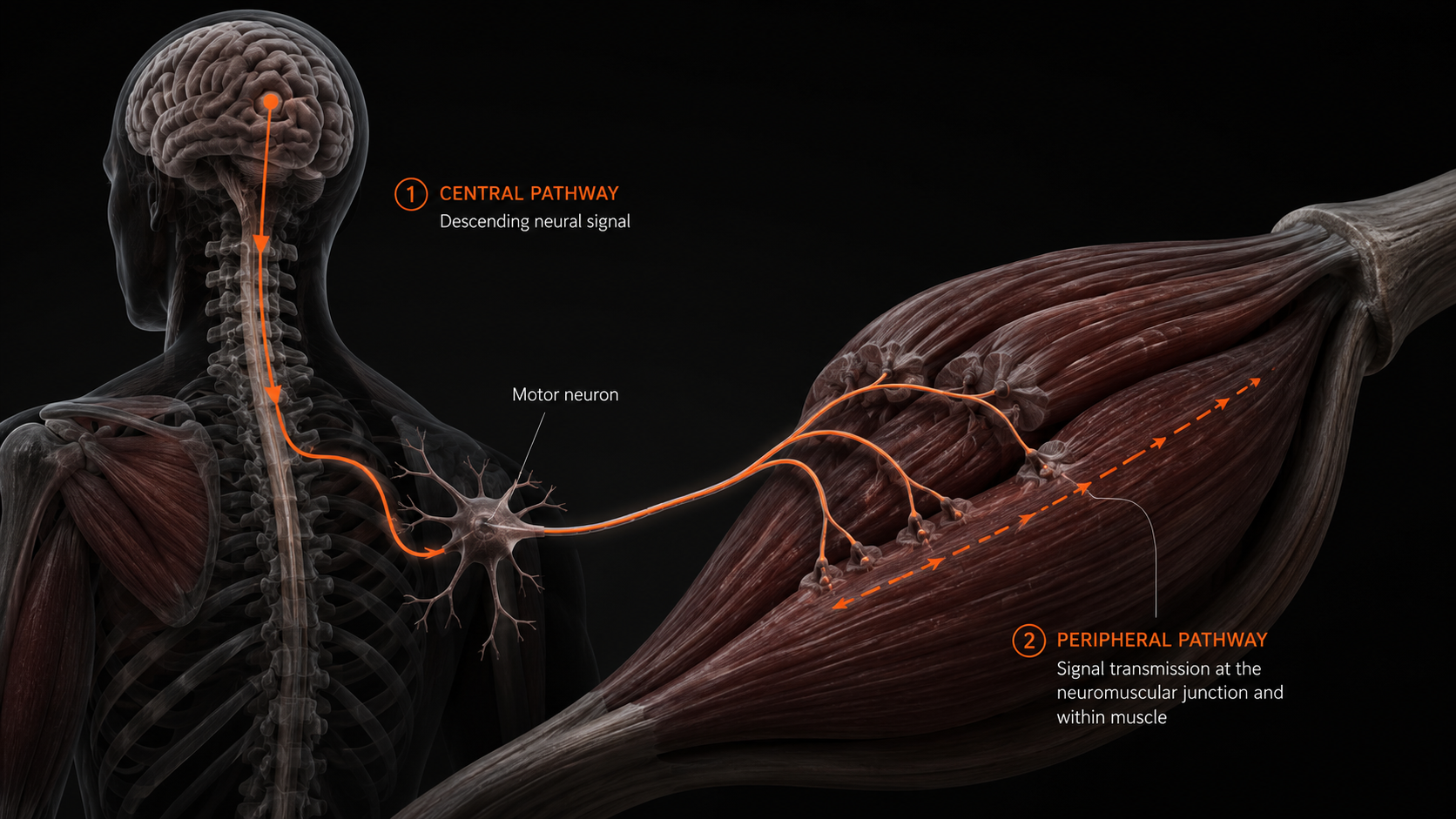
The mechanisms behind post workout muscle fatigue involve several independent biological systems, each with its own restoration timeline and its own way of failing to signal incomplete recovery. Understanding how these systems work separately is what makes the subjective-to-objective gap legible.
The Lagging Indicator Problem
Post workout muscle fatigue has measurable physiological markers that persist beyond the resolution of soreness and the return of subjective readiness: reduced maximal force production, decreased peak power, and elevated rate of perceived exertion at submaximal loads (Peake et al. 2017). In a meta-analysis of soccer match recovery, hamstrings force production capacity remained substantially impaired 72 hours post-match (effect size: -0.7), while subjective well-being showed considerably smaller impairment (effect size: 0.2-0.4) across the same window (Silva et al. 2018). The force deficit and the feeling of readiness coexist without contradiction.
The reason is mechanistic. The experience of fatigue is partly generated by inflammation, altered fluid balance, and metabolite accumulation, byproducts of hard training that produce discomfort and signal the need for rest. These clear through circulation and metabolic processing relatively quickly. Once the inflammatory signature fades and the neurological sensation of heaviness resolves, the person feels recovered. The tissue-level restoration that actually governs performance, including contractile repair, substrate replenishment, and neural drive normalization, operates on a different and longer schedule.
PERIPHERAL FATIGUE
Changes within the muscle itself
Substrate depletion, cross-bridge cycling disruption, and ionic imbalances at the fiber level.
CENTRAL FATIGUE
Changes in the neural signal
Reduced motor drive from the brain and spinal cord to the working muscles — independent of the muscle’s local state.
Subjective recovery tracks the resolution of discomfort. It does not track the restoration of capacity. When these two processes are treated as synonymous, the interval between soreness resolved and actually ready to train becomes invisible.
Neuromuscular Fatigue: The Force Production Gap
Neuromuscular fatigue has two distinct components. Peripheral fatigue arises within the muscle itself: substrate depletion, cross-bridge cycling disruption, and ionic imbalances at the fiber level. Central fatigue involves reduced motor drive from the nervous system, a decrease in the neural signal propagating from the brain and spinal cord to the working muscles. Both mechanisms reduce force output, and both operate on independent timelines (Gandevia 2001). Restoring substrate availability in the periphery does not automatically restore central motor drive, and the two rarely return to baseline simultaneously.
Rate of force development (RFD), the speed at which maximal force can be generated from a low or resting state, is particularly sensitive to neuromuscular fatigue. This quality underpins most high-output athletic movements: explosive entries in BJJ, punching speed, the clean rate in strength work, and first-step reactivity in any defensive or offensive sequence. RFD recovers on a meaningfully slower timeline than peak torque following eccentric exercise (Molina & Denadai 2012). Peak force can be substantially restored while explosive force capacity remains suppressed. The athlete returning to training 24 to 48 hours after a high-intensity session may have adequate peak strength and still be operating with degraded explosive output.
−0.7
FORCE PRODUCTION EFFECT SIZE AT 72H POST-MATCH
0.2–0.4
SUBJECTIVE WELL-BEING EFFECT SIZE — SAME WINDOW
Source: Silva et al. 2018 (PMID 29098658)
In practice, a session that begins with a normal warm-up and comfortable early sets can still reflect a system with reduced RFD in the movements that actually matter. The deficit is not felt; it is measured in bar speed, reaction time, and the rate at which performance falls off during a long round. Central motor drive is also shared with executive attention and cognitive processing, which means suppressed motor output after hard training carries over into cognitive function in the following days. This connection is covered more directly in Section 3.
Glycogen Stores: The Fuel Timeline
Muscle glycogen is the primary fuel for moderate-to-high intensity work. After exhaustive exercise, full glycogen replenishment requires 24 hours or longer under optimal post-exercise carbohydrate conditions, and substantially longer when intake is delayed or insufficient (Jentjens & Jeukendrup 2003). When carbohydrate ingestion is delayed by several hours following training, glycogen synthesis rates can drop by approximately 50 percent relative to the optimal post-exercise window. Athletes who eat adequately overall but not strategically immediately after training may arrive at the following session with sub-optimal glycogen stores despite feeling energized.
The complication is that energy sensation is not governed by muscle glycogen status directly. Mood, alertness, and motivation to train are influenced more by blood glucose regulation, cortisol rhythms, and sleep quality, variables that can normalize well before glycogen stores have been fully restored. A person can feel genuinely ready to perform while carrying a meaningful fuel deficit into the session.
~50%
REDUCTION IN GLYCOGEN SYNTHESIS RATE WHEN CARBOHYDRATE INTAKE IS DELAYED POST-EXERCISE
24+
HOURS FOR FULL GLYCOGEN REPLENISHMENT UNDER OPTIMAL CONDITIONS
Source: Jentjens & Jeukendrup 2003 (PMID 12617691)
Training on depleted glycogen does not announce itself at the start. The deficit typically surfaces mid-session as endurance capacity drops earlier than expected, high-intensity output ceiling decreases, or sustainable pacing becomes difficult to maintain. Across consecutive training days, cumulative glycogen depletion erodes session quality incrementally. No single session feels catastrophically impaired; the degradation accumulates quietly and is frequently attributed to other causes, including “a bad day.”
The Autonomic Nervous System and What Recovery Actually Means
Hard training shifts the autonomic nervous system (ANS) toward sympathetic dominance: heart rate increases, parasympathetic tone decreases, and the systemic stress response is amplified. This is the appropriate biological response to a demanding training stimulus. Autonomic nervous system recovery means restoring parasympathetic dominance, specifically vagal tone, and this process depends on conditions that go well beyond simply stopping training.
The inputs that drive ANS recovery are: sleep architecture (not just duration, but the proportion of deep and REM sleep), cortisol clearance, nutritional support, and the absence of additional novel stressors. These physiological conditions govern the rate at which the ANS rebalances. The subjective experience of feeling rested or relaxed is not an input into this process. The ANS resets in response to actual physiological conditions, not in response to perception of those conditions.
WHAT ACTUALLY DRIVES ANS RECOVERY
Sleep architecture
Proportion of deep and REM sleep, not total duration alone.
Cortisol clearance
Return to normal diurnal cortisol pattern.
Nutritional support
Substrate availability for cellular repair.
Absence of novel stressors
Reduced psychological and environmental load.
A person who sleeps seven hours with fragmented architecture, returns to a high-demand work environment the next morning, and feels fine by evening may still carry measurably suppressed parasympathetic tone. The sensation of being okay and the biological state of being recovered occupy two independent spaces. Sleep quality is a key variable in the recovery relationship, covered in depth in the companion article on sleep and muscle recovery. The most accessible, practical window into ANS balance in daily life is heart rate variability.
Low HRV Meaning: What the Signal Is Actually Telling You
Heart rate variability measures the variation in time between consecutive heartbeats. This variation is primarily regulated by the autonomic nervous system. When parasympathetic (vagal) tone is high, the ANS modulates heart rate fluidly between beats, producing greater variability. When sympathetic dominance is elevated, that modulation is suppressed, and beat-to-beat intervals become more uniform, producing lower HRV.
Low HRV meaning, in the context of recovery, is not a pathological signal. It is a systemic signal: the ANS remains in a more sympathetic-dominant state than baseline. This commonly follows hard training, inadequate or fragmented sleep, accumulated psychological stress, or illness. The important characteristic of low HRV is that it does not reliably produce a subjective sense of limitation. Research on using heart rate measures to monitor training status has demonstrated that HRV can reflect incomplete recovery while athletes report subjective readiness to perform (Buchheit 2014). Vagally-mediated HRV, specifically the RMSSD index, has been validated as a reliable non-invasive marker of parasympathetic nervous system reactivation following exercise (Laborde et al. 2024).
CONDITIONS THAT COMMONLY PRODUCE LOW HRV
Hard training
Particularly high-volume or high-intensity sessions.
Inadequate or fragmented sleep
Poor sleep architecture suppresses parasympathetic reactivation.
Accumulated psychological stress
Sustained work or life demands extend sympathetic dominance.
Illness
Systemic immune activation elevates sympathetic tone.
The practical application of HRV is in the direction of a trend, not the value of a single reading. A morning HRV value that is lower than an individual’s rolling baseline indicates that the system is still in recovery, regardless of how the morning feels subjectively. A consistent downtrend over three to five mornings, even while subjective readiness feels normal, is a reliable indicator of accumulating systemic load. A single low reading is less informative than a direction. For athletes who want to go further on interpreting HRV ranges, wearable protocols, and contextual factors, the companion article on low HRV meaning covers that territory in full.
Restoring substrate availability in the periphery does not automatically restore central motor drive, and the two rarely return to baseline simultaneously.
A morning HRV value that is lower than an individual’s rolling baseline indicates that the system is still in recovery, regardless of how the morning feels subjectively.
What This Gap Looks Like at the Gym and at Work

The mechanisms above are physiological abstractions until they produce observable outcomes. The force production gap, glycogen deficit, and suppressed ANS recovery all express themselves concretely, often subtly, and in ways that are easy to misattribute or miss altogether.
In the Gym — Training on a Base That Hasn’t Reset
The performance signature of incomplete recovery in a training session is characteristically back-loaded. Warm-up feels normal. The first working sets meet expectations. The deficit surfaces later: in sustained output, in the ability to maintain technical precision under load, and in the ceiling of peak-intensity work.
For athletes in combat sports, including BJJ, boxing, and Muay Thai, the expression is often most visible in later rounds of hard sparring or at the end of a drilling block. Reaction time degrades, decision-making under pressure slows, and the ability to sustain high-output bursts shortens. An athlete who has been training on a partially unrestored base long enough may not recognize this as a deficit, because it has gradually become their normal training state. The comparison point, what full recovery actually feels like to train on, has been absent long enough to be forgotten.
EARLY SIGNALS OF INCOMPLETE RECOVERY IN TRAINING
3.1
Bar Speed Decline
Velocity drops earlier in the session at loads that normally feel controlled.
3.2
Early RPE Ceiling
Perceived exertion elevates at submaximal loads before the usual point of fatigue.
3.3
Movement Quality Degradation
Technical precision breaks down in later sets under load.
In strength training, bar speed is among the earliest objective signals. An athlete training on an unrestored neuromuscular base will typically see velocity decline earlier in the session, hit RPE ceilings at loads that normally feel manageable, and have greater difficulty maintaining movement quality across later sets. These are not dramatic failures; they are the kind of incremental degradations that accumulate quietly over a training block and eventually surface as a performance plateau, a nagging injury, or a long stretch of sessions that feel unexpectedly hard.
The injury risk dimension is worth naming directly. Neuromuscular fatigue increases the probability of movement pattern breakdown under load. Most non-contact training injuries do not occur when athletes are completely exhausted and visibly impaired. They occur when athletes are partially fatigued and still operating at near-maximal effort, precisely the scenario a person who feels fine enters with confidence. Full proprioceptive control and accurate motor output require both peripheral muscle function and intact central motor drive. Both are compromised by incomplete recovery.
At Work — Cognitive Fatigue Symptoms and the Executive Performance Lag
Cognitive fatigue symptoms after a demanding training block are mechanistically continuous with the physical recovery deficit described above. Central nervous system load, suppressed dopaminergic and serotonergic activity, and elevated systemic cortisol are shared variables between physical training stress and cognitive performance. The two systems draw from the shared recovery budget, not separate ones.
COGNITIVE PERFORMANCE AFTER A HIGH-LOAD WEEK
Reduced working memory
Fewer competing considerations held in active processing simultaneously.
Slower decision-making under pressure
Longer processing time in high-stakes situations.
Earlier analysis fatigue
Sustained cognitive tasks require more effort and produce less thorough output.
Research has established that prior cognitive effort impairs subsequent physical exercise performance by elevating the subjective perception of effort, even when cardiorespiratory and muscular output parameters remain unchanged (Marcora et al. 2009). The relationship runs in the other direction as well: a hard training week imposes CNS load that reduces working memory capacity, processing speed, and executive function in the days that follo
Training load and work stress draw from the same recovery budget
CNS load, neurotransmitter shifts, and elevated cortisol are shared variables between physical training stress and cognitive performance. A hard training day and a demanding work day don't tap separate reserves — they spend the same one. Draw on both at once and it drains faster than either alone.
Hard training day — physical load draws on the budgetThe professional expression of this is subtle but specific. A person finishing a demanding week of both training and work-related stress may make decisions that feel confident and well-considered but are generated on a reduced information-processing base. They hold fewer competing considerations in working memory simultaneously, fatigue more quickly in tasks requiring sustained analysis, and arrive at conclusions with slightly less thoroughness under time pressure. These reductions are real; they are simply not felt as impairment from the inside.
The interaction also flows bidirectionally. A psychologically demanding work environment, involving back-to-back high-stakes decisions, sustained deadline pressure, and difficult interpersonal situations, extends the time required for the ANS to rebalance after training. A stressful afternoon of work does not allow the body to recover at the same rate as the same time spent in a genuinely low-demand state. A weekend that is full of family obligations, travel, social scheduling, and background work anxiety is not automatically a recovery window regardless of how rested it feels on Sunday evening.
The comparison point, what full recovery actually feels like to train on, has been absent long enough to be forgotten.
The two systems draw from the same recovery budget, not separate ones.
The Most Expensive Mistake: Confusing Absence of Symptoms with Restoration

The practical consequence of using subjective readiness as the primary metric for training decisions is a set of recurring, predictable errors. Each one traces back to a mechanism already described in this article.
The most common error is treating the absence of soreness as confirmation of readiness. Delayed onset muscle soreness (DOMS) is generated primarily by inflammatory processes following eccentric muscle damage. Those inflammatory processes clear considerably faster than the neuromuscular recovery they accompany. Soreness typically peaks at 24 to 72 hours and then resolves, while force production deficits and RFD suppression persist across the same window and beyond. Soreness resolution marks the end of the inflammatory signal, not the restoration of mechanical capacity.
The second error is sliding into functional overreaching without recognizing it. Functional overreaching is a state in which accumulated training load has transiently exceeded the body’s capacity to adapt, producing short-term performance decrements without lasting psychological damage (Meeusen et al. 2013). It is recoverable with adequate rest. But it frequently goes unrecognized when subjective feel is the primary readiness signal, because each individual session feels manageable even while the cumulative load is building. The athlete continues adding sessions on top of unresolved fatigue for days or weeks. By the time the performance drop becomes undeniable, the recovery requirement is longer than it would have been with earlier load adjustment. The companion article on overtraining symptoms covers the progression from functional overreaching into non-functional overreaching and overtraining syndrome.
WHAT CLEARS WITHIN 24–48 HOURS
Discomfort resolves; readiness returns
Delayed onset muscle soreness (DOMS), inflammatory discomfort, metabolite clearance, neurological sensation of heaviness, energy and motivation.
WHAT PERSISTS BEYOND 48 HOURS
Capacity restoration takes longer
Neuromuscular force production capacity, rate of force development (RFD), glycogen stores (without optimal refueling), autonomic nervous system balance.
The third error is treating training stress as categorically separate from work and life stress. The ANS does not distinguish between physical training load and psychological load when allocating recovery resources. A week of demanding professional obligations, including extended high-stakes decision-making, significant interpersonal conflict, and disrupted sleep from travel or early meetings, reduces the physiological resources available for training adaptation. An athlete who maintains full training intensity through a high-work-stress period without adjusting load is accumulating a recovery deficit that will eventually produce a performance signal. The lag between the onset of the deficit and when it becomes felt can be days to weeks.
The fourth error is treating a single adequate night of sleep as an ANS reset. Restoring parasympathetic balance after several consecutive nights of poor sleep quality requires multiple nights of well-architected sleep. A single good night partially reduces the accumulated sympathetic load, but it does not clear trending ANS suppression developed over several suboptimal nights. The number that matters is not last night’s sleep hours; it is the quality trend across the past several nights.
Soreness resolution marks the end of the inflammatory signal, not the restoration of mechanical capacity.
Recovery Time Between Workouts: What the Biology Actually Suggests

How much recovery time between workouts is not a question with a fixed answer. Recovery time is a dynamic variable, different after every session and different for every athlete at every point in their training cycle. It is a function of training intensity and volume, sleep quality in the preceding nights, cumulative systemic load, nutritional substrate, and total stress from all sources. A blanket rule, whether 48 hours between sessions, 72, or any calendar-based guideline, ignores all of these inputs.
The more useful framing is mechanistic: how long until glycogen is restored, neuromuscular output has returned to baseline, and parasympathetic tone has rebalanced? After a moderate session with good recovery conditions, including optimal post-session nutrition, high-quality sleep, and minimal psychological stress, the answer might be 24 hours. After a high-volume training week alongside a demanding work project, disrupted sleep, and elevated baseline stress, the answer might be 72 hours or more. Subjective feel does not reliably distinguish between these two states.
The practical signals worth monitoring are accessible without sophisticated equipment. Morning heart rate variability, measured consistently before rising and trended over three to five readings, provides a directional indicator of ANS state. Resting heart rate on waking tracks in the same direction: a consistent elevation above individual baseline signals accumulated systemic load, not simply cardiovascular demand. Within the training session itself, bar speed and rate of perceived exertion (RPE) at submaximal loads are among the earliest indicators of a base that has not fully reset. An athlete who notices elevated RPE in the second and third working sets at loads that normally feel controlled has real, actionable information about their actual state, independent of how they felt walking through the door.
OBJECTIVE RECOVERY SIGNALS WORTH MONITORING
5.1
Morning HRV Trend
Tracking below individual baseline over 3–5 readings indicates ANS in sympathetic-dominant state. Single readings are less informative than direction.
5.2
Resting Heart Rate on Waking
Consistent elevation above individual baseline signals accumulated systemic load, not simply training demand.
5.3
Early-Session Bar Speed and RPE
Elevated perceived exertion at submaximal loads in the second and third working sets indicates a neuromuscular base that has not fully reset.
The integration between professional load and training load is the point that most high-performing athletes and professionals underestimate systematically. During a demanding work period, involving significant projects, travel, sustained high-stakes pressure, and disrupted sleep schedules, the appropriate training adjustment is reduced volume and intensity. This adjustment is not optional and it is not detraining. The ANS requires the same recovery inputs regardless of where the stress originated, and accounting for professional load in training decisions is load management that reflects the full systemic picture, not just the gym component of it.
Treating subjective readiness as the only input to training and recovery decisions is navigating by a signal known to lag behind physiological reality. Pairing it with objective indicators gives recovery decisions a more accurate foundation.
Treating subjective readiness as the only input to training and recovery decisions is navigating by a signal known to lag behind physiological reality.
Frequently Asked Questions
How long does post workout fatigue last?
Post workout fatigue varies by system. Subjective symptoms typically resolve within 24 to 48 hours, but neuromuscular force production can remain impaired for 48 to 72 hours, glycogen replenishment requires at least 24 hours under optimal conditions, and autonomic nervous system balance depends on sleep quality and accumulated stress load, not on the clock alone.
Is feeling fine after a workout a sign of full recovery?
Not reliably. Subjective readiness reflects the resolution of inflammatory discomfort, including soreness, fatigue sensation, and neurological drag. It does not track the restoration of force production capacity, glycogen stores, or autonomic nervous system balance. All three systems can remain below baseline while subjective readiness has returned to normal.
What does low HRV mean after training?
Low heart rate variability after training indicates that the autonomic nervous system remains in a sympathetic-dominant state. Parasympathetic tone, which governs the recovery state, has not yet rebalanced. A morning HRV reading below an individual’s rolling baseline suggests that recovery is still in progress, regardless of how rested the person feels subjectively.
How many rest days between workouts does the body need?
Recovery time between workouts is not fixed. It depends on training volume and intensity, sleep quality in the preceding days, nutritional substrate, and total stress from work and life. After a moderate session with good recovery conditions, 24 hours may be sufficient. After high-volume training during a high-stress period, 48 to 72 hours or more may be required.
Can work stress slow down recovery from training?
Yes. The autonomic nervous system does not distinguish between physical training stress and psychological stress when allocating recovery resources. A demanding work period involving poor sleep, sustained cognitive load, and elevated cortisol extends the time required for parasympathetic tone to rebalance after training. Work stress and training stress share the same recovery budget.
The Takeaway
Feeling fine after training is real information. It reflects the resolution of a specific set of recovery signals: inflammation clearing, metabolites processed, neurological energy and motivation returned. These are genuine changes, and they are meaningful. What they do not reflect is the status of the systems that actually govern performance capacity.
Neuromuscular output, glycogen stores, and autonomic nervous system balance operate on independent restoration timelines. They do not reliably telegraph their status through how you feel. At the gym, this determines whether the next training session builds on a restored base or adds load to a system still in the process of adapting to the previous stimulus. At work, it determines whether decisions made at the end of a hard week are produced by a fully functional cognitive system or one running quietly below baseline while feeling adequate.
Recovery is a physiological process with specific inputs: sleep architecture, nutritional substrate, reduced systemic load, and time. The subjective sense of readiness satisfies none of those requirements on its own. The more reliable posture is to treat feeling fine as one data point among several, informative but bounded, and most accurate when paired with objective signals that reflect what the body is actually doing rather than what it reports feeling like doing.
Recovery is a physiological process with specific inputs: sleep architecture, nutritional substrate, reduced systemic load, and time.
Feeling fine is not the same as being recovered. The biology of readiness runs on a different clock than your perception of it.
Force output, glycogen stores, and autonomic nervous system balance each operate on their own restoration timelines. None of them announce incomplete recovery through how you feel — which is exactly why pairing subjective readiness with objective signals changes the quality of training decisions.
Mydos Performance
— Fatigue, Recovery and Durability Series —
Post Workout Fatigue: Why Feeling Fine Doesn’t Mean You’re Recovered
What subjective readiness can and cannot tell you about biological state
· By Ricardo Londono, MD/PhD ·