
The Gap Between Feeling Fine and Actually Being Fine

What causes muscle fatigue during exercise is the starting point for answering one of the most consistent questions in exercise physiology: why does performance collapse late in a workout or race when the early stages felt entirely manageable? The experience of feeling capable, then hitting a wall that seems to appear from nowhere, is both predictable and mechanistic. The central governor theory offers the organizing framework for what is actually happening: the brain, not the muscles, is the primary regulator of performance, and it begins limiting output well before anything has catastrophically failed.
This gap between what you feel and what is happening physiologically is not a glitch in the system. It is built into how the body manages energy and protective regulation. Subjective effort is a lagging indicator of physiological state, not a live readout. By the time the difficulty spike arrives, several systems have already been declining for some time.
This matters for one practical reason: athletes who calibrate by feel are working with incomplete information. The experience of extreme fatigue during exercise arrives as a single acute event, but it reflects the simultaneous collapse of compensatory buffers that have been thinning since the session began. Those buffers are finite, and what follows explains what is depleting them.
Subjective effort is a lagging indicator of physiological state, not a live readout.
Four Systems That Fail Before You Notice
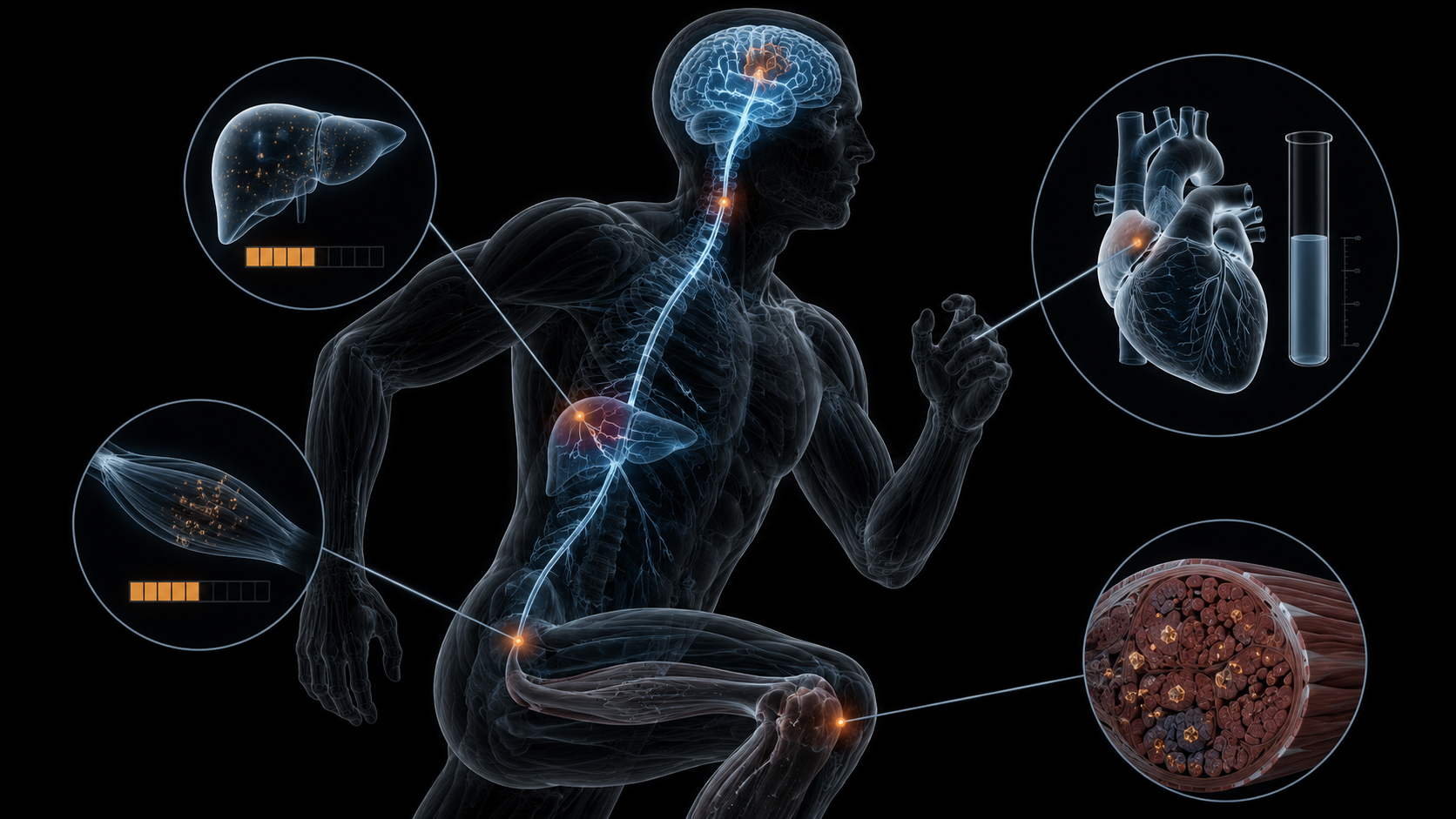
Late-stage performance decline is the product of four biological systems deteriorating in parallel. They do not fail in a clean sequence of discrete stages. They accumulate concurrently throughout the effort, each one's decline accelerating the others. The subjective experience of sudden collapse late in exercise reflects the simultaneous exhaustion of their compensatory reserves, not the sudden appearance of a new problem.
01
Glycogen Depletion
When muscle glycogen falls below a critical threshold, the body shifts to fat oxidation, which generates ATP more slowly and at higher oxygen cost — reducing sustainable power output before the athlete perceives any change.
02
Cardiac Drift
Plasma volume loss reduces stroke volume; heart rate rises at constant workload to maintain cardiac output, producing measurable cardiovascular deterioration that is invisible to the athlete without objective monitoring.
03
Peripheral Fatigue
Inorganic phosphate accumulates, pH falls, and calcium handling deteriorates inside the muscle fiber, progressively reducing the force produced per contraction while the athlete attributes the difficulty to general effort.
04
Central Governor Regulation
The brain continuously integrates signals from all three systems and reduces motor drive output to enforce a ceiling that prevents catastrophic physiological failure — well before the muscles actually fail.
When the Primary Fuel Runs Out
The body uses multiple substrates during exercise, but it strongly prefers carbohydrate at moderate to high intensities. Carbohydrate, stored as muscle glycogen in the muscles and liver, generates ATP at a rate that fat oxidation cannot match (Romijn et al. 1993). At race pace or high-effort training intensities, the speed of ATP production matters more than total fuel available, and fat oxidation is substantially slower.
When glycogen falls below a critical threshold, the body shifts toward fat as its primary substrate. Fat stores are not depleted in this scenario, and the athlete will not bonk from running out of fat. The problem is that fat produces ATP less efficiently per unit of oxygen consumed and at a lower absolute rate (Romijn et al. 1993). The practical outcome is a reduction in the power output sustainable at the same metabolic cost, or an increase in the metabolic cost of sustaining the same power output. The shift does not feel like anything specific at the moment it occurs. What arrives, some minutes later, is the downstream consequence of running the engine on a slower fuel source. For a deeper look at the depletion timeline, see glycogen stores and how long they last at different intensities.
Glycogen depletion also does not operate in isolation. It raises thermal load, reduces the buffer available to the cardiovascular system, and amplifies the peripheral fatigue signals feeding into the brain's regulatory system. Each mechanism in this section compounds the others.
Multiple systems exhaust their compensatory reserves simultaneously, and the aggregate regulatory output is felt as a single, acute event.
Cardiac Drift — Why Your Heart Rate Rises at the Same Pace
Cardiac drift refers to the progressive rise in heart rate at a constant workload during sustained exercise, typically beginning within 10 to 20 minutes of moderate to high intensity effort. It is one of the clearest measurable examples of the gap between subjective effort and physiological state, because it is quantifiable on any heart rate monitor and yet invisible to the athlete who is not watching.
The primary driver is plasma volume reduction. As sweat losses accumulate, the total volume of blood in circulation decreases. Stroke volume, the amount of blood pumped per heartbeat, falls as cardiac filling pressure drops. The heart compensates by increasing its rate to maintain cardiac output, which is the product of stroke volume and heart rate (Coyle and Gonzalez-Alonso, 2001). A rising heart rate at constant power is not the heart working harder in any meaningful physiological sense. It is the cardiovascular system compensating for a declining blood volume by increasing beat frequency.
A rising heart rate at constant power is not the heart working harder in any meaningful physiological sense.
A secondary driver compounds this mechanism. Rising core temperature during sustained effort diverts blood flow toward the skin for thermoregulation, reducing the volume available to working muscles. At sustained efforts in warm conditions, both mechanisms operate simultaneously, each accelerating the other. The result is that heart rate climbs five to ten beats per minute over 20 to 30 minutes of steady effort while perceived exertion remains flat. When the gap between cardiac output and muscular demand becomes large enough to affect performance, everything feels harder at once.
Peripheral Fatigue — What's Happening Inside the Muscle
Peripheral fatigue is defined as a reduction in the force-generating capacity of the muscle originating at or below the level of the neuromuscular junction. It is the mechanical layer of fatigue, occurring independently of what the brain is regulating or what the cardiovascular system is delivering.
Three specific cellular mechanisms are primarily responsible. First, as ATP is hydrolyzed during muscle contraction, inorganic phosphate accumulates inside the muscle fiber. Elevated inorganic phosphate directly impairs cross-bridge cycling, the physical interaction between actin and myosin filaments that generates contractile force, by reducing the force produced per cross-bridge and impairing calcium release from the sarcoplasmic reticulum (Allen et al. 2008). Second, the accumulation of hydrogen ions from accelerated metabolism lowers the pH inside the muscle fiber. Reduced pH impairs the sensitivity of troponin to calcium and reduces the activity of myosin ATPase, the enzyme that drives the contraction cycle (Fitts, 1994). Third, the sarcoplasmic reticulum becomes progressively less effective at releasing and reuptaking calcium with repeated stimulation, disrupting the coupling between the neural signal arriving at the muscle and the contraction that should follow — a process known as calcium handling deterioration (Allen et al. 2008).
Each of these processes is gradual, but their combined effect on force production is not linear. There is a threshold quality to peripheral fatigue: the muscle functions normally across a range of cumulative work, then force output drops steeply as multiple impairments converge. The athlete does not experience this at the cellular level. They experience the downstream output, which is increasing effort required to maintain the same mechanical result from the muscle.
The Central Governor Theory — The Brain's Protective Shutdown
The three mechanisms described above produce a continuous stream of signals reaching the brain: falling metabolic fuel reserves, rising cardiovascular strain, degrading contractile efficiency. The central governor theory, developed by exercise physiologist Tim Noakes, proposes that the brain continuously integrates these signals and adjusts motor drive output to keep the body operating within physiologically safe boundaries (Noakes, 2000).
The brain's regulatory output is motor drive: the frequency and the number of motor units activated in the working muscles. As the cumulative load from the four systems rises, the brain progressively reduces motor unit recruitment. The athlete experiences this reduction as fatigue, specifically as the sensation that maintaining the same effort requires increasing will. Physiologically, it is a protective downregulation. The muscles have not reached a point of catastrophic failure. The brain has moved the ceiling downward to prevent them from doing so.
The perceived wall is not a floor being hit. It is a ceiling being enforced.
The practical implication of this model is that the perceived wall is not a floor being hit. It is a ceiling being enforced. When an athlete reaches what feels like their absolute limit, there is always a margin of remaining physiological capacity that the brain has chosen not to deploy (Tucker, 2009). This is not an argument for ignoring the signal. The signal exists because the underlying load is real. It is an argument for understanding what the signal actually represents: a regulatory output calibrated to cumulative physiological load, not a readout of objective muscle failure.
The central governor integrates all four systems described in this section. As glycogen falls, cardiac output becomes less efficient, and peripheral fatigue degrades force production, each contributes to the regulatory calculation. The ceiling adjusts incrementally with each signal. The athlete feels the accumulation suddenly rather than gradually because the brain's compensatory willingness to maintain drive against rising signals reaches a limit across multiple systems simultaneously, and the regulatory output changes in a way that feels abrupt.
When Both Systems Fail at Once
The distinction between central fatigue and peripheral fatigue is useful for understanding mechanism, but the two are not independent processes in practice. They accumulate in parallel throughout the effort, and their convergence is what produces the characteristic experience of late-stage exercise collapse. Central fatigue refers to the reduction in motor drive originating in the central nervous system. One contributor is a shift in the neurotransmitter environment during prolonged exercise. As tryptophan crosses the blood-brain barrier and is converted to serotonin, the ratio of serotonin to dopamine in relevant brain regions increases. This ratio shift is associated with reduced motivation and elevated perceived effort (Davis & Bailey, 1997). The evidence for this specific mechanism is suggestive rather than definitive, and it represents one of several contributors to central fatigue rather than a complete explanation.
Peripheral fatigue is the contractile layer deteriorating independently within the muscle. Both layers accumulate throughout the effort. The brain's capacity to sustain motor drive despite rising peripheral fatigue signals is the buffer that produces the feeling of fine. When central drive can no longer compensate for the degree of peripheral decline, both layers cross their effective thresholds in proximity to each other. Multiple systems exhaust their compensatory reserves simultaneously, and the aggregate regulatory output is felt as a single, acute event.
Multiple systems exhaust their compensatory reserves simultaneously, and the aggregate regulatory output is felt as a single, acute event.
What This Looks Like When You're Actually Racing (Or Training Hard)

The hitting the wall marathon experience is the most thoroughly documented real-world instance of multi-system convergence, and the clearest concrete example of what the central governor is protecting against. Around miles 18 to 22 in most recreational marathon runners, glycogen is near depletion, cardiac drift has been accumulating for two hours or more, peripheral fatigue has been building since the early miles, and the central governor begins enforcing a ceiling that the current pace cannot meet. The result is a sudden, severe drop in performance that most marathon runners who have hit the wall recognize immediately. The mechanism is not new at that point. Everything that produces the wall has been building from the start. What changes at mile 20 is that the compensatory buffers across all four systems run out in proximity to each other.
The same sequence occurs across shorter, higher-intensity efforts, compressed onto a much shorter timeline. In Brazilian jiu-jitsu, Muay Thai, and boxing, the equivalent window is typically the second half of round two onward, depending on intensity and the individual's conditioning level. An athlete who trains seriously in these disciplines has likely noticed that the first 60 to 90 seconds of a hard round feel manageable, and then something changes. At near-maximal intensities, glycogen utilization rates via glycolytic pathways are much higher, cardiac strain accumulates faster, and peripheral fatigue in the specific movement patterns of the sport appears before the round is over. The central governor enforces its ceiling faster and at a lower level of total accumulated work.
STARTING TOO HARD
All Four Timelines Accelerate
Glycogen depletes faster. Cardiac drift accumulates faster. Peripheral fatigue builds faster. The central governor enforces its ceiling earlier and at a lower level of total work performed.
PACING TO THE SYSTEM
All Four Timelines Extended
Glycogen preserved longer. Cardiac load managed. Peripheral buffering maintained longer. The governor ceiling stays higher across the effort and drops later.
The implication for performance management follows directly from the mechanism. The central governor's effective ceiling at any given point in an effort is set by the cumulative physiological load up to that moment. An athlete who starts harder than the effort requires moves all four timelines forward simultaneously: glycogen utilization rate increases, cardiac strain accumulates more rapidly, peripheral fatigue develops faster, and the effective ceiling drops earlier in the session. Pacing is not a psychological strategy for managing discomfort. It is a physical strategy for managing the timeline of four simultaneously accumulating systems. The science of oxygen delivery and aerobic conditioning explains why trained athletes can sustain higher absolute intensities before reaching the same relative thresholds.
Pacing is not a psychological strategy for managing discomfort. It is a physical strategy for managing the timeline of four simultaneously accumulating systems.
The Misreadings That Cost Performance

The first misreading is treating the wall as a mental failure. Because the central governor mechanism involves subjective difficulty and reduced motivation, athletes frequently interpret the late-stage difficulty spike as a failure of will or a fitness problem. The mechanism does not support this framing. The brain is doing precisely what it is designed to do: regulating motor output to prevent catastrophic failure. Labeling this a mental failing is physiologically inaccurate and produces no useful corrective information, because the right response to central governor regulation is not to override it with willpower but to understand what accumulated load triggered it.
The second is using perceived exertion as a real-time proxy for physiological state. Cardiac drift is silent without objective monitoring. Heart rate at the start of a session does not predict heart rate at minute 45 at the same power output, but an athlete tracking only feel will not detect the divergence until the performance gap is already significant. The feeling of steady effort can be entirely accurate as a description of perceived exertion and entirely misleading as a description of cardiovascular load.
01
Mental Failure Misattribution
The brain is doing precisely what it is designed to do. The wall is central governor regulation, not a character deficit. Framing it as a mental failure provides no actionable information.
02
RPE as a Proxy for Load
Cardiac drift is invisible without objective monitoring. Perceived effort and cardiovascular strain diverge silently over 20 to 30 minutes of sustained effort.
03
Reactive Fueling
Glycogen depletion does not produce a timely warning signal. The subjective sensation of depletion arrives after the substrate switch is already underway and its downstream effects are in motion.
04
Thirst as a Dehydration Proxy
Cardiac drift begins before the thirst threshold. Plasma volume loss reduces stroke volume and raises heart rate before the sensation of thirst appears — making thirst a lagging indicator of cardiovascular stress.
The third is reactive fueling. Glycogen depletion does not produce a clear, timely warning signal before it begins affecting the other systems. By the time the downstream consequences arrive as perceived fatigue or reduced power output, the depletion process is already well underway and its effects on cardiac drift and peripheral fatigue are accelerating. A fueling strategy triggered by the sensation of depletion arrives too late to prevent the cascade. The sensation is a lagging indicator of a process that began much earlier.
The fourth is interpreting dehydration as a comfort issue. Cardiac drift is a cardiovascular response to plasma volume loss. An athlete who waits to feel thirsty before drinking is tracking a subjective signal that is both delayed and imprecise relative to the cardiovascular mechanism it reflects. Mild dehydration at levels below the thirst threshold reduces stroke volume, raises heart rate, and accelerates thermal load simultaneously, with no distinctive subjective warning.
The feeling of steady effort can be entirely accurate as a description of perceived exertion and entirely misleading as a description of cardiovascular load.
What to Do With This Understanding

For fueling, the mechanism points toward scheduling rather than reactive response. At efforts lasting longer than 60 to 75 minutes, glycogen stores will be affecting performance before the subjective feeling of depletion arrives. Fueling on a predetermined schedule, beginning before depletion is perceptible, follows directly from understanding that the substrate switch is silent and that its effects are already cascading before the athlete notices anything. The relevant question is not whether you feel depleted but whether the duration and intensity of the effort have depleted your stores.
For cardiovascular monitoring, the mechanism points toward tracking heart rate actively during prolonged sessions rather than relying on perceived effort alone. A rising heart rate at fixed power output is an early, quantifiable signal of cardiac drift in progress. Recognizing this pattern before it becomes performance-affecting gives the athlete information that the subjective channel cannot provide. What causes muscle fatigue during exercise is, in large part, the downstream accumulation of these cardiovascular and peripheral fatigue signals. Monitoring the cardiovascular layer in real time reduces the dependence on a channel that consistently reports too late.
FOUR THRESHOLD LEVERS
Glycogen Threshold
Aerobic conditioning raises the intensity at which glycogen becomes the dominant substrate, delaying the fuel depletion timeline and the downstream cascade it triggers.
Cardiac Efficiency
Better cardiovascular fitness reduces the heart rate required at a given power output, slowing the rate at which cardiac drift accumulates and extending the window before cardiovascular performance limits.
Peripheral Buffering
Trained muscles manage inorganic phosphate accumulation and calcium dysregulation more effectively, delaying the onset of force reduction and extending the contractile capacity timeline.
Central Drive Capacity
Conditioning raises the cumulative physiological load the central governor tolerates before enforcing a ceiling, increasing the total work that can be performed before the regulatory ceiling drops.
For interpreting the difficulty spike, the central governor framework shifts the useful question. The question is not whether to push through the discomfort. The question is what threshold the governor has reached and what the underlying signals represent. An athlete who understands the mechanism can evaluate whether the ceiling reflects actual physiological limitation or the exhaustion of the body's willingness to sustain drive against rising costs. That distinction does not make the effort easier, but it provides a more accurate basis for performance decisions than the reflex to label difficulty as a mental problem.
For training, the framework suggests measuring progress as threshold management rather than general conditioning improvement. Better aerobic fitness does not eliminate the four mechanisms. It delays their onset, raises the glycogen threshold at which the substrate switch becomes performance-limiting, improves cardiac efficiency under sustained load, and increases the peripheral buffering capacity of the muscle fiber. A more conditioned athlete runs the same four-system sequence on a longer timeline and at a higher absolute level of work. This is a more precise model for understanding adaptation than the generalized idea of getting fitter.
Better aerobic fitness does not eliminate the four mechanisms. It delays their onset, raises the glycogen threshold at which the substrate switch becomes performance-limiting, improves cardiac efficiency under sustained load, and increases the peripheral buffering capacity of the muscle fiber.
Frequently Asked Questions
What is the central governor theory in exercise physiology?
The central governor theory proposes that the brain is the primary limiter of exercise performance, not the muscles. It continuously monitors signals from the cardiovascular system, metabolic state, and muscles, then reduces motor drive to prevent catastrophic physiological failure. Fatigue, in this model, is a regulatory output of the brain, calibrated to cumulative load.
Why does performance drop late in exercise even when I felt fine earlier?
Multiple physiological systems decline in parallel from the start of exercise: glycogen depletes, cardiac drift accumulates, and peripheral muscle fatigue builds. These processes occur without clear subjective warning because the body's compensatory buffers maintain perceived effort temporarily. When those buffers are exhausted simultaneously, performance drops all at once.
What causes muscle fatigue during exercise?
Muscle fatigue during exercise has two layers. Peripheral fatigue occurs inside the muscle: inorganic phosphate accumulates and impairs cross-bridge cycling, pH drops and reduces enzyme efficiency, and calcium handling deteriorates. Central fatigue originates in the brain, where the central governor progressively reduces motor drive as cumulative physiological load rises. Both layers accumulate and converge.
What is cardiac drift and why does it happen?
Cardiac drift is the progressive rise in heart rate at a constant workload during sustained exercise. As sweat losses reduce plasma volume, stroke volume falls, and the heart compensates by beating faster to maintain cardiac output. Rising core temperature compounds this by diverting blood toward the skin. The result is rising heart rate at constant effort with no change in perceived exertion.
Does hitting the wall in a marathon mean you ran out of energy?
Hitting the wall in a marathon reflects multi-system convergence, not simply depleted energy stores. Glycogen depletion contributes by forcing a shift to less efficient fat oxidation, but cardiac drift, peripheral muscle fatigue, and central governor regulation are accumulating simultaneously. The wall occurs when the compensatory reserves across all four systems are exhausted at the same time.
The Bottom Line
Subjective effort during exercise is not a readout of physiological state. It is a regulatory output of the central nervous system, calibrated to the cumulative load of four simultaneously deteriorating systems. The central governor theory describes the architecture of this regulation: the brain integrates signals from fuel availability, cardiovascular strain, contractile capacity, and neurotransmitter environment, and enforces a ceiling to prevent catastrophic failure.
The gap between feeling fine early and failing late is structural. The compensatory buffers built into each of the four systems create the impression of stable function while the systems are actually declining. When those buffers are exhausted simultaneously, the ceiling drops all at once. The wall is not a surprise event. It is the predictable endpoint of a process that has been running from the first minutes of the effort.
Understanding the sequence does not change the sequence. Glycogen still depletes, cardiac drift still accumulates, peripheral fatigue still builds, and the central governor still enforces its ceiling. What understanding changes is the quality of the decisions made while the sequence is running: when to fuel, what objective signals to monitor, how to interpret the late-stage difficulty spike, and what fitness development is actually building toward. The mechanism is fixed. The decisions around it are not.
The wall is not a surprise event. It is the predictable endpoint of a process that has been running from the first minutes of the effort.
The body does not fail suddenly. It runs a predictable sequence of four deteriorating systems while the brain enforces a protective ceiling, and by the time you feel it, the sequence has been running for some time.
Understanding the sequence does not change it. It changes the quality of the decisions made while it is running: when to fuel, what to monitor, and what the difficulty spike is actually telling you.
Mydos Performance
— What Actually Limits Performance Series —
What Causes Muscle Fatigue During Exercise: Why Performance Falls Off Late (Even When You Feel Fine Early)
Four biological systems are already failing before you notice anything.
· By Ricardo Londono, MD/PhD ·