
The Problem Isn't Motivation

The scenario is familiar enough that most athletes stop questioning it. You finish a full workday, sit down for ten minutes, and the idea of going to the gym feels genuinely impossible. Not difficult or inconvenient. Impossible. The gear bag is in the corner. The session is on the calendar. And yet the body offers nothing that resembles willingness.
The standard interpretation is motivational. You tell yourself you're not feeling it tonight, that you're mentally not there, that you'll make it up tomorrow. This interpretation feels accurate because the experience is real, and something is genuinely missing. The question is what.
What is missing is not motivation. The feeling of not wanting to train is the brain's interpretation of a physiological signal, not a direct readout of psychological state. Energy and motivation are not synonyms. They do not share a mechanism. They do not respond to the same interventions. Treating one as the other produces decisions that are wrong in both directions: skipping sessions the body was capable of completing, or forcing sessions through deficits that training cannot fix. The cost accumulates in both cases, and it is rarely attributed correctly.
The feeling of not wanting to train is the brain's interpretation of a physiological signal, not a direct readout of psychological state.
No motivation to workout is a signal worth reading accurately. This article explains what energy actually is at the cellular level, how the brain converts physiological state into felt experience, and why the conversion is unreliable enough to systematically mislead even experienced athletes. The goal is a more accurate diagnostic framework for a signal that most athletes are currently reading wrong. If you find yourself always tired despite doing everything right, the mechanism described here is likely part of the explanation.
What Energy Actually Is

Energy, in the physiological sense, has a precise meaning that gets lost in everyday usage. At the cellular level, energy is the availability of adenosine triphosphate, or ATP, the molecule that powers muscular contraction, neural signaling, and every other energy-requiring process in the body. ATP itself is not stored in large quantities. It is continuously resynthesized from three overlapping pathways, each dominant at different exercise intensities and durations.
The phosphocreatine system operates over the first ten to fifteen seconds of maximal effort, resynthesizing ATP from stored creatine phosphate without requiring oxygen. Glycolysis takes over for efforts lasting from roughly fifteen seconds to two minutes, breaking glucose or glycogen down to pyruvate and producing ATP rapidly but generating lactate as a byproduct. Oxidative phosphorylation, the aerobic system, dominates for anything beyond two minutes, using oxygen to produce ATP from carbohydrate and fat substrates with significantly higher efficiency and no lactate accumulation at submaximal intensities.
The Three Energy Systems
Phosphocreatine System
Dominant for the first 10–15 seconds of maximal effort. No oxygen required. Fuel: creatine phosphate.
Glycolysis
Dominant from 15 seconds to 2 minutes. Fast ATP production, lactate byproduct. Fuel: glucose or glycogen.
Oxidative Phosphorylation
Dominant beyond 2 minutes. High efficiency, no lactate at submaximal output. Fuel: carbohydrate and fat.
For the athlete training BJJ, boxing, or Muay Thai for an hour after a full workday, oxidative phosphorylation is the system that matters most. The session is not a sprint. It involves sustained moderate-to-high intensity effort with intermittent high-intensity bursts, and that profile places substrate availability and oxygen delivery at the center of what limits performance.
What none of these systems do is report their status directly to conscious experience. There is no internal display showing glycogen reserves at forty percent or ATP resynthesis rate falling. What the body has instead is a sensory signaling system that transmits the physiological state of working muscle to the brain, where it is processed and converted into something the conscious mind can interpret. That conversion is the site of the confusion.
What none of these systems do is report their status directly to conscious experience.
What Glycogen Depletion Actually Feels Like

Glycogen, the stored form of glucose in muscle and liver, is the primary fuel for moderate-to-high-intensity exercise. Fat can be oxidized aerobically, but fat oxidation is rate-limited in a way that becomes consequential as exercise intensity rises. Above roughly sixty to sixty-five percent of maximum oxygen uptake, the rate at which fat can be broken down and delivered to working muscle is insufficient to fully support energy demand (Romijn et al. 1993). The system does not switch cleanly from fat to carbohydrate. It runs them in parallel, with carbohydrate contributing an increasingly large share as intensity increases. Glycogen depletion, therefore, does not reduce an athlete's output gradually. It changes what is physiologically possible.
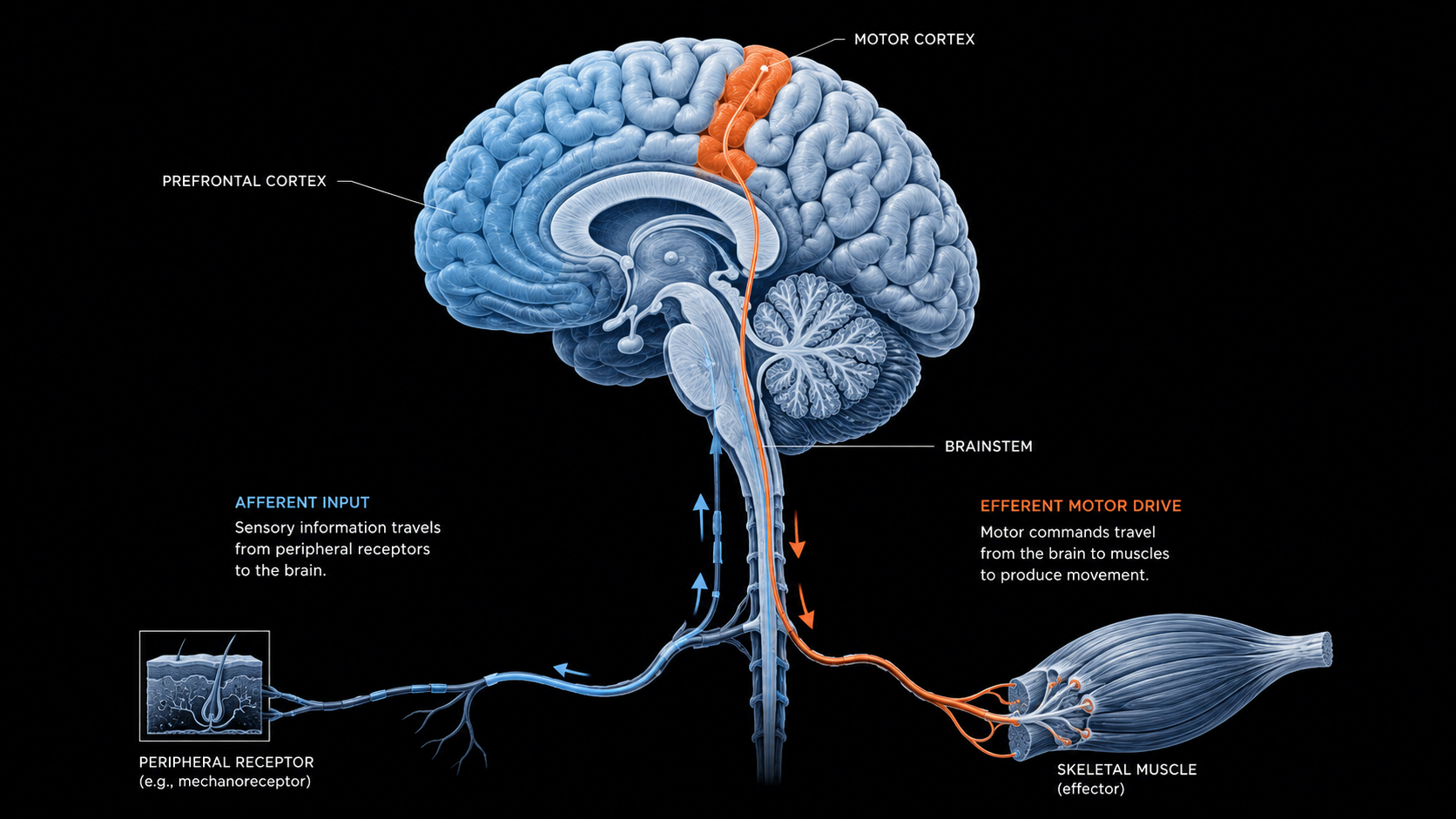
The mechanism through which depletion communicates with the brain runs through sensory neurons embedded in working muscle, classified as group III and IV muscle afferents [CITE: group III IV afferent fibers — Kaufman 2010 or Amann UNVERIFIED]. These neurons are sensitive to mechanical and metabolic changes in the muscle environment, including accumulation of lactate, hydrogen ions, and potassium, as well as changes in muscle temperature and the metabolic signals associated with substrate availability. As glycogen falls and the metabolic environment of working muscle shifts, these afferents increase their firing rate and transmit that signal to the central nervous system.
The CNS response to this incoming signal is not neutral. Elevated afferent activity from metabolically stressed muscle contributes to an increase in the rate of perceived exertion and a reduction in central motor drive, the brain's capacity to recruit and sustain motor unit activation (Marcora et al. 2009). The athlete does not receive this as a precise report. The experience is more diffuse: a heaviness in the limbs, effort that feels disproportionate to pace, a sharpness that is absent from movement that should be automatic. It does not feel like low glycogen. It feels like not wanting to be there. The relationship between glycogen depletion and mental fatigue runs directly through this signaling pathway.
Physiological Signal
Glycogen Depletion
Afferent fibers transmit metabolic stress signals to the CNS. The brain raises perceived effort and reduces motor drive.
Brain's Interpretation
"I'm Not Feeling It."
The athlete reads elevated RPE as motivational absence — not as a substrate and signaling state.
This is the misattribution moment. An athlete arriving at training after a full workday with partially depleted glycogen from the cognitive and mild physical demands of the day will encounter this signal before the warm-up ends. The substrate state is the cause. The motivational interpretation is the brain's best guess at what is producing the experience, not an accurate readout of psychological state.
It does not feel like low glycogen. It feels like not wanting to be there.
The substrate state is the cause. The motivational interpretation is the brain's best guess at what is producing the experience, not an accurate readout of psychological state.
How the Brain Decides How Hard Something Feels
Rate of perceived exertion is one of the most studied variables in exercise physiology, partly because it is the most reliable predictor of performance limits. Gunnar Borg introduced the RPE scale in the 1960s as a tool for quantifying the subjective intensity of exercise, and decades of research confirmed that it tracks closely with physiological parameters including heart rate, oxygen consumption, and lactate levels. The assumption embedded in that relationship, that RPE is a readout of peripheral physiology, shaped how coaches and athletes interpreted the scale for decades.
The picture is more complicated. RPE is not a direct measure of what the body is doing. It is the brain's integrative output, combining afferent signals from working muscle with central factors including arousal state, prior experience, expectation, and the brain's assessment of remaining capacity. Marcora has argued that perceived effort is generated centrally as a corollary discharge from the motor cortex, representing the neural effort required to produce a given motor output rather than the peripheral cost of that output (Marcora et al. 2009). The distinction matters because it means RPE can rise without any change in the muscle's actual contractile capacity.
The central governor model, developed primarily by Tim Noakes and colleagues, extends this logic further. Noakes proposed that the brain functions as a central regulator of exercise intensity, adjusting motor drive output not by waiting for peripheral failure but by anticipating it [CITE: Noakes central governor — UNVERIFIED PMID]. In this framework, the brain integrates incoming physiological signals and uses them to forecast the cost of continued effort, reducing motor drive when the forecast indicates unacceptable physiological risk. The athlete does not run out of muscle. The brain reduces recruitment before that point.
Psychobiological Model (Marcora)
Effort as Central Signal
Perceived effort is a corollary discharge from the motor cortex — the neural cost of sending the movement command, not a readout of peripheral fatigue.
Central Governor Model (Noakes)
Effort as Protective Regulation
The brain anticipates physiological failure and reduces motor recruitment before limits are reached. RPE is the regulatory signal, not a passive readout.
The debate between these models is ongoing in the exercise science literature, and it would be inaccurate to present either as settled consensus. What they share, and what is most relevant here, is the recognition that the felt sense of effort is a brain product, not a peripheral report. It is an estimate, built from real physiological inputs, but subject to interpretation errors. When the central governor processes inputs indicating low glycogen, elevated cortisol, and accumulated CNS fatigue from a full workday, it produces a high RPE estimate before the session begins. The athlete encounters that estimate and reads it as "I don't want to train tonight." What it actually represents is the brain's assessment of current physiological cost, not the body's ceiling.
A high RPE at the start of a session is an opening estimate. It is based on current state, and current state can change once training begins.
The felt sense of effort is a brain product, not a peripheral report.
A high RPE at the start of a session is an opening estimate. It is based on current state, and current state can change once training begins.
CNS Fatigue and the Cost of a Full Workday

Central nervous system fatigue is a specific physiological phenomenon that is frequently conflated with general tiredness or low motivation. For the purposes of this article, CNS fatigue refers to a measurable reduction in central motor drive, specifically the brain's capacity to recruit and sustain motor unit activation, independent of any change in the contractile capacity of the muscle itself. A fatigued CNS produces less motor output for a given subjective effort, but the muscle could do more if the signal telling it to were not attenuated.
The mechanism involves, among other factors, changes in neurotransmitter balance in the CNS. Sustained cognitive work shifts the ratio of serotonin to dopamine in brain regions involved in effort regulation and motivation [CITE: serotonin dopamine CNS fatigue — Meeusen 2006 UNVERIFIED]. Elevated serotonin relative to dopamine is associated with increased fatigue perception and reduced willingness to initiate and sustain high-effort tasks. The prefrontal cortex, which is heavily engaged by the decision-making, emotional regulation, and sustained attention demands of professional work, is also implicated in the regulation of perceived effort. Extended engagement depletes the resources it contributes to that regulation.
5.1
CNS Motor Drive Reduction
Sustained cognitive work shifts the serotonin-to-dopamine ratio in effort-regulating brain regions, reducing the brain's capacity to initiate and sustain high motor output.
5.2
HPA Axis Activation
Workday stress elevates cortisol via hypothalamic-pituitary-adrenal axis activation, suppressing anabolic signaling and amplifying perceived effort cost.
5.3
Elevated Baseline RPE
The central governor integrates these inputs before training begins — the opening RPE estimate is not neutral. It reflects a system that has been running under cognitive and hormonal load all day.
Marcora and colleagues demonstrated this mechanism directly. Participants who performed ninety minutes of cognitively demanding work before an exercise test reached exhaustion significantly faster than control participants, despite identical cardiovascular and metabolic responses throughout the test (Marcora et al. 2009). Heart rate, oxygen consumption, and lactate were the same between groups. The only measured difference was perceived effort, which was elevated throughout the exercise bout in the mentally fatigued group. The physiological cost of the exercise was identical. The experienced cost was not.
The cortisol contribution is also real, though the mechanisms are distinct. Psychological stress activates the hypothalamic-pituitary-adrenal axis, elevating circulating cortisol [CITE: HPA axis cortisol exercise — Duclos 2008 UNVERIFIED]. Cortisol suppresses anabolic signaling pathways, including testosterone and IGF-1 mediated signaling, and influences CNS function in ways that can amplify perceived effort and reduce engagement with high-effort activity. An athlete completing a high-stakes, cognitively demanding workday is not arriving at training with a neutral hormonal environment. The HPA axis has already been activated, and its outputs are shaping how the evening training session will feel before it begins.
An athlete who has spent eight to ten hours in sustained cognitive work arrives at the gym with an elevated CNS fatigue baseline, a shifted neurotransmitter balance, and cortisol-mediated changes in how the brain processes effort. The central governor is already running a conservative estimate. The RPE at warm-up is not a fresh reading. It is the output of a system that has been running under load all day. How well you slept the night before will also have a significant bearing on how much of this CNS load has cleared.
The physiological cost of the exercise was identical. The experienced cost was not.
The RPE at warm-up is not a fresh reading. It is the output of a system that has been running under load all day.
The Second Wind Is Not Recovery. It Is Masking.

Most athletes who train consistently have experienced the second wind. The warm-up feels difficult, the body is reluctant, and the session seems like a mistake. Then, somewhere in the first ten to fifteen minutes, something shifts. The movement becomes less effortful, the earlier reluctance fades, and the session becomes productive. The common interpretation is that the body needed time to warm up, or that pushing through the initial resistance was the right call.
The mechanism is more specific than that, and the distinction matters. When exercise begins, the sympathetic nervous system initiates a catecholamine response, releasing epinephrine and norepinephrine into circulation [CITE: catecholamine exercise onset — Davis 2000 UNVERIFIED; if unverified, remove placeholder — mechanism is physiologically standard]. These catecholamines increase arousal, enhance cardiovascular output, and modulate the brain's processing of incoming afferent signals from working muscle. The elevated afferent activity that was producing a high RPE estimate before training is, in part, suppressed or reweighted by the catecholamine-driven shift in CNS state. The brain's interpretation of the same physiological signals changes. The RPE drops.
What did not change is the underlying physiological state. Glycogen stores were not replenished. CNS fatigue from the workday was not resolved. Cortisol did not normalize. The catecholamine response altered how the brain processed the incoming signals, not the signals themselves. The second wind is a change in interpretation, not a change in substrate availability or central motor drive capacity.
What Changes
Brain's Signal Processing
Catecholamine release shifts how the CNS weights incoming afferent signals. RPE drops. The session feels more possible.
What Doesn't Change
Underlying Physiological State
Glycogen stores are not replenished. CNS fatigue is not resolved. Cortisol does not normalize. The substrate and hormonal state is unchanged.
This distinction is consequential. On a day of mild CNS fatigue and moderate glycogen availability, the catecholamine window produces a productive session. The athlete feels better, performs reasonably well, and the session contributes to adaptation. On a day of genuine physiological depletion or accumulated overtraining, the catecholamine window eventually closes, and the suppressed fatigue signals return. The session that felt possible at minute fifteen becomes a liability by minute forty-five. The second wind, in that case, provided misleading information. Whether that day-to-day variation makes sense is explained in detail in the article on why some days feel effortless and others don't.
The experience of the second wind is data. It is real, it is mechanistically explicable, and it provides useful information about the recoverability of the current state. It is not permission to override all incoming physiological signals. The athlete who interprets it as proof that pushing through is always correct has confused a temporary arousal response for an indication of actual capacity.
The second wind is a change in interpretation, not a change in substrate availability or central motor drive capacity.
What This Looks Like After a Full Workday

The evening training session for a working athlete is not a physiologically neutral starting point. It is the accumulation of a day's worth of physiological demands arriving simultaneously at a window that requires high-effort output.
Consider the inputs that are present before the warm-up begins. CNS fatigue and glycogen stores have been partially drawn down by the metabolic demands of cognitive work, which, while far less glycogen-intensive than physical training, is not without substrate cost over an eight to ten hour period. The HPA axis has been activated by the demands and stressors of the workday, producing elevated cortisol that is suppressing anabolic signaling and influencing CNS processing of effort signals. The serotonin-dopamine balance in the CNS has shifted in the direction associated with elevated fatigue perception. The central governor is running a conservative RPE estimate based on all of this incoming information. And the athlete has not eaten since lunch.
Recoverable State
CNS-Mediated Fatigue
Glycogen partially depleted. Catecholamine response at exercise onset will shift RPE downward. Session becomes productive once underway.
Genuine Deficit
Accumulated Physiological Debt
Glycogen critically low, cortisol significantly elevated, CNS fatigue does not resolve with warm-up. Pushing through extends recovery timeline and increases injury risk.
The felt experience of all of this arriving at once is not low motivation. It is a high physiological cost state being interpreted through the most familiar psychological frame available. The athlete does not have access to a readout of their glycogen level or cortisol concentration. What they have is the experience of not wanting to be there, of the session feeling impossible before it has begun.
Two presentations can produce this experience, and they require different responses. In the first, the fatigue is primarily CNS-mediated and recoverable within a session. Glycogen is depleted but not critically so. The catecholamine response at exercise onset will shift the brain's RPE estimate, and the session will become productive. In the second, the physiological debt is genuine and accumulated. Glycogen is critically low, cortisol is significantly elevated from a sustained high-stress period, and the CNS fatigue is not the kind that resolves with a warm-up. Pushing through this state does not produce adaptation. It extends the recovery timeline and increases injury risk.
From the inside, these two presentations feel identical. Both produce the experience of not wanting to train. Both feel like motivation problems. The body's reporting system does not label them differently. The athlete has to infer which situation applies from indirect signals, and most athletes are not trained to read those signals accurately because they have been taught to interpret the experience as psychological rather than physiological.
The felt experience of all of this arriving at once is not low motivation. It is a high physiological cost state being interpreted through the most familiar psychological frame available.
The Two Ways This Confusion Causes Damage

The misattribution between energy state and motivational state does not produce neutral outcomes. It produces two distinct failure modes, and both are common enough that most serious athletes have experienced them without recognizing the underlying cause.
Failure Mode 1
Overreach
Physiological depletion is read as a motivation deficit. The session is forced. In genuine deficit states, this produces accumulated debt, extended recovery, and a reinforced false narrative.
Failure Mode 2
Avoidance
A recoverable CNS fatigue state is read as physical inability. The session is skipped. The catecholamine response that would have corrected the RPE estimate never engages.
The first is overreach. An athlete who interprets genuine physiological depletion as a motivation problem responds with the tools they have for motivation problems: discipline, commitment, and forcing the session. In a state of mild CNS fatigue and moderate glycogen availability, this can work, because the catecholamine response resolves the RPE mismatch and the session becomes productive. In a state of genuine depletion, it does not work, because the catecholamine window closes and the full physiological cost of the session becomes apparent mid-training. The body was not holding back motivation. It was signaling a real constraint. Pushing through that constraint does not produce toughness. It produces accumulated physiological debt, extended recovery, and a hardened narrative in which training felt terrible because the effort was not sufficient, when in fact the mechanism was the cause and willpower was never the variable.
The second is avoidance. An athlete who interprets a recoverable CNS fatigue state as physical inability skips a session that their body was capable of completing productively. The RPE at rest, elevated by CNS fatigue and cortisol, feels prohibitive. The athlete makes a reasonable-seeming decision: the body is not ready, rest is the responsible choice. But the catecholamine response that would have shifted the RPE estimate never engaged, because the session never began. The missed session reinforces a false narrative about declining fitness or diminishing commitment. The athlete attributes the avoidance to something psychological rather than recognizing that the felt sense of incapacity was a CNS state, not a physical ceiling.
Both failure modes share a common root. The athlete applied a psychological frame to a physiological signal. The correction is not stronger willpower in either direction. It is a more accurate model of what the signal actually represents. For a deeper look at what happens when overreach becomes systemic, see Overtraining Syndrome in Athletes.
The body was not holding back motivation. It was signaling a real constraint.
Knowing the Difference Before You Decide

The diagnostic challenge is real. The body does not label its signals with sufficient precision to make the distinction automatic. What is available is a set of indirect indicators that, taken together, provide a better prior than the default motivational interpretation.
9.1
Onset Timing
Fatigue present before any physical demand reflects CNS state, HPA activation, or substrate depletion from the day — not a physical capacity limit.
9.2
Quality of Fatigue
CNS fatigue presents as flatness and lack of sharpness. Glycogen-depleted fatigue presents as muscular heaviness and disproportionate effort at pace.
9.3
Warm-Up Response
If RPE drops within 10–15 minutes of exercise onset, the session is likely recoverable. If RPE stays elevated or worsens past the warm-up, the signal reflects genuine depletion or overreach.
The first indicator is onset timing. Fatigue that is present at rest, before any physical demand has been introduced, is more likely to reflect CNS state, HPA axis activation, or substrate depletion from the day than it is to reflect a limitation in physical capacity. Fatigue that emerges during training, after the initial catecholamine response has engaged, is more likely to reflect an actual physiological limit being reached. The timing of the signal carries information about its source.
The second indicator is the quality of the fatigue. CNS-mediated fatigue tends to present as a flattened quality of experience, a lack of sharpness or engagement, without the specific physical heaviness associated with substrate depletion. Glycogen-depleted fatigue has a more localized, muscular quality: limbs that feel dense, effort that exceeds the physiological demand of the pace. These presentations overlap, and neither is perfectly discriminating, but they are different enough to be worth attending to.
The third indicator, and the most reliable, is the response to the warm-up. The central governor updates its RPE estimate as physiological information from the session comes in. If the catecholamine response engages and RPE drops within ten to fifteen minutes of exercise onset, the initial high-RPE signal was likely a CNS state misread rather than an accurate report of physical limitation. The session is recoverable. If RPE stays elevated or increases past the warm-up despite normal cardiovascular response, the signal is more likely to reflect genuine depletion or accumulated overtraining. Understanding the six biological systems behind why daily readiness varies gives a more complete picture of what drives this response.
This framework does not eliminate uncertainty. The body's reporting system has genuine limitations, and no indirect indicator is perfectly reliable. The goal is a better prior, not certainty. An athlete who approaches the no-motivation training day as a physiological diagnostic problem rather than a character test will make better decisions on average, even when individual cases remain ambiguous.
The goal is a better prior, not certainty. An athlete who approaches the no-motivation training day as a physiological diagnostic problem rather than a character test will make better decisions on average, even when individual cases remain ambiguous.
Frequently Asked Questions
Why do I have no motivation to work out after a long day?
The feeling is typically a combination of CNS fatigue, partially depleted glycogen, and elevated cortisol from HPA axis activation during the workday. These physiological states collectively raise your baseline rate of perceived exertion before you arrive at the gym. What reads as low motivation is the brain's interpretation of a high physiological cost state.
Is low motivation to exercise the same as low energy?
They are not the same. Energy refers to ATP availability and the substrates required to resynthesize it, primarily glycogen and oxygen. Motivation is a psychological attribution the brain applies to explain the felt sense of effort and reluctance. Low energy produces signals that the brain often interprets as motivational failure, but the underlying mechanism and the appropriate response are different.
What causes CNS fatigue before a workout?
CNS fatigue refers to a measurable reduction in the brain's capacity to recruit and sustain motor unit activation, independent of any change in the muscle's contractile capacity. It accumulates from sustained cognitive work, which shifts neurotransmitter balance in the CNS and depletes prefrontal resources involved in effort regulation. An athlete arriving after eight to ten hours of demanding work may have measurably elevated CNS fatigue before training begins.
What is the central governor theory?
The central governor model proposes that the brain regulates exercise intensity by adjusting motor drive output in anticipation of physiological failure, rather than waiting for peripheral muscle failure. The felt sense of effort is the brain's regulatory signal, and it can be elevated by incoming inputs including low glycogen, CNS fatigue, and elevated cortisol even when the muscle's contractile capacity is not yet compromised. The model is supported by experimental evidence but remains an active area of scientific debate.
Should I work out when I have no energy?
The more useful question is what kind of low-energy state you are in. CNS-mediated fatigue that resolves within the first ten to fifteen minutes of exercise, as the catecholamine response engages, is different from genuine substrate depletion. If RPE drops significantly after the warm-up, the session is likely recoverable. If it stays elevated or worsens, the signal reflects something that additional effort will not resolve.
Bottom Line
Energy is not motivation, and the brain does not clearly distinguish between them when it generates the signal that athletes interpret as not wanting to train. What feels like a psychological state is, in most cases, a neurological product built from physiological inputs: substrate availability, central motor drive, neurotransmitter balance, hormonal environment. The brain packages all of that into a felt sense of effort and reluctance, and the conscious mind receives it as "I'm not feeling it tonight."
The relevant question is not whether to trust that signal. The signal is real. The relevant question is what it is reporting. A high RPE at rest is the central governor's opening estimate based on current physiological state, and current physiological state can include CNS fatigue from eight hours of demanding work, partially depleted glycogen, and cortisol-mediated changes in how the brain processes effort. That is a different situation than lacking motivation. It requires a different response.
The relevant question is not whether to trust that signal. The signal is real. The relevant question is what it is reporting.
An athlete who can distinguish between these situations will make fewer decisions based on a misread signal. Fewer sessions pushed through genuine depletion. Fewer sessions skipped because a recoverable CNS state was interpreted as physical inability. The mechanism does not change. The diagnostic accuracy does.
The brain doesn't tell you your energy is low. It tells you it doesn't want to. Those are different signals with different sources — and they require different responses.
Substrate state, CNS fatigue, and hormonal environment shape the felt sense of effort before you ever arrive at the gym. Reading that signal accurately is a trainable skill, not a willpower problem.
Mydos Performance
— Sustained Energy vs. Borrowed Energy Series —
No Motivation to Workout? The Science of Energy vs. Motivation
When the body signals high cost, the brain writes a story about motivation
By Ricardo Londono · 2026