
What You Think Runs Out When You Fade

Performance does not fail because the body runs out of stored energy. It fails because the rate at which energy can be regenerated cannot keep pace with the rate at which it is being consumed. The 3 energy systems in the body each regenerate ATP at different speeds and for different durations, which means the variable that actually determines when performance drops is rate of resynthesis, not total supply.
The body's entire muscular output runs on adenosine triphosphate (ATP), a molecule that stores and releases chemical energy through the hydrolysis of a phosphate bond. At any given moment, skeletal muscle holds approximately 0.4 millimoles per gram wet weight of ATP (Hargreaves & Spriet 2020). This is enough to sustain maximal effort for roughly 2 to 3 seconds before depletion would occur if no resynthesis were happening. But resynthesis is always happening. The question the rate-limitation framework asks is whether resynthesis is happening fast enough to match the power demand of the current effort.
This distinction reframes the common understanding of energy system failure. Muscle glycogen stores alone can power several hours of moderate aerobic work before becoming a meaningful constraint. In practice, performance degrades long before any substrate runs out, because the rate of ATP resynthesis through the pathway currently carrying most of the load cannot sustain the power demand being placed on it. Depletion is a red herring in almost all athletic contexts below ultra-endurance distances.
0.4 mmol/g
Muscle ATP concentration (wet weight)
2–3 SEC
Time to ATP depletion without resynthesis
Understanding why requires understanding what each pathway does and, specifically, what each one cannot do. The phosphocreatine system operates at the highest rate but for the shortest duration. Anaerobic glycolysis covers the middle range in both time and output rate. Oxidative phosphorylation provides effectively unlimited substrate capacity but is constrained by a rate ceiling that becomes the bottleneck during high-intensity efforts. Each system's failure signature is distinct, and identifying which system failed in a given effort is the information that determines what to train, how long to rest, and which physiological adaptations will produce measurable improvement.
Depletion is a red herring in almost all athletic contexts below ultra-endurance distances.
The 3 Energy Systems in the Body: Rate, Capacity, and When Each One Fails
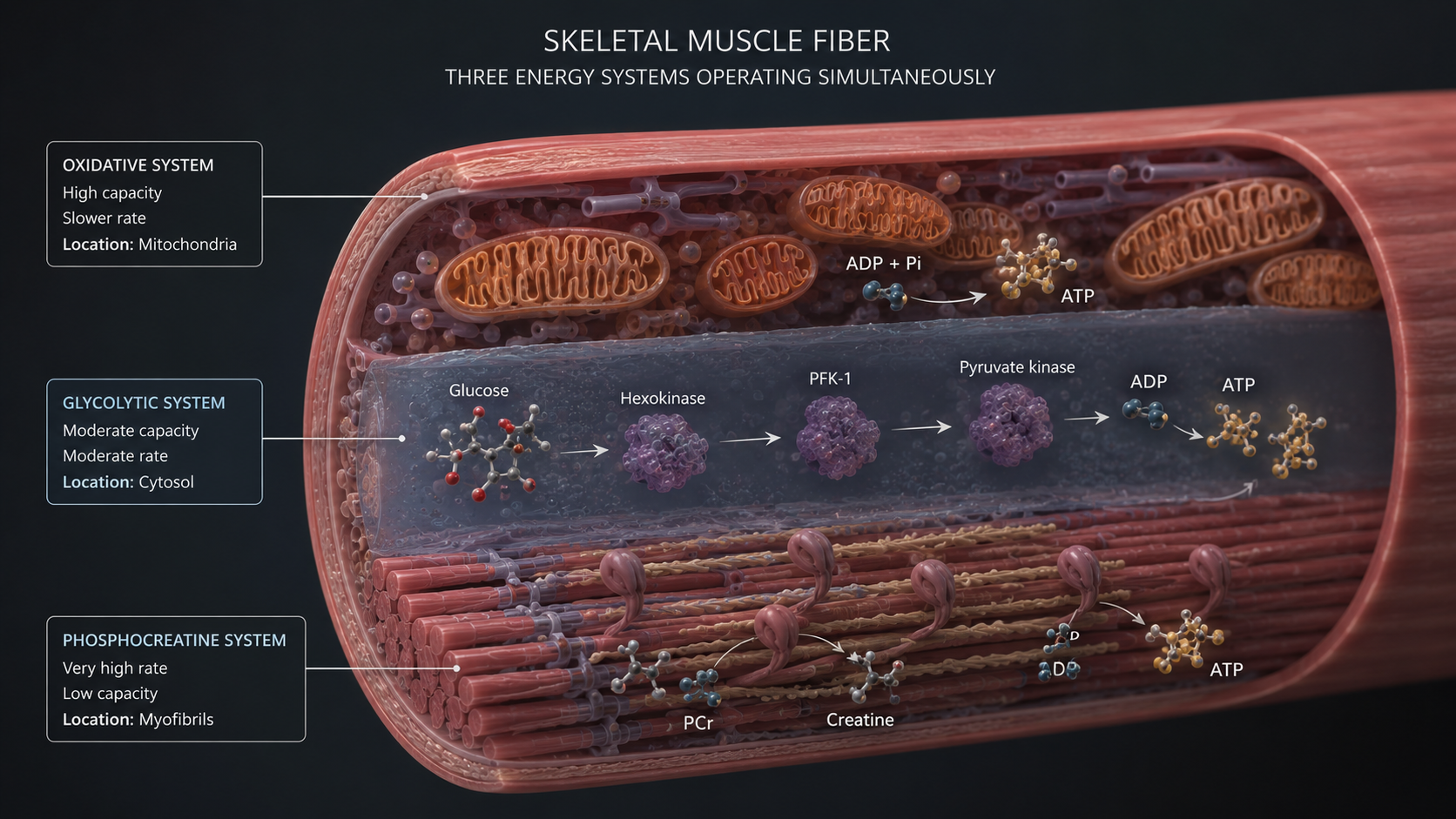
None of the three energy systems operates in isolation. All three are active simultaneously, each contributing some proportion of the total ATP being produced at any given moment. Intensity and duration determine how the contribution is distributed across the three pathways. At low intensity, the oxidative system handles nearly all demand without meaningful supplementation from the other two. At moderate to high intensity, glycolysis contributes an increasing fraction. At maximal intensity, where power demand exceeds what any single pathway can deliver at its current output rate, phosphocreatine, glycolysis, and oxidative phosphorylation are all running simultaneously.
The dominant pathway for any given effort is the one contributing the largest fraction of total ATP production. When that pathway reaches its rate ceiling, power output drops, because the remaining two pathways cannot compensate quickly enough at the current demand level. Each of the three pathways described below has a distinct rate ceiling, a distinct capacity, and a distinct failure mode.
The 3 Energy Systems
Phosphocreatine (PCr)
Fastest ATP resynthesis rate. No oxygen required. Capacity: ~10 seconds of maximal effort.
Anaerobic Glycolysis
Moderate rate. Glucose → 2 ATP + H⁺. Duration range: 10 seconds to 2 minutes.
Oxidative Phosphorylation
Highest capacity, rate ceiling is the limiting factor. ~30–36 ATP per glucose. Duration: 2 minutes and beyond.
What Is Phosphocreatine? The Body's Fastest ATP Pathway
Phosphocreatine is a high-energy phosphate compound stored in skeletal muscle. It participates in a single-step reaction catalyzed by creatine kinase: PCr transfers its phosphate group directly to ADP, regenerating ATP almost instantaneously (Wallimann et al. 1992). No oxygen is required, and no multi-step enzymatic cascade is involved. This is why the phosphocreatine system delivers ATP at the highest rate of the three pathways. The chemistry is simpler and faster than anything glycolysis or oxidative phosphorylation can produce, which makes it the dominant source of power for maximal short-duration efforts.
The trade-off for that speed is capacity. Muscle PCr stores are limited, and maximal-rate utilization exhausts them within approximately 10 seconds of truly all-out effort (Bogdanis et al. 1996). A maximal power clean, a starting acceleration in a sprint, an explosive takedown attempt, the first exchange of a striking combination: these efforts are phosphocreatine-limited. Oxygen delivery, glycogen availability, and mitochondrial function are mechanistically irrelevant within this duration window. Whatever those systems are doing, they are not what determines whether the effort succeeds.
What phosphocreatine is doing during these efforts is acting as a buffer, not a fuel in the traditional sense. The body cannot produce ATP through glycolysis fast enough to meet the demand of maximal muscular contraction in the first few seconds of effort. PCr bridges that gap by providing immediate phosphate donation until glycolysis can increase its own output rate. The result is that the first several seconds of maximal effort can proceed at full power before the rate-limiting constraints of the slower pathways begin to affect output.
01
Fastest ATP Pathway
The creatine kinase reaction is a single step requiring no oxygen — near-instantaneous ATP delivery at the highest rate of any pathway.
02
Depletes in ~10 Seconds
Full-effort phosphocreatine is exhausted within approximately 10 seconds of truly maximal work (Bogdanis et al. 1996).
03
Creatine Extends the Buffer
Creatine supplementation increases resting PCr concentration, delaying depletion and improving recovery of the PCr pool between efforts.
Creatine supplementation acts on this system specifically by increasing the concentration of PCr in skeletal muscle. More PCr available before depletion means either more work accomplished within the same time window or the same work completed with a smaller proportion of PCr depleted, which in turn accelerates recovery of the buffer for subsequent efforts. The performance benefit is confined to this pathway and this duration range. Creatine does not improve performance in efforts that are primarily glycolytic or aerobic, because it does not act on those pathways.
Phosphocreatine Recovery Time: The Biology Behind Rest Intervals
Phosphocreatine resynthesis begins as soon as a maximal effort stops. The creatine kinase reaction runs in reverse during recovery: ATP donates a phosphate group back to creatine, restoring PCr stores. This reversal requires ATP, which during recovery is supplied primarily by oxidative phosphorylation. PCr resynthesis is therefore aerobically dependent. The faster the aerobic system can deliver ATP during rest periods, the faster PCr stores are restored (Bogdanis et al. 1996).
The resynthesis curve is not linear. Approximately 70% of depleted PCr is restored within 90 to 120 seconds of rest (Harris et al. 1976). Full restoration requires 3 to 5 minutes. This kinetic profile has direct structural implications for training design. Resting 60 seconds before a maximal power effort means the following effort begins with roughly 50 to 60% of PCr available. That is sufficient to produce near-maximal output for a few seconds, but the set will encounter earlier power decline than it would from a fully restored baseline. The reduced output is not a product of fatigue in a general sense. It is a product of starting with less of the specific rate-limiting substrate for that effort.
~70%
PCr restored within 90–120 seconds of rest
3–5 MIN
Time to full phosphocreatine restoration
The aerobic dependency of PCr recovery is an underappreciated connection between aerobic fitness and explosive performance. An athlete with higher aerobic base development can deliver ATP oxidatively at a higher rate during rest periods, which accelerates PCr resynthesis between efforts. This is part of the mechanism by which aerobic base development improves output in power-based sports. The aerobic system in this context is not being trained for endurance. It is being trained to recover PCr faster between explosive efforts, so that each subsequent set or round begins from a higher phosphocreatine baseline.
Phosphocreatine recovery time therefore functions as a direct biological constraint on how frequently maximal power output can be reproduced. The resynthesis kinetics are not an academic detail. They are the biological basis for rest interval prescription in strength and power training.
Anaerobic Glycolysis and Muscle Fatigue: The H⁺ Problem
As PCr depletes during a sustained high-intensity effort, glycolysis ramps up to take over primary ATP supply. Glycolysis cleaves glucose through a series of enzymatic steps to produce pyruvate, yielding 2 ATP per glucose molecule in the process. The rate is faster than oxidative phosphorylation but substantially slower than PCr-mediated ATP transfer. Glycolysis is the dominant ATP pathway from roughly 10 seconds to 2 minutes of high-intensity effort — the time range covering a 400-meter sprint, a competitive round on the mat, or a maximal rowing piece of approximately 2 minutes.
The Common Belief
“Lactic Acid”
Lactate accumulates in muscle, causing the burn and the force decline in high-intensity work.
The Actual Mechanism
Hydrogen Ion Accumulation (H⁺)
Intracellular pH falls, impairing calcium sensitivity, actin-myosin interaction, and glycolytic enzyme function.
The question of how lactic acid causes muscle fatigue has a more precise answer than most training resources provide. Lactate, formed at high glycolytic rates when pyruvate cannot enter the Krebs cycle fast enough, is not the proximate cause of the burn, the force decline, or the performance drop in this zone. Lactate is transported out of the producing muscle fiber via monocarboxylate transporters and used as fuel by the heart, type I slow-twitch fibers, and the liver (Brooks 2018). It is a metabolite with a functional role in other tissues, not a waste product accumulating to toxic levels in the working muscle.
The actual mechanism of performance limitation during sustained glycolytic effort is hydrogen ion accumulation and the resulting decrease in intracellular pH. At high glycolytic rates, proton production outpaces the muscle's buffering capacity. As intracellular pH falls, several failure modes converge simultaneously: calcium sensitivity of troponin decreases, reducing the force generated per cross-bridge cycle; actin-myosin interaction is inhibited; and phosphofructokinase, a key regulatory enzyme in glycolysis itself, is partially inhibited by the acidity (Allen et al. 2008). The last of these creates a feedback where the accumulating H⁺ begins suppressing the very pathway generating it, producing the characteristic rapid output decline in the final phase of a maximal glycolytic effort.
The training implication is that performance decline arrives earlier, when acid load exceeds buffering capacity, rather than when glycogen depletion occurs. Developing that buffering capacity requires deliberately working in the zone where H⁺ accumulation occurs: repeated efforts in the 30-second to 2-minute range, with sufficient recovery between sets for pH to normalize, rather than continuous exposure to accumulating acidity.
2 ATP
Per glucose — anaerobic glycolysis
30–36 ATP
Per glucose — oxidative phosphorylation
The Aerobic Energy System: Maximum Capacity, Rate Ceiling
Oxidative phosphorylation occurs in the mitochondria and yields substantially more ATP per glucose molecule than glycolysis — approximately 30 to 36 ATP compared to 2 via the glycolytic pathway alone. Fatty acids also enter the aerobic system, providing even greater ATP yield per molecule at the cost of slower processing. The aerobic energy system is the most efficient of the three pathways, with an effective substrate capacity that is not a practical limiting factor in most athletic performance contexts. The constraint that matters in high-intensity sport is rate, not capacity.
At intensities below roughly 60 to 70% of maximal aerobic capacity, oxidative phosphorylation can supply ATP demand almost entirely on its own. As intensity increases, the rate at which mitochondria can produce ATP through oxidative means cannot keep pace with the power demand, and glycolysis contributes an increasing fraction of the total output. The metabolic cost of the glycolytic contribution accumulates in the form of byproducts, particularly H⁺, which creates the familiar performance ceiling at high intensities: the point where maintaining power output requires a level of glycolytic supplementation that the acid buffering system cannot sustain.
The rate ceiling of the aerobic system is determined primarily by mitochondrial density, oxidative enzyme activity, and the capacity to deliver oxygen to the working mitochondria. These variables are trainable (Holloszy 1967; Hood 2001). Aerobic base training at moderate intensity over weeks and months increases mitochondrial density and the concentration of enzymes involved in the Krebs cycle and electron transport chain. The result is that a higher absolute power output can be sustained aerobically, which delays the point at which glycolytic supplementation becomes substantial and H⁺ accumulation begins to limit performance.
Commonly Tracked
VO₂max
Maximum rate of oxygen uptake. An upper bound on oxidative ATP production. Useful but not the whole story.
What Sets the Actual Ceiling
Mitochondrial Density + Enzyme Activity
The concentration of mitochondria and oxidative enzymes determines how efficiently available oxygen converts to ATP across all intensities.
VO₂max is commonly used as a proxy for aerobic capacity, and it reflects the maximum rate of oxygen uptake, providing an upper bound on oxidative ATP production. Two athletes with identical VO₂max values can have meaningfully different aerobic rate ceilings at submaximal intensities, because mitochondrial efficiency and oxidative enzyme activity vary independently of peak oxygen uptake. The relevant training target for raising the aerobic rate ceiling is the mitochondrial machinery that determines how efficiently available oxygen translates to ATP production across a range of intensities, not peak VO₂max as a standalone number.
Phosphocreatine recovery time therefore functions as a direct biological constraint on how frequently maximal power output can be reproduced.
The actual mechanism of performance limitation during sustained glycolytic effort is hydrogen ion accumulation and the resulting decrease in intracellular pH.
How Long to Rest Between Sets: The Mechanism, Not the Recommendation

Most training programs specify rest intervals as convention: one minute for hypertrophy, three minutes for strength, two minutes for conditioning work. These generalizations are not wrong as broad categories. The problem is that they are not grounded in the biology of which pathway is being loaded in a given effort, and applying the wrong rest interval changes the training stimulus in ways that are rarely identified or acknowledged.
How long to rest between sets has a biological answer that depends entirely on which energy pathway was the primary source of ATP for the preceding effort. If the effort was maximal and lasted 10 seconds or less, PCr was the dominant pathway, and the rest interval required for full resynthesis is 3 to 5 minutes. Resting for 60 or 90 seconds before the next set does not mean the next set is the same exercise with somewhat less output. It means the next set is a different kind of physiological work: partially glycolytic, partially PCr-driven, with a compressed expression of the quality the exercise was intended to develop.
For strength and power training, where the goal is to reproduce maximal force output across multiple sets, short rest intervals accumulate a PCr deficit that compounds over the session. Each set begins with a lower PCr baseline, requiring a greater glycolytic contribution to match the same ATP demand. The result is higher metabolic stress and reduced mechanical output. That specific combination is useful for metabolic conditioning. It is counterproductive for developing maximal force or maximal rate of force development.
01
Maximal Power (Efforts Under 10 Seconds)
PCr-dominant. Full phosphocreatine restoration requires 3 to 5 minutes. Starting the next set earlier means reduced PCr baseline and a different training stimulus.
02
Hypertrophy Work (60–90 Seconds of Rest)
Deliberate incomplete PCr recovery. The partial deficit generates metabolic stress alongside the mechanical stimulus. This is the intended training state, not a compromise.
03
Glycolytic Capacity (Efforts 30 Seconds to 2 Minutes)
Hydrogen ion accumulation must clear and intracellular pH must normalize before the next maximal bout. Near-complete recovery requires 5 to 8 minutes. Shorter rest trains H⁺ tolerance, not maximal glycolytic rate.
For hypertrophy training, shorter rest intervals are deliberate and physiologically grounded. Incomplete PCr recovery creates the metabolic stress and the hormonal environment that contributes to hypertrophic signaling alongside the mechanical stimulus of the work itself. Resting 60 to 90 seconds between sets is a specific design choice to operate with a partial PCr deficit, generating a metabolic stress response. These are different training goals using the same exercise movements.
For glycolytic capacity development, the required rest period is longer than most athletes build into their programs. H⁺ must be cleared, intracellular pH must normalize, and glycolytic enzyme function must recover before another maximal glycolytic bout can be performed at a high output rate. This typically requires 5 to 8 minutes for near-complete recovery. Treating a 30-second all-out effort as though it has the same recovery requirements as aerobic interval work shifts the training stimulus from maximal glycolytic rate output toward H⁺ tolerance, which is a different adaptation with different performance implications.
Resting 60 or 90 seconds before the next set does not mean the next set is the same exercise with somewhat less output. It means the next set is a different kind of physiological work: partially glycolytic, partially PCr-driven, with a compressed expression of the quality the exercise was intended to develop.
Where Athletes Apply This Framework Wrong

The most common error in training design is using subjective readiness as a proxy for the actual recovery state of the rate-limiting pathway. An athlete who feels prepared to go at 90 seconds before a maximal power set may be subjectively ready but is physiologically beginning the next set with approximately 60% of PCr available. The session produces work, creates fatigue, and generates the impression of productive training while systematically underloading the phosphocreatine system. Over time, this produces an athlete who is well-conditioned for moderate-intensity glycolytic work but whose explosive output is limited by a PCr system that is rarely trained to depletion and full recovery.
A related error is misidentifying the cause of a performance drop during an effort. An athlete who fails at 8 seconds into a maximal sprint set and concludes that the limiting factor was oxygen delivery or glycogen availability has misread the failure signature. PCr depletion at 8 to 10 seconds produces a specific and rapid loss of power that neither glycogen depletion nor aerobic insufficiency mimics. Glycogen depletion accumulates gradually across many minutes to hours of moderate output. When power drops sharply within the first 10 seconds of a truly maximal effort, the mechanism is PCr, and the relevant intervention is rest, not substrate provision.
The H⁺ fatigue mechanism is also frequently misapplied. Many athletes treat the burn associated with high-intensity glycolytic work as something to be managed or reduced rather than developed. The impulse to flush what is colloquially called lactic acid through active recovery between sets reflects this misunderstanding. Light movement between sets does assist acid buffering by supporting ongoing aerobic metabolism and facilitating H⁺ transport, but the goal is pH normalization, not removal of lactate as though it were a contaminant. More importantly, the buffering capacity that determines how long an athlete can sustain output in the glycolytic zone is developed by repeatedly generating and tolerating the acid load, not by minimizing exposure to it.
01
Using Subjective Readiness as a Recovery Proxy
Feeling ready at 90 seconds and being physiologically ready are different states. PCr may be 60% restored. The session trains tolerance, not the phosphocreatine capacity it was designed to load.
02
Misreading the PCr Failure Signature
A sharp power loss within 10 seconds of maximal effort is phosphocreatine depletion. Oxygen delivery and glycogen availability are not the mechanism at this timescale.
03
Avoiding the H⁺ Stimulus
Reducing acid load exposure with active recovery between sets also reduces the training stimulus for glycolytic buffering capacity. Avoiding the burn avoids the adaptation.
04
Treating Aerobic Training as Endurance-Only
Aerobic development directly improves PCr recovery rate between explosive efforts. Neglecting it because the sport is not primarily aerobic leaves inter-effort recovery unnecessarily constrained.
A fourth error is treating the aerobic system as a tool relevant only to endurance sports. The PCr recovery connection means that aerobic development directly improves the rate at which explosive capacity is restored between efforts. A combat athlete with higher mitochondrial density recovers PCr more completely between rounds than one who has neglected aerobic work, even if both athletes have similar PCr capacity at full rest. The aerobic system functions as the recovery infrastructure for explosive work. Neglecting it because the sport is not primarily aerobic leaves the rate of inter-effort recovery unnecessarily constrained.
Systematically avoiding the burn is systematically avoiding the stimulus that develops the capacity to sustain output in that zone.
Applying the Rate Framework to Training, Recovery, and Supplementation

The practical value of the rate-limitation framework is that it makes two categories of decisions more precise: identifying what is actually failing in a given effort, and choosing interventions that address the actual failure mechanism rather than a general approximation of it.
The first step is identifying the bottleneck in the specific context. A combat athlete who loses power during the final minute of a 5-minute round is constrained by the oxidative rate ceiling and glycolytic buffering capacity. The same athlete who loses power in the first explosive exchange of a fresh round, with adequate rest since the preceding round, is more likely PCr-limited, either through insufficient rest since the last round or through a PCr capacity that is undertrained relative to the demand. These are different problems with different training responses, and both can look like fading from the outside.
Creatine monohydrate is the intervention with the most established evidence for directly increasing the PCr-based rate ceiling. The mechanism is increased muscle PCr concentration, which extends the depth and duration of the phosphate buffer before depletion. The performance benefit is confined to this pathway and this duration range. Creatine does not act on glycolytic buffering or the aerobic rate ceiling, because the mechanism does not extend to those pathways.
Three Interventions, Three Pathways
Creatine Monohydrate
Phosphocreatine pathway. Increases resting PCr concentration. Performance benefit is specific to efforts under approximately 10 seconds and to sets with incomplete PCr recovery between them.
Aerobic Base Training
Oxidative phosphorylation pathway. Drives mitochondrial biogenesis over weeks and months, raising the aerobic rate ceiling and accelerating PCr resynthesis during rest periods.
Cordyceps (Proposed Mechanism)
Oxidative phosphorylation pathway. Proposed upregulation of mitochondrial respiratory chain activity. If the mechanism is confirmed, the performance effect is on the aerobic rate ceiling — not the PCr system or H⁺ buffering.
Aerobic base development raises both the oxidative rate ceiling and the PCr recovery rate, as described in the mechanism sections above. The training stimulus is sustained moderate-intensity work that drives mitochondrial biogenesis across weeks and months. The resulting adaptation increases the absolute power output that can be sustained aerobically and reduces the glycolytic contribution at submaximal intensities, which delays H⁺ accumulation at any given output level. For power and strength athletes who have neglected aerobic training, the most immediate benefit is faster PCr recovery between maximal efforts within a session.
Some compounds, including cordyceps-class adaptogens, are proposed to operate on mitochondrial efficiency and oxidative phosphorylation specifically. The proposed mechanism involves upregulation of mitochondrial respiratory chain activity, which would translate to a higher rate of oxidative ATP production per unit of mitochondrial mass. Where evidence supports this mechanism, the performance implication is an effect on the aerobic rate ceiling, similar in direction to what aerobic training produces through different signaling. These compounds do not act on the PCr pathway or H⁺ buffering. Their relevance, if confirmed, is to the aerobic rate ceiling, which makes them a different kind of intervention from creatine, targeting a different part of the energy system profile.
Creatine does not act on glycolytic buffering or the aerobic rate ceiling, because the mechanism does not extend to those pathways.
Frequently Asked Questions
What are the 3 energy systems in the body?
The three energy systems are the phosphocreatine system, which delivers ATP instantly but depletes within about 10 seconds of maximal effort; anaerobic glycolysis, which covers the 10-second to 2-minute range at high intensity; and oxidative phosphorylation, which has near-unlimited capacity but a rate ceiling that becomes limiting during intense efforts. All three systems are always active simultaneously.
How long should I rest between sets?
Rest interval length depends on which energy system was the primary ATP source for the preceding effort. Maximal power efforts under 10 seconds require 3 to 5 minutes for full phosphocreatine resynthesis. Hypertrophy work deliberately uses 60 to 90 seconds to generate metabolic stress from incomplete PCr recovery. Using the same rest interval for both produces different training outcomes.
What is phosphocreatine and what is its function?
Phosphocreatine is a high-energy phosphate compound stored in skeletal muscle. Its function is to rapidly regenerate ATP during brief maximal efforts by donating a phosphate group to ADP via the creatine kinase reaction. This reaction requires no oxygen and occurs almost instantly, making it the fastest ATP resynthesis pathway for efforts lasting approximately 10 seconds or less.
Does lactic acid cause muscle fatigue?
Lactate does not cause muscle fatigue. It is transported via monocarboxylate transporters to the heart, liver, and slow-twitch fibers where it is used as fuel. The actual mechanism of fatigue during high-intensity glycolytic efforts is hydrogen ion accumulation, which lowers intracellular pH and impairs calcium sensitivity, actin-myosin interaction, and glycolytic enzyme function.
Why does aerobic fitness improve explosive performance?
Phosphocreatine resynthesis after maximal efforts requires oxygen and is funded by oxidative phosphorylation during rest. An athlete with greater aerobic capacity, specifically higher mitochondrial density and oxidative enzyme activity, restores phosphocreatine stores faster between explosive efforts. This is the mechanism by which aerobic base training improves repeated sprint capacity and power output across sets or rounds.
The Bottleneck Moves: Know Where It Is
The three resynthesis pathways do not operate in fixed roles across a training session or career. The rate-limiting system shifts continuously as intensity changes, as duration extends, and as fatigue accumulates. A training approach that develops one pathway without reference to the others produces an athlete with a specific, predictable gap: strong in the effort duration the trained pathway governs, limited in the zones where the undertrained pathway becomes rate-limiting.
The framework this article is built on changes the questions worth asking about training and recovery. The relevant question is not “am I fit enough?” but “which system is rate-limiting for this specific effort, and is that system trained to meet the demand?” Rest interval selection, aerobic base volume, creatine use, and glycolytic conditioning all address specific rate ceilings. Applied without identifying which ceiling is actually limiting in the context where performance matters, they are interventions without a mechanism-grounded target.
An athlete who understands the failure signature of each pathway can work backward from a performance drop to its cause. A sharp power loss within 10 seconds indicates PCr. A burn and output decline between 30 and 120 seconds indicates H⁺ accumulation limiting glycolytic rate. A gradual aerobic ceiling compression over several minutes at high intensity indicates the oxidative rate ceiling. Each signature points toward a different training response, a different rest interval, and a different physiological variable worth developing. That precision is the practical output of understanding how the rate-limitation model works in each of the three systems.
The relevant question is not “am I fit enough?” but “which system is rate-limiting for this specific effort, and is that system trained to meet the demand?”
Rate limits. Capacity is almost never the problem. The system that cannot keep pace with demand is the one to train — and it shifts with every effort.
Each energy pathway has a specific failure signature: phosphocreatine depletes within 10 seconds, hydrogen ions accumulate between 30 and 120 seconds, and the aerobic rate ceiling compresses gradually over minutes. Knowing which one failed changes the response.
Mydos Performance
— Cellular Energy & Fuel Systems Series —
3 Energy Systems in the Body: ATP Resynthesis — The Rate That Actually Limits You
Phosphocreatine, glycolysis, and oxidative phosphorylation — each one fails at a different speed, for a different reason.
· By Ricardo Londono, MD/PhD ·