
The Effort Isn't the Problem

Energy system training is something most serious athletes assume happens automatically with hard work. Training is taxing, recovery is real, and performance improves over time, so it is easy to conclude that the stimulus and the adaptation must be aligned. They rarely are, and the reason is cellular.
The body produces ATP through three distinct bioenergetic pathways. Which pathway dominates at any given moment depends on the intensity and duration of effort. When an athlete trains, they load one or more of these pathways specifically, not fitness in the abstract, and the pathway loaded is determined by the structure of the session, not by the athlete's intention or the effort they bring to it. The question that most training programs never formally ask is which pathway a given session develops and which pathway the target activity actually requires.
When the answer to those two questions diverges, a mismatch exists. The athlete may perform well by every measurable standard in their training environment and still underperform in their actual sport; the explanation is not insufficient effort. The metabolic system that competition demands was never the one training stressed.
The metabolic system that competition demands was never the one training stressed.
Training the Energy Systems: What You're Actually Doing When You Train Hard
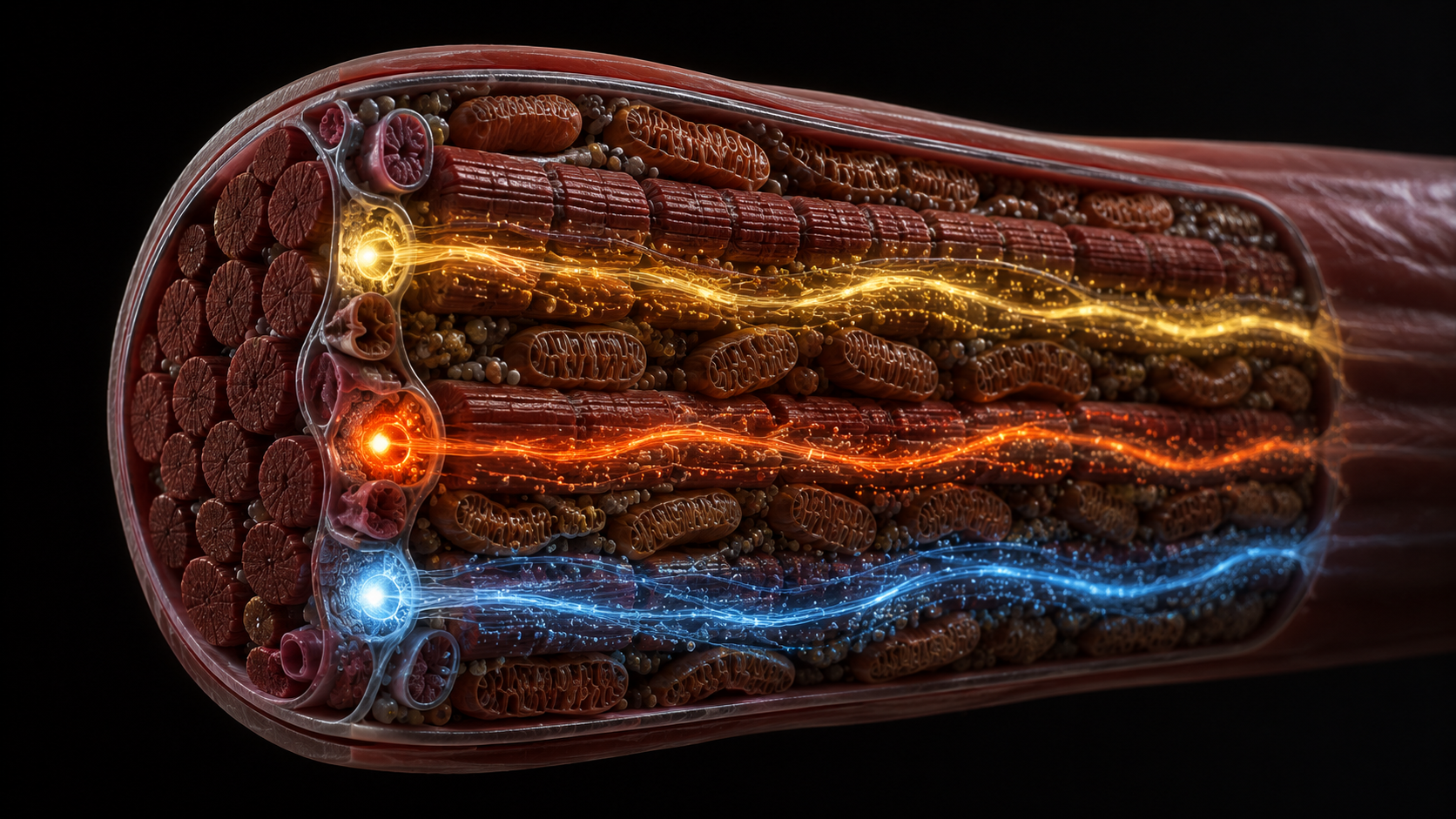
Understanding the mismatch starts with the three-pathway framework. All three bioenergetic systems operate simultaneously at all times; what changes with intensity and duration is the ratio of their contribution. They do not switch on and off sequentially. They exist on a continuum, and every effort engages all three to some degree, with the dominant pathway shifting as the conditions of the effort change.
The phosphocreatine system, also called the ATP-PCr system, is recruited most heavily during maximal or near-maximal efforts lasting up to approximately 10 seconds. ATP is regenerated from creatine phosphate without requiring oxygen and without producing lactate, which makes it the fastest available energy source and also the most limited, since phosphocreatine stores are small and deplete quickly.
Anaerobic glycolysis takes over as the dominant energy source when effort is sustained beyond what the phosphocreatine system can fuel and oxygen delivery is insufficient to support oxidative metabolism at the required rate. Glycolysis converts glucose to ATP more rapidly than oxidative phosphorylation but less rapidly than the ATP-PCr system, producing lactate as a byproduct. It is most active during efforts lasting roughly 30 seconds to three minutes at high intensity, and its sustainable ceiling is set by the aerobic system's capacity to clear the metabolic products of glycolytic work.
THREE ENERGY SYSTEMS
PHOSPHOCREATINE
Fastest. Fuels maximal efforts up to ~10 seconds. No oxygen required. No lactate produced. Recovery is aerobic-dependent.
GLYCOLYSIS
Intermediate. Fuels high-intensity efforts lasting 30 seconds to ~3 minutes. Produces lactate. Ceiling determined by aerobic clearance capacity.
OXIDATIVE PHOSPHORYLATION
Sustained. Dominant below ~70% VO2max. Highest ATP yield per molecule. Recovery substrate for the other two systems.
Oxidative phosphorylation is the slowest of the three pathways per unit time but produces the most ATP per molecule of substrate, approximately 36 to 38 ATP per glucose compared to two from glycolysis. It dominates at intensities below roughly 70% of VO2max and operates continuously during all recovery periods. Its rate is limited by mitochondrial density and the oxygen delivery capacity of the cardiovascular system.
When an athlete trains, each session loads one or more of these pathways based on the work's intensity, duration, and rest structure. A session that emphasizes one pathway does not develop the others proportionally. An athlete who trains primarily in the glycolytic zone is not incidentally developing phosphocreatine output or oxidative base in parallel. Energy system specificity applies at the cellular level.
The Fastest Pathway: Phosphocreatine and the Price of Explosive Output
The ATP-PCr system works because creatine phosphate donates a phosphate group to ADP, regenerating ATP almost instantaneously. No oxygen is required and no lactate is produced, which is why the phosphocreatine system underlies the most explosive human movements: a maximal sprint, a takedown entry, a heavy clean, or a plyometric jump. These efforts are phosphocreatine-fueled because no other pathway produces ATP at a high enough rate to meet the demand. The constraint is duration. Phosphocreatine stores in a given muscle group deplete substantially within 6 to 10 seconds of maximal effort. At that point, power output must either decline or the glycolytic system must compensate. What most athletes do not account for is the mechanism that governs how quickly those stores are replenished.
PCr resynthesis between efforts is an aerobic process. Restoring phosphocreatine after depletion requires oxidative phosphorylation, which means the aerobic system is the recovery mechanism for the phosphocreatine system (Harris et al. 1976; Bogdanis et al. 1996). The rate of PCr resynthesis between explosive efforts is tied directly to the athlete's aerobic capacity: higher VO2max and greater mitochondrial density mean faster phosphocreatine recovery and more complete restoration before the next effort begins.
The performance consequence of this is concrete. An athlete whose aerobic base is underdeveloped will recover phosphocreatine more slowly between explosive bouts, whether those are grappling exchanges, repeated sprints, or heavy barbell sets. Each successive effort draws from a less completely restored phosphocreatine pool. Output declines not because the phosphocreatine system is deficient, but because the system responsible for resupplying it was never a training priority.
The Glycolytic Energy System: High Output, Short Window, Real Ceiling
LACTATE
Fuel, Not Fatigue
At physiological pH, lactic acid dissociates into lactate and H+. Lactate is a fuel molecule the aerobic system actively recycles — not the agent of performance limitation.
H+ IONS
The Real Ceiling
Hydrogen ion accumulation causes intracellular acidosis, disrupting the contractile proteins that produce muscle force. This is the mechanism that limits performance at high intensity.
When effort is sustained above what the phosphocreatine system can fuel and the aerobic system cannot supply ATP at the required rate, glycolysis becomes the dominant energy source. The glycolytic energy system converts glucose to pyruvate and then, when oxygen availability is insufficient, to lactate, generating ATP faster than oxidative phosphorylation can. This makes it the primary pathway for efforts in the 30-second to three-minute range at high intensity: a sustained grappling exchange, a hard 400-meter pace, or repeated back-to-back rounds with incomplete rest.
Understanding this pathway requires addressing a persistent misattribution about what limits performance during glycolytic work. Lactate is not the cause of the burning sensation or the force reduction that limits performance at high intensity. At physiological pH, lactic acid dissociates fully into lactate ions and hydrogen ions. Lactate itself functions as a fuel molecule that the aerobic system actively consumes and recycles (Brooks 2000). The agent responsible for impaired contractile function at high intensity is the accumulation of hydrogen ions and the resulting intracellular acidosis, which disrupts the contractile proteins responsible for muscle force production (Robergs et al. 2004). This distinction matters for training because it shifts the target: lactate is recyclable fuel, and a more capable aerobic system means faster lactate clearance. The H+ load is what must be managed.
The lactate threshold is the intensity at which hydrogen ion and lactate accumulation exceed the body's current clearance rate, producing a ceiling on sustainable high-intensity output. That ceiling is not fixed; it responds to training (Jones and Carter 2000). Deliberate lactate threshold training, sustained work at the intensity band near this threshold (approximately 80 to 90% of maximum heart rate, held for 20 to 40 minutes), shifts the threshold upward over weeks and months. Athletes who do not specifically train at this intensity zone tend not to improve it, regardless of how much total training volume they accumulate, because the threshold adaptation requires a sustained stimulus in the specific intensity band where glycolysis is dominant and aerobic clearance is still engaged.
Aerobic Energy System Training: Why the Slowest Pathway Is the Foundation of All Three
WITHOUT AEROBIC BASE
Slow Recovery Across All Systems
Phosphocreatine restores slowly between explosive efforts. Lactate clears slowly after glycolytic rounds. Every successive effort draws from a less-recovered state.
WITH AEROBIC BASE
Faster Recovery Everywhere
Higher mitochondrial density accelerates PCr resynthesis and lactate clearance simultaneously. All three energy systems perform at higher output across the session.
Oxidative phosphorylation converts oxygen and substrate, primarily glucose and fat, into ATP with the highest yield of the three pathways. The process takes place in the mitochondria and is rate-limited by mitochondrial density and oxygen delivery capacity. These structural constraints determine how much aerobic ATP can be produced per unit time and, consequently, how quickly the aerobic system can recover the other two pathways after high-intensity work.
Aerobic energy system training is relevant to every athlete, including those in explosive and mixed-demand sports, because the aerobic system performs two simultaneous recovery functions during and between high-intensity efforts. It restores phosphocreatine through oxidative phosphorylation during recovery intervals (Harris et al. 1976; Bogdanis et al. 1996), and it recycles lactate produced during glycolytic work by using it as an oxidative fuel (Brooks 2000). Both functions are limited by the same underlying variable: mitochondrial density and the oxidative capacity of the working muscle fibers. An athlete with a robust aerobic base recovers phosphocreatine faster, sustains a higher glycolytic ceiling, and can repeat high-intensity work more completely across a session.
Aerobic base training, sustained moderate-intensity work below the lactate threshold, produces the structural adaptation that matters here: mitochondrial biogenesis. Repeated aerobic demand signals the muscle fiber to produce more mitochondria per unit of tissue, increasing the cellular capacity for oxidative ATP production (Holloszy 1967; Hood 2001). This adaptation is not achieved incidentally through high-intensity work, because mitochondrial biogenesis is primarily a response to sustained aerobic demand, not to peak intensity. An athlete who concentrates exclusively on high-intensity training loads the glycolytic and phosphocreatine systems while leaving the structural recovery substrate of both underdeveloped. The downstream effect is that every subsequent round, every hard interval, every explosive sequence across a session costs more than it should and takes longer to recover from.
PCr resynthesis between efforts is an aerobic process. Restoring phosphocreatine after depletion requires oxidative phosphorylation, which means the aerobic system is the recovery mechanism for the phosphocreatine system.
An athlete who concentrates exclusively on high-intensity training loads the glycolytic and phosphocreatine systems while leaving the structural recovery substrate of both underdeveloped.
What Energy System Does Your Training Actually Use?

Most athletes do not formally audit which energy system their training loads versus which energy system their sport requires. The result is a mapping problem that volume cannot correct. Working harder at the wrong pathway produces an athlete who is well-developed in one bioenergetic dimension and underprepared in others.
Weight training is a useful starting point. A standard strength session, compound lifts performed for three to six repetitions with two to four minutes of rest between sets, is phosphocreatine-dominant on the work side and aerobically dependent on the recovery side. The output quality of each set depends on how completely phosphocreatine has been restored in the preceding rest interval. An athlete who trains this way while neglecting aerobic base is implicitly limiting the rate at which PCr recovers, which caps training quality across the session and across consecutive training days.
HIIT formats create a different misalignment. Most group HIIT formats use work intervals of 20 to 45 seconds with rest intervals of similar or shorter duration. The short rest interval does not allow meaningful PCr resynthesis, so later intervals in the session are performed with progressively less phosphocreatine contribution, with the glycolytic system compensating. Simultaneously, the work durations are often too short and intensity too variable to drive lactate threshold adaptation specifically. Many HIIT formats neither train the PCr peak nor develop the lactate threshold; they train glycolysis at submaximal and inconsistent rates with incomplete recovery, which is a genuine stimulus but not the one athletes typically believe they are getting.
01
WEIGHT TRAINING
Phosphocreatine dominant on the work side. Aerobic recovery dependent between sets. PCr restoration quality determines training quality across the session.
02
HIIT (SHORT REST)
Rest intervals too short for PCr resynthesis. Too variable for lactate threshold adaptation. Trains glycolysis at submaximal rates — not the system most athletes believe.
03
ZONE 2 ONLY
Builds oxidative base and lactate clearance capacity. Does not tax the glycolytic ceiling or phosphocreatine output. Prepares for one dimension, leaves others undertrained.
04
MIXED-DEMAND SPORT (BJJ / MUAY THAI)
Requires PCr for explosive outputs, glycolytic capacity for sustained pressure, and aerobic recovery between efforts. Training only one pathway prepares the athlete for one dimension of the sport.
Zone 2 training produces the inverse problem. Pure aerobic volume builds the oxidative base and lactate clearance capacity but does not tax the glycolytic ceiling or improve phosphocreatine output. An athlete whose training is primarily aerobic will have strong recovery capacity but a limited glycolytic ceiling and relatively low explosive power, which becomes apparent the moment the activity demands repeated short bursts at maximal intensity.
Sports with mixed energy demands expose all three gaps simultaneously. A BJJ or Muay Thai athlete's competitive rounds require repeated phosphocreatine-powered explosive outputs (takedown entries, strikes, explosive defensive movements), glycolytic capacity during sustained pressure exchanges lasting one to three minutes, and aerobic recovery between rounds and within-round rest moments. A training program that loads only one of these three pathways will produce an athlete prepared for one dimension of the sport and exposed in the others. The diagnostic question is direct: what is the intensity, duration, and work-to-rest structure of the target activity, and which pathway does that profile load?
Why the Mismatch Costs More After 40
~1%
Annual VO2max Decline After Age 30
Fleg et al. 2005
Aerobic capacity declines with age in physically active adults, and the rate accelerates through the fourth and fifth decades of life (Fleg et al. 2005). Because PCr recovery rate and lactate clearance capacity are both aerobic-dependent, the same energy system mismatch that a 25-year-old can partially compensate for becomes progressively more costly at 40, 45, or 50.
The mechanism is direct. As VO2max declines, the aerobic recovery capacity for all three pathways degrades in proportion. PCr takes longer to restore between explosive efforts, lactate accumulates faster relative to the clearance rate, and the effective glycolytic ceiling drops. The glycolytic system itself does not change substantially with age; what degrades is the aerobic infrastructure that manages its byproducts. The athlete who managed a demanding HIIT program at 35 finds at 45 that recovery between efforts takes longer and high-intensity output is harder to sustain across a session, and the explanation is the degraded aerobic recovery substrate, not the power systems themselves.
This decline is not a fixed biological outcome for athletes who train deliberately. Longitudinal data shows that habitual aerobic exercise substantially attenuates the rate of VO2max decline with age (Fleg et al. 2005). For an athlete in their 40s, deliberate aerobic base training is among the highest-return physiological investments available, specifically because it preserves the recovery substrate that underpins all three energy systems. An athlete in their late 40s with a well-maintained aerobic base will recover faster between explosive efforts and sustain higher glycolytic output than one with equivalent training volume distributed primarily toward high-intensity work.
The diagnostic question is direct: what is the intensity, duration, and work-to-rest structure of the target activity, and which pathway does that profile load?
An athlete in their late 40s with a well-maintained aerobic base will recover faster between explosive efforts and sustain higher glycolytic output than one with equivalent training volume distributed primarily toward high-intensity work.
Where Energy System Training Goes Wrong

The most common failures in how athletes approach energy system training share a root error: equating effort, training format, or movement pattern with pathway specificity.
The first failure is treating intensity as a proxy for energy system. A hard workout loads some pathway, but which one depends on the duration of the work interval and the structure of recovery, not on how taxing the effort feels. An athlete who describes training as intense without specifying interval duration, rest length, and absolute intensity cannot know which pathway is being developed. Effort perception and pathway specificity are independent variables.
The second is using HIIT as a substitute for lactate threshold training. HIIT formats with short rest intervals prevent meaningful PCr restoration, which causes later intervals in a session to shift toward glycolytic compensation with incomplete phosphocreatine contribution. These formats produce a genuine cardiovascular stimulus, but that stimulus differs from lactate threshold training, which requires sustained effort at a specific intensity band for long enough to drive the threshold upward. The gap is a duration and intensity prescription problem, not a question of effort.
01
INTENSITY IS NOT A PATHWAY
Which energy system a session develops is determined by the duration of work and the structure of recovery — not by how hard the effort feels.
02
HIIT IS NOT THRESHOLD TRAINING
Short rest intervals shift work toward glycolysis. This creates a cardiovascular stimulus, but not the specific lactate threshold adaptation that raises the glycolytic ceiling.
03
ALL SPORTS NEED AEROBIC BASE
PCr recovery rate and the glycolytic ceiling both depend on aerobic capacity. Avoiding zone 2 leaves the recovery substrate of the highest-intensity systems underdeveloped.
04
MOVEMENT IS NOT ENERGY SYSTEM
The same drill performed in 3-second bursts versus continuous 5-minute rounds trains completely different energy systems. Work-to-rest ratio determines the pathway, not the movement.
The third is avoiding zone 2 because the sport does not appear aerobic. PCr recovery rate and the glycolytic ceiling both depend on aerobic capacity. A combat sports athlete or team sport player who never builds the aerobic base leaves the recovery substrate of their most critical pathways underdeveloped, which means every round, every game, and every hard training session requires longer recovery and produces less output than it would with an adequate aerobic base.
The fourth is training sport-specific movements without training sport-specific energy demands. A BJJ athlete drilling takedowns in 3-second explosive repetitions is loading the phosphocreatine system. The same athlete drilling takedowns for continuous 5-minute rounds is loading the glycolytic system and aerobic base. The movement is identical; the energy system demand is different. The variable that determines which pathway is stressed is the work-to-rest ratio and duration structure, and athletes who do not control those variables deliberately are training an energy system without knowing which one. Why recovery between efforts feels inconsistent often traces back to this gap.
A combat sports athlete or team sport player who never builds the aerobic base leaves the recovery substrate of their most critical pathways underdeveloped, which means every round, every game, and every hard training session requires longer recovery and produces less output than it would with an adequate aerobic base.
What This Means in Practice

Step 1: Build the Aerobic Base for All Three Systems
Aerobic base training, sustained work at moderate intensity below the lactate threshold (typically 60 to 75% of maximum heart rate for 45 to 90 minutes per session), produces the mitochondrial adaptations that improve recovery across all three pathways. Increased mitochondrial density accelerates PCr resynthesis, raises lactate clearance capacity, and lifts the sustainable ceiling for glycolytic output. These adaptations respond to aerobic volume and continuity of demand, which is why they are not achieved as a side effect of high-intensity sessions. High-intensity work loads the phosphocreatine and glycolytic systems; it does not produce the sustained aerobic stimulus that drives mitochondrial biogenesis at the same time (Holloszy 1967; Hood 2001).
For an athlete training BJJ, boxing, or a similar mixed-demand sport, two to three aerobic base sessions per week at conversational intensity functions as investment in the metabolic infrastructure that determines how completely the phosphocreatine system recovers between exchanges and how long the glycolytic ceiling holds across a round.
WHAT AEROBIC BASE TRAINING ACTUALLY DEVELOPS
MITOCHONDRIAL DENSITY
More mitochondria per muscle fiber increases the rate of oxidative ATP production and directly accelerates PCr resynthesis between explosive efforts.
LACTATE CLEARANCE
Higher oxidative capacity means faster recycling of lactate from glycolytic work, delaying H+ accumulation and raising the effective glycolytic ceiling.
RECOVERY RATE
Both PCr recovery and lactate clearance are rate-limited by aerobic capacity. Improving the aerobic base improves recovery speed across all three energy systems simultaneously.
One compound with documented relevance to this specific pathway is cordyceps (Cordyceps sinensis Cs-4 extract), which has been shown in human trials to improve VO2max and aerobic exercise tolerance (Chen et al. 2010; Hirsch et al. 2017). The proposed mechanism involves enhanced mitochondrial respiration and oxygen utilization. The significance of this for the non-endurance athlete is that the evidence targets the oxidative pathway specifically, which is precisely the pathway that most non-endurance athletes underinvest in, and whose development produces the PCr recovery and lactate clearance improvements described above.
Step 2: Train the Glycolytic Ceiling Deliberately
Once a functional aerobic base is in place, the lactate threshold can be targeted specifically. The training requirement is sustained effort at the intensity band near the threshold (approximately 80 to 90% of maximum heart rate, held for 20 to 40 minutes). At this intensity, glycolysis is dominant, lactate production is elevated, and aerobic clearance is still engaged enough to modulate the H+ accumulation rate. The threshold shifts upward over weeks of consistent exposure, allowing the athlete to sustain higher absolute intensity before accumulation exceeds clearance.
The aerobic base is a prerequisite for effective threshold training. The aerobic system is what clears lactate during threshold sessions; without sufficient aerobic capacity, H+ and lactate accumulate faster, sessions cross from threshold-specific into anaerobic territory, and the intended adaptation is not produced. For combat sports athletes, threshold-specific training takes the form of sustained sparring or drilling at controlled intensity for 20 to 30 minutes without full-recovery rest, tempo cardio at similarly sustained output, or structured interval work with work-to-rest ratios around 2:1 at an intensity that can be held for the full interval duration.
Step 3: Map Your Training to Your Sport's Demands
01
IS MY AEROBIC BASE SUFFICIENT?
Can my aerobic system restore PCr fast enough between the explosive efforts my sport demands? If recovery between efforts is visibly slow, the answer is no.
02
IS MY GLYCOLYTIC CEILING HIGH ENOUGH?
Can I sustain the required intensity for the full duration my sport demands before H+ accumulation limits output? If performance drops within rounds or sets, the answer may be no.
03
IS MY PCR OUTPUT ADEQUATE?
Can I produce explosive output on demand, repeatedly, across the duration of competition? If explosive efforts degrade across the session, the bottleneck may be aerobic recovery, not PCr output itself.
The energy system audit begins with a precise characterization of the target activity. What is the typical duration and intensity of the highest-effort exchanges? What is the work-to-rest ratio during competition or live training? How many of those exchanges occur within a session? These questions produce a demand profile that maps directly to the three-pathway framework.
From there, the audit compares the demand profile to the current training structure. The questions that reveal gaps are specific: is the aerobic base sufficient to support PCr recovery at the rate the sport requires? Is the glycolytic ceiling high enough to sustain the required intensity for the required duration? Is phosphocreatine output and recovery speed adequate for the explosive demands of the activity? Each gap points to a specific pathway that is undertrained relative to the sport's actual demands. Closing the mismatch is a rebalancing problem: the fix is adjusting which pathways are deliberately targeted and in what proportions, guided by the demand profile of the activity rather than training habit or format preference.
Aerobic base training produces the mitochondrial adaptations that improve recovery across all three pathways. Increased mitochondrial density accelerates PCr resynthesis, raises lactate clearance capacity, and lifts the sustainable ceiling for glycolytic output.
The aerobic base is a prerequisite for effective threshold training. The aerobic system is what clears lactate during threshold sessions; without sufficient aerobic capacity, H+ and lactate accumulate faster, sessions cross from threshold-specific into anaerobic territory, and the intended adaptation is not produced.
Frequently Asked Questions
What energy system is used in weight training?
Strength training primarily uses the phosphocreatine (ATP-PCr) system during maximal or near-maximal lifts lasting up to about 10 seconds. The aerobic system then dominates during rest intervals, restoring phosphocreatine through oxidative phosphorylation. Aerobic capacity directly determines how completely phosphocreatine recovers between sets and how consistently training quality holds across the session.
How do you train energy systems?
Energy system training requires matching workout structure to the target bioenergetic pathway. Phosphocreatine output improves with short maximal efforts and full recovery intervals. The lactate threshold rises with sustained work at 80 to 90 percent of maximum heart rate for 20 to 40 minutes. Aerobic base develops through prolonged moderate-intensity work below the lactate threshold, two to three sessions per week.
What energy system does interval training use?
Interval training's dominant pathway depends on work duration and rest structure. Intervals of 20 to 45 seconds load the glycolytic system. Longer intervals of two to four minutes with full recovery favor the oxidative system. Short rest intervals prevent phosphocreatine resynthesis, shifting work toward glycolysis regardless of how hard the effort feels subjectively.
What causes the burning sensation during intense exercise?
The burning sensation during high-intensity exercise is caused primarily by hydrogen ion accumulation, which produces intracellular acidosis and impairs muscle fiber force production. Lactate itself is not the cause; it functions as a fuel molecule the aerobic system actively recycles. A stronger aerobic base clears lactate faster and delays the point at which H+ accumulation becomes limiting.
Why does aerobic fitness matter for power and strength athletes?
The aerobic system is the recovery substrate for both explosive and glycolytic work. Phosphocreatine resynthesis between explosive efforts requires oxidative phosphorylation, meaning a higher aerobic capacity directly translates to faster recovery between sprints, rounds, or heavy sets. Athletes who neglect aerobic base leave their fastest and most powerful energy pathway dependent on a slow and underdeveloped recovery mechanism.
The Mismatch Is Correctable
Energy system training is not a specialty reserved for elite performers or sports scientists. It is the question that every athlete answers implicitly with every training session: which pathway is this developing, and is that the one my activity depends on? Most athletes have never asked that question directly, and the gap between what training loads and what competition demands is the consequence.
In almost every non-endurance sport and in most training histories, the same asymmetry appears: the aerobic base is underweighted relative to its structural contribution to the other two pathways. The aerobic system is the recovery substrate for the fastest pathway, the clearance mechanism for the most productive one, and the structural foundation that determines how long an athlete can sustain quality output across any activity with repeated high-intensity demands. High-intensity training volume does not substitute for this. An athlete who can output intensely and recovers slowly is limited by the recovery variable the moment competition or training demands sustained, repeated, high-quality effort.
The correction is available to any athlete willing to map their physiology honestly against the demands of their activity. It does not require different exercises or more time. It requires knowing which system the activity runs on and training that system with the same deliberate attention that good athletes bring to every other aspect of their preparation.
The aerobic system is the recovery substrate for the fastest pathway, the clearance mechanism for the most productive one, and the structural foundation that determines how long an athlete can sustain quality output across any activity with repeated high-intensity demands.
Hard work loads some energy system. Deliberate training loads the right one. The aerobic base is almost always the one that's missing.
Every explosive and glycolytic effort in training depends on the aerobic system to recover. An underdeveloped aerobic base doesn't just limit endurance — it caps the ceiling on every other system, in every sport, at every age.
Mydos Performance
— Cellular Energy and Fuel Systems Series —
Energy System Training: The Mismatch Between Your Workout and Reality
Three bioenergetic systems, one overlooked recovery bottleneck
· By Ricardo Londono, Md/PhD ·